
Wedding Day Timeline Template: Indian Wedding Run Sheet for Planners
A practical wedding day timeline template for Indian weddings: planner run sheet columns, sample 3-day schedule, vendor handoffs, guest communication rules, and copy-paste day-of checklist.
The best wedding day timeline template for an Indian wedding is a planner run sheet, not a pretty guest itinerary. It should track event timing, vendor load-in, setup-complete deadlines, family owners, guest-facing reminders, dependencies, and escalation rules across every function.
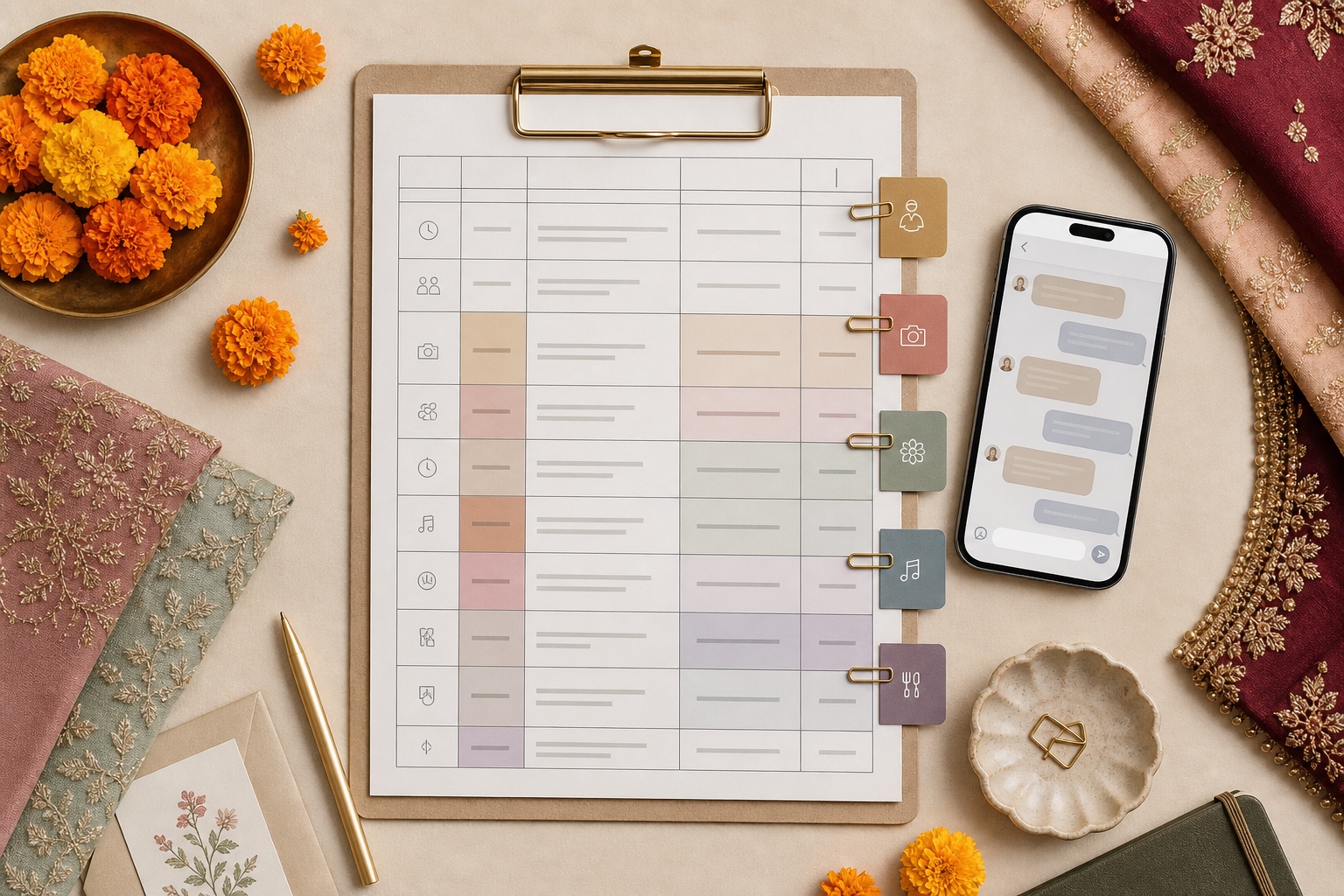
A wedding day timeline template sounds like a spreadsheet. In an Indian wedding, it is the difference between a calm production team and six people shouting into separate WhatsApp groups while the baraat waits outside the wrong gate.
The outcome you want is simple: every planner, vendor, family owner, and hospitality lead knows what happens next, who owns it, what can move, and what absolutely cannot move. Use this as the planner-facing run sheet for haldi, mehndi, sangeet, wedding ceremony, reception, and destination wedding movement.
What is a wedding day run sheet?
A wedding day run sheet is the private operating timeline used by the planner and vendor team to execute the wedding. It is more detailed than a guest itinerary because it tracks load-in, setup deadlines, dependencies, cue owners, family movements, food service, photo calls, payments, and escalation contacts.
If coordinators change across a long wedding day, pair the timeline with a wedding planner shift handover template so live delays, exceptions, and decision authority move with the incoming lead.
Reference the separate wedding vendor arrival schedule for load-in slots, setup-complete deadlines, access points, inspections, and breakdown; duplicating those details creates version conflicts.
In plain English: the guest itinerary says "Sangeet starts at 8 PM." The planner run sheet says "sound check complete by 5:30 PM, dancers arrive 6:15 PM, family photo call 6:45 PM, guest doors 7:15 PM, performances 8:10 PM, dinner opens after couple dance."
What should a wedding day timeline template include?
A wedding day timeline template should include the facts that affect execution, not every note anyone has ever shared. If a column does not help someone act faster on the wedding day, remove it.
Keep the private wedding vendor contact list beside the run sheet so every load-in time, setup-complete time, and escalation contact maps to a real on-site lead instead of a generic company number.
Add the wedding day contact list beside it for family captains, venue, hospitality, transport, guest-help, and emergency escalation. The run sheet tells the team what happens next; the contact list tells them who can fix it when the next thing is blocked.
Use these columns:
| Column | What to write | Example | | --- | --- | --- | | Time | Real production time | "5:30 PM" | | Function | Event name | "Sangeet" | | Action | What must happen | "Sound check complete" | | Owner | Person accountable | "AV lead: Rohan" | | Location | Exact place | "Ballroom stage" | | Dependency | What must happen first | "Decor stage ready" | | Guest-facing note | What guests need to know | "Doors open 7:15 PM" | | Escalation | Who decides if blocked | "Lead planner + bride's brother" | | Status | Open, confirmed, done | "Confirmed 48h out" |
The fast decision rule: guests need confidence; vendors need instructions; family owners need cues. Put all three in the same master timeline, but only share the rows each group should see.
What is the best wedding day timeline template for Indian weddings?
The best Indian wedding timeline template is function-by-function, not one giant hourly list. Indian weddings have different guest groups, outfits, vendors, meals, rituals, and venues across each function, so the run sheet should reset by event while keeping one master owner view.
Copy this structure for each function:
| Timing block | Owner | What must be ready | | --- | --- | --- | | Vendor load-in | Planner ops lead | Venue access, power, tables, parking | | Setup complete | Vendor lead | Decor, sound, food counters, signage | | Family call time | Family captain | Bride/groom side present and dressed | | Guest arrival | Hospitality lead | Welcome desk, water, directions, seating | | Main moment | Ritual or stage owner | Priest, emcee, performers, photographer | | Food service | Catering lead | Service timing, Jain meals, VIP tables | | Exit or transition | Transport lead | Shuttles, valet, next-event reminder |
This format works because each row has a person who can say "done." A timeline without owners is just wishful thinking in a nicer font.
How do you build the run sheet for a 3-day Indian wedding?
Build the run sheet backwards from the immovable moments: muhurat, pheras, venue handover, sound restrictions, hotel checkout, airport transfers, and vendor load-in limits. Then add family cues, guest arrival buffers, food service, photography, and transport around those anchors.
Here is a sample 3-day planner view:
| Day | Function | Guest arrival | Main moment | Production notes | | --- | --- | --- | --- | --- | | Day 1 | Welcome tea | 4:30 PM | Family welcome at 5 PM | Hospitality desk live, room keys checked | | Day 1 | Mehndi | 7:00 PM | Bride entry at 7:30 PM | Mehndi artists seated, snacks open, music tested | | Day 2 | Haldi | 10:30 AM | Haldi starts 11 AM | Towels, stain-safe seating, lunch reset | | Day 2 | Sangeet | 7:15 PM | Performances 8:10 PM | AV check, emcee script, dance order, dinner cue | | Day 3 | Wedding | 6:30 AM | Pheras 7:12 AM | Priest ready, garlands, family seating, photo list | | Day 3 | Reception | 7:30 PM | Couple entry 8:15 PM | Stage lights, receiving line, dinner stagger | | Day 4 | Checkout brunch | 9:00 AM | Family goodbyes | Bags, airport cars, vendor returns |
For destination weddings, add one transport row before and after every function. The schedule is only real if guests can physically move through it.
How is the planner run sheet different from the guest itinerary?
The planner run sheet is the private production document. The guest itinerary is the public instruction set. They should agree on facts, but they should not contain the same level of detail.
| Detail | Planner run sheet | Guest itinerary | | --- | --- | --- | | Vendor load-in | Yes | No | | Guest arrival time | Yes | Yes | | Ritual start time | Yes | Yes, if useful | | Decor setup deadline | Yes | No | | Dress code | Sometimes | Yes | | Food timing | Yes | Yes | | Payment notes | Yes | Never | | Family conflict notes | Private owner only | Never | | Transport pickup | Yes | Yes | | Escalation contacts | Yes | Usually no |
If you need the public version, use the wedding itinerary template for Indian wedding guests. Keep this article's template for planners, coordinators, vendors, and family captains.
When should the final wedding day schedule be locked?
Lock the working schedule 14 days before the first event, confirm every vendor and family owner 7 days out, then freeze the final run sheet 48 hours before production starts. A wedding can still absorb emergencies after that, but it cannot absorb casual preference changes.
Use this timing:
| Timing | What to lock | | --- | --- | | 30 days out | Event order, venue rooms, broad guest arrival windows | | 14 days out | Vendor arrival windows, transport plan, food timing | | 7 days out | On-site vendor leads, family owners, photo calls | | 48 hours out | Final run sheet, escalation tree, guest reminders | | Morning of event | Weather, shuttle, medical/accessibility changes only |
Pair the 48-hour freeze with the vendor communication checklist. Every vendor should reply with the same confirmed arrival time, setup-complete time, and on-site lead that appears in the run sheet. Have a second coordinator run the wedding planner quality control checklist rather than letting the timeline author self-approve it. If the whole final week still feels loose, use the wedding production week checklist to separate vendor execution, family decisions, guest support, and internal planner ops before the schedule is frozen.
What can go wrong with a weak wedding day timeline?
Weak timelines fail because they hide dependencies. "Haldi at 11" looks simple until the decorator needs 90 more minutes, the photographer is still shooting getting-ready photos, the caterer cannot open lunch until the lawn is cleared, and the bride's cousins are asking where to park.
Common failure modes:
- Guest time and production time are mixed: guests arrive while setup is still visible.
- No setup-complete time: vendors know arrival time but not readiness deadline.
- No family owner: planner has to chase relatives during rituals.
- No transport buffer: one late shuttle delays the baraat, pheras, or reception entry.
- No guest question channel: the planner's phone becomes the help desk.
- No escalation rule: five people debate a decision that one owner should make.
The fix is not a prettier PDF. The fix is a run sheet with owners, deadlines, dependencies, and one place guests can ask routine questions. For the groom's procession, use the baraat planning checklist to split assembly, movement, route checkpoint, arrival, and venue handoff into separate owned rows.
How should guest communication fit into the day-of timeline?
Guest communication should be a separate layer attached to the timeline. Every function needs a short guest-facing reminder with arrival time, venue pin, dress code, food timing, transport note, and the approved question channel.
Use this day-before template:
Tomorrow: Haldi at 11 AM, guest arrival 10:30 AM. Venue: Courtyard Lawn, Hotel Arya. Wear yellow, white, or light festive clothes you do not mind staining. Lunch opens at 1 PM. Hotel shuttle leaves the lobby every 20 minutes from 10 AM. Ask schedule, dress code, or transport questions here: [Mandap Chat link].
This is where Mandap Chat for wedding planners is useful. Upload the schedule, venue pins, dress codes, transport plan, hotel block details, food notes, and FAQ rules. Guests can ask "what time should I reach sangeet" or "is there a shuttle after reception" without interrupting the planner during vendor load-in.
For destination weddings, connect the schedule to the hotel room block plan so check-in, breakfast, shuttle pickup, and room changes do not become separate WhatsApp chaos.
The copy-paste wedding day run sheet checklist
Before you mark the timeline final, check every function against this list:
- Event name, venue, room or lawn, and map pin are correct.
- Guest arrival time and real start time are separate.
- Vendor load-in and setup-complete times are listed.
- Every row has one owner, not "team."
- Priest, emcee, photographer, caterer, decor, sound, and transport dependencies are visible.
- Family photo calls have names, not vague groups.
- Food service has start time, VIP rule, Jain/veg note, and staff meal rule.
- Transport rows include pickup point, captain, vehicle count, and last shuttle.
- Guest-facing reminder is written and approved.
- Mandap Chat or the wedding FAQ has the same public schedule.
- The wedding emergency kit has a named owner and location for each function.
- Escalation tree says who decides timing, money, guest, weather, and ritual changes.
- Printed backup exists for the lead planner, hospitality desk, and venue captain.
If family photos are a major pressure point, build a separate wedding family photo list and attach only the confirmed photo-call blocks to this run sheet. The private photo list can carry names, sensitive combinations, and gatherer notes without cluttering the production timeline.
What is the 80/20 of day-of coordination?
The 80/20 of day-of wedding coordination is this: freeze the facts 48 hours out, give every row one owner, and remove guest questions from the planner's phone. Most wedding-day chaos comes from ambiguous ownership, not from lack of effort.
If you already have a planner, ask for the run sheet, not just the pretty itinerary. If you are planning the wedding yourself, start with the guest itinerary, build the private run sheet behind it, connect reception entry and family photos to the wedding seating chart, and put the guest-facing answers into Mandap Chat so the schedule can answer questions while you are busy living the day.
Frequently asked questions
What is a wedding day run sheet?+
What should a wedding day timeline template include?+
How is a planner run sheet different from a guest itinerary?+
When should the final wedding day timeline be locked?+
How does Mandap Chat help with the wedding day schedule?+
Continue the series
A wedding planner escalation matrix assigns each type of problem a severity, response time, first owner, final decision owner, and communication route before the wedding begins.
Wedding planner quality control is a separate verification pass that checks whether approved details match across contracts, run sheets, vendor briefs, venue plans, and guest communication before execution begins.
An NRI wedding budget in India should be built in INR around guest count, city, event count, room nights, and production complexity—then protected with separate currency and contingency buffers.
Wedding plus-one wording should state exactly who is invited, where the guest adds their companion's name, and whether the rule applies to every function. Clear language feels kinder than a vague invitation followed by an awkward refusal.
Wedding vendor meals keep photographers, planners, drivers, decor, sound, and hospitality teams working through long Indian wedding functions. Count crew by event, confirm dietary needs, schedule service before the guest rush, and give one caterer captain the final list.