
Wedding Planner Shift Handover Template for Indian Weddings
Use this wedding planner shift handover template to transfer live timings, vendor issues, guest exceptions, payments, and decision authority between event teams.
A wedding planner shift handover is a five-minute operational briefing that transfers the current event status, next 90 minutes, unresolved exceptions, decision authority, and communication channels to the incoming lead.
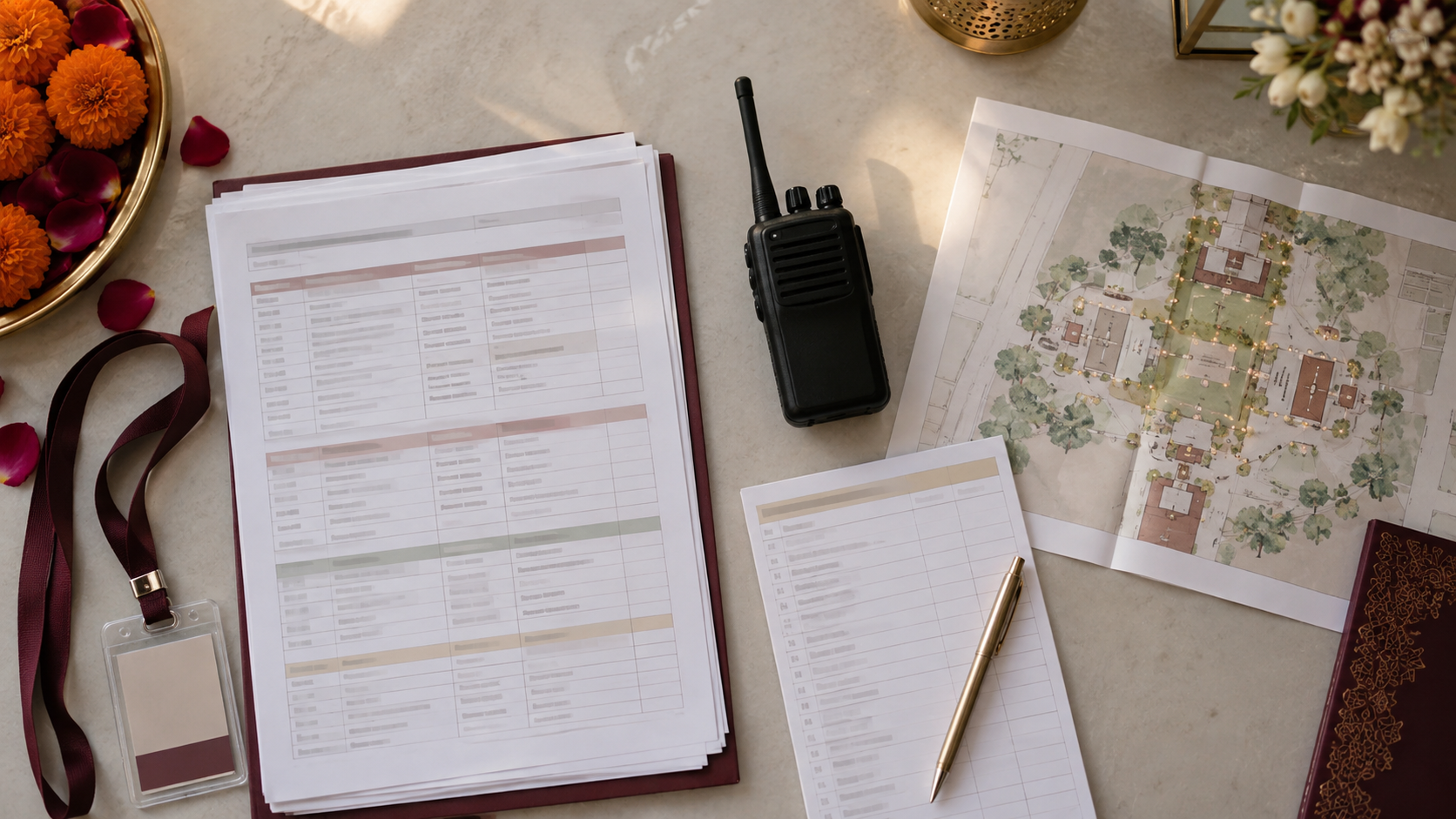
The outgoing planner knows the baraat is 20 minutes late, the florist is missing two centrepieces, the groom's grandmother needs a quieter route, and the photographer is waiting for one family member. The incoming planner knows none of it. That gap—not the lack of another spreadsheet—is what breaks the next hour.
Use this wedding planner shift handover template whenever responsibility moves between coordinators during a multi-event Indian wedding. The fast rule is: transfer the next 90 minutes, every live exception, and who can make each decision. A five-minute briefing can prevent an hour of calls, contradictory guest messages, and avoidable family stress.
What should a wedding planner shift handover include?
A wedding planner shift handover should include the current event status, the next 90 minutes of the run sheet, vendor delays, guest exceptions, open payments, approved changes, and decision authority. The incoming lead must know what is happening now, what happens next, what is off-plan, and whom to call before accepting control.
Use this seven-part handover:
| Handover block | What to transfer | Example | | --- | --- | --- | | Now | Actual event status | Baraat left Hotel A at 6:10 PM | | Next | Next 90 minutes | Milni, varmala, family photographs | | Exceptions | Anything off-plan | Two VIP rooms not ready | | Vendors | Late, blocked, or awaiting approval | Florist needs stage access | | Guests | Mobility, transport, food, or room issues | Wheelchair route changed | | Decisions | Owner and deadline | Rain call belongs to lead planner at 6:30 PM | | Channels | Radio, group, and emergency contact | Operations on Radio 2; guest help via one link |
If a detail does not affect the next shift, link it rather than reading it aloud.
What is a wedding planner shift handover?
A wedding planner shift handover is a short, controlled transfer of live event responsibility from an outgoing team lead to an incoming lead. It combines a written status snapshot with a verbal briefing and ends when the incoming lead confirms ownership.
This is narrower than a full wedding planner handover, which transfers an entire project or planning phase. A shift handover happens during execution: between morning and evening teams, venue captains, hospitality desks, transport coordinators, or function leads.
Copy this wedding planner shift handover template
Put this template at the top of the event operations chat or inside the live run sheet. Update it immediately before the overlap begins.
SHIFT HANDOVER — [wedding / function]
Transfer time: [date and time]
Outgoing lead: [name + phone/radio]
Incoming lead: [name + phone/radio]
Current status: [what is happening now; actual vs planned time]
Next 90 minutes: [three to five milestones with owners]
Live exceptions: [issue, impact, owner, next check time]
Vendor status: [only late, blocked, changed, or unpaid items]
Guest/family exceptions: [private needs and assigned owner]
Approved changes: [what changed, who approved, timestamp]
Pending decisions: [decision, deadline, authorised approver]
Guest message status: [latest approved message/link]
Escalation: [operations, venue, transport, medical/security contacts]
Accepted by: [incoming lead + time]
Never write “all on track” without an actual-time check. Record the factual state: “Sangeet doors opened 7:25 PM, 15 minutes late; performances still start 8:00 PM.”
How do you run a five-minute shift handover?
Run the handover beside the operations point, not while either lead is walking between crises. The outgoing lead updates the written snapshot first; both leads then scan the next 90 minutes, review exceptions, confirm decision rights, and announce the transfer to the team.
For guest-facing questions, attach the wedding guest communication roles matrix so the incoming lead can distinguish routine answers from invitation, transport, accessibility, hospitality, and emergency escalations.
Use this sequence:
- Minute 0–1: establish now. Compare actual time with the current wedding day run sheet.
- Minute 1–2: scan the next 90 minutes. Name each milestone, location, and owner.
- Minute 2–3: review red and amber exceptions. Skip completed issues.
- Minute 3–4: confirm decisions and messages. State who may approve timing, money, ritual, or guest changes.
- Minute 4–5: accept and announce. The incoming lead repeats the top three priorities and confirms ownership.
Keep a 15-minute overlap after this briefing. The incoming lead should be able to observe one operating cycle and ask follow-up questions before the outgoing lead disconnects.
Which issues must be escalated instead of handed over normally?
Escalate anything involving safety, medical support, security, legal or venue restrictions, missing people, major financial exposure, or a change that affects many guests. A shift handover can transfer awareness, but it must not quietly transfer decisions beyond the incoming lead's authority.
Use a simple threshold:
| Level | Meaning | Action | | --- | --- | --- | | Green | On plan or already resolved | Record briefly | | Amber | Delay or exception with an owner and workable fallback | Hand over with next check time | | Red | Safety, medical, security, ceremony, major guest, or budget risk | Call the authorised lead now |
For a medical or security emergency, contact local emergency services and the venue's trained team first. Do not wait for the next shift or publish private details in a general operations group.
How should Indian wedding functions be handed over?
Hand over Indian wedding functions event by event because each function has different vendors, rituals, guest flows, family owners, and failure points. The incoming lead needs the next function's operating reality, not a summary of the whole wedding weekend.
Mehendi and haldi
Confirm artist status, seating, supplies, water and towel stations, changing-room readiness, family photo calls, surface protection, and guest movement. Flag elderly guests or anyone needing step-free access privately to the hospitality owner.
Sangeet
Transfer performance order, missing performers, rehearsal changes, audio files, stage manager, green-room access, dinner opening, and the person authorised to cut or reorder an act. A “five-minute delay” can become 30 minutes if the food and transport teams hear different versions.
Wedding ceremony
Confirm baraat location, welcome team, milni participants, priest or officiant status, ritual items, seating, varmala, family photo gatherers, and ceremony decision authority. Keep the public guest itinerary simpler than this private production view.
Reception and departures
Transfer couple entry, stage queue, VIP greetings, dinner service, speeches, return shuttles, room keys, luggage, vendor breakdown, and final payments. Pair the handover with the wedding shuttle schedule so the next lead can see route captains and actual departure status.
What should stay out of the main handover message?
Keep medical details, family conflict, room numbers, payment credentials, passport information, and unverified rumours out of the general team message. The main handover should identify the operational need and private owner without exposing sensitive information.
Write “mobility support required for one guest; hospitality lead has details,” not a diagnosis. Write “payment approval pending with finance owner,” not bank information. Use the wedding day contact list to route exceptions to named people instead of broadcasting private context.
How do you keep guest answers correct during a shift change?
Give both shifts one approved guest source, one update owner, and one escalation path. Before the transfer, confirm whether any timing, venue, shuttle, dress code, meal, or access detail changed. Update the source first, then send one targeted correction only to affected guests.
The incoming lead should not inherit 12 versions of an answer across personal chats. Put approved schedules and guest FAQs into Mandap Chat for wedding planners, then let the team share one current link. Routine questions stay out of the operations channel, while unusual or urgent issues reach the correct human.
Wedding planner shift handover checklist
Before the outgoing lead leaves, confirm:
- [ ] Actual event status matches the live run sheet.
- [ ] The next 90 minutes have named owners.
- [ ] Every amber or red issue has an owner and next check time.
- [ ] Late or blocked vendors are identified.
- [ ] Pending payments and approvals have authorised owners.
- [ ] Guest, transport, room, food, and accessibility exceptions are assigned privately.
- [ ] Approved timing or venue changes are reflected in guest information.
- [ ] Radio channels and urgent contacts work.
- [ ] Incoming lead repeats the top three priorities.
- [ ] Acceptance time is recorded.
- [ ] The team is told who now owns the shift.
The handover is complete only when the incoming lead says, “I have it,” and can explain what happens next.
FAQ
What should a wedding planner shift handover include?
Include current status, the next 90 minutes, vendor delays, guest and family exceptions, pending payments, approved changes, decision authority, and escalation channels. Focus on facts that can change the incoming team's next action.
How long should a wedding event handover take?
Five to ten minutes is enough for a normal handover, followed by at least a 15-minute overlap. If the event is moving venues or handling a major disruption, extend the overlap until the incoming lead can operate independently.
When should wedding planner shifts overlap?
Overlap before a responsibility change, never after the outgoing lead has left. Avoid scheduling the transfer exactly at guest arrival, a ceremony cue, a major vendor load-in, or a transport departure.
Who owns the wedding after a shift handover?
The incoming lead owns the shift after explicitly accepting it. Senior planners and family approvers still retain any decision rights named in the handover, especially for money, rituals, safety, and major guest-impact changes.
Can a wedding handover be done on WhatsApp?
Use WhatsApp to share the structured snapshot and record acceptance, but add a live verbal briefing during an active event. Sensitive information should move through a private, appropriate channel rather than the general team group.
Frequently asked questions
What should a wedding planner shift handover include?+
How long should a wedding event handover take?+
When should wedding planner shifts overlap?+
Who owns the wedding after a shift handover?+
Can a wedding handover be done on WhatsApp?+
Continue the series
Wedding planner quality control is a separate verification pass that checks whether approved details match across contracts, run sheets, vendor briefs, venue plans, and guest communication before execution begins.
An NRI wedding budget in India should be built in INR around guest count, city, event count, room nights, and production complexity—then protected with separate currency and contingency buffers.
Wedding plus-one wording should state exactly who is invited, where the guest adds their companion's name, and whether the rule applies to every function. Clear language feels kinder than a vague invitation followed by an awkward refusal.
Wedding vendor meals keep photographers, planners, drivers, decor, sound, and hospitality teams working through long Indian wedding functions. Count crew by event, confirm dietary needs, schedule service before the guest rush, and give one caterer captain the final list.
A wedding planner SOP turns repeat work into a clear operating system: each task has a trigger, owner, deadline, proof of completion, and escalation rule, so the team can execute consistently without routing every decision through the founder.