
Wedding Planner Quality Control Checklist for Indian Weddings
Use this wedding planner quality control checklist to catch timing, vendor, guest, venue, and handoff errors before an Indian wedding goes live.
Wedding planner quality control is a separate verification pass that checks whether approved details match across contracts, run sheets, vendor briefs, venue plans, and guest communication before execution begins.
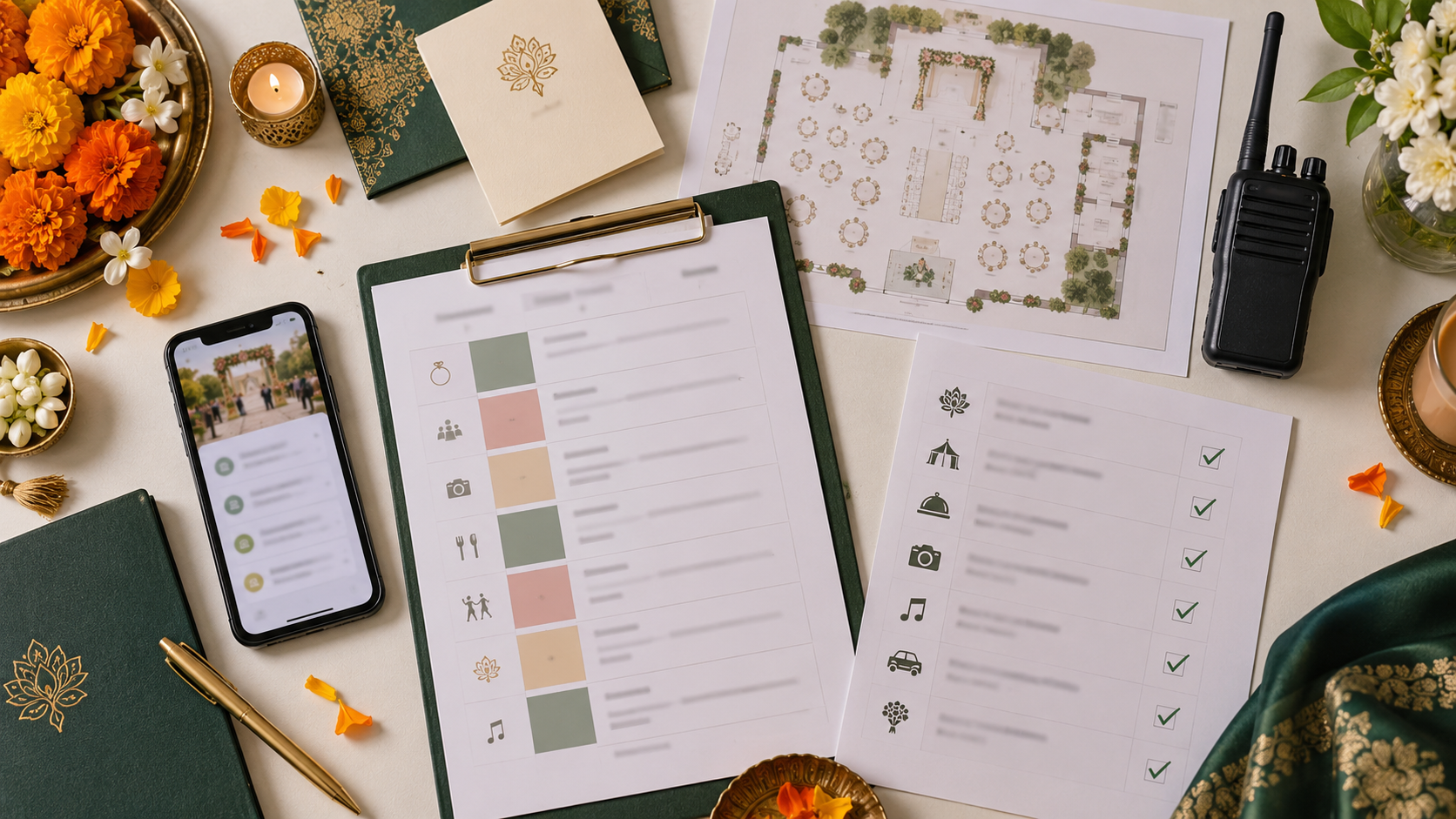
A beautiful plan can still fail because the shuttle received yesterday's timing, the caterer used the wrong guest count, or the ballroom name changed in the run sheet but not in the guest message. Indian weddings multiply these risks across several events, venues, vendors, family decision-makers, and hundreds of guests.
Use this wedding planner quality control checklist as the final error-catching layer. The fast rule is: verify every detail that can move people, money, food, or event timing against its approved source—then record who checked it and when. Do not ask the same person who created a document to be its only reviewer.
What is wedding planner quality control?
Wedding planner quality control is an independent verification pass that confirms approved details match across every document and channel used to execute a wedding. It checks contracts, run sheets, vendor briefs, venue plans, guest communication, payments, and live handoffs before an error reaches the couple or guests.
Quality assurance designs a reliable process: templates, approval rules, naming conventions, and a wedding planner SOP. Quality control tests the actual output: is this event's final run sheet correct, complete, current, and usable?
What should a wedding planner check first?
Check the details with the largest blast radius first: date, time, venue, guest movement, food, money, and safety. A spelling error is embarrassing; a wrong hotel departure time can strand 80 guests. Rank checks by consequence instead of reading every document from top to bottom.
| Priority | Check | Failure it prevents | Approved source | | --- | --- | --- | --- | | Critical | Event date, start time, venue and room | Guests or vendors arriving incorrectly | Signed approval and venue confirmation | | Critical | Transport route, passenger count and dispatch | Missed ceremony or stranded guests | Final arrival list and transport plan | | Critical | Food count, allergies and service time | Shortfall or unsafe service | Caterer BEO/menu and approved RSVP data | | High | Vendor scope, arrival and power needs | Missing setup or delayed production | Contract and final vendor brief | | High | Ceremony dependencies and family owners | Ritual or item unavailable | Approved ceremony plan | | High | Payment status and release conditions | Vendor hold or duplicate payment | Contract and payment ledger | | Medium | Signage, names and guest-facing copy | Confusion or poor experience | Approved wording sheet |
Use the wedding day run sheet template as the execution spine, but verify each critical line against the original approval rather than another copied tracker. Assign each unresolved risk a trigger and owner in the wedding planner escalation matrix.
Copy this wedding planner quality control checklist
Run this checklist seven days before the first event, repeat the live-detail sections 24 hours before each event, and rerun affected checks after any material change.
Master information
- [ ] Couple names, event dates, time zone, venue and room names match every master document.
- [ ] The latest file has a version date, owner, and clear “FINAL” status.
- [ ] Old links and duplicate PDFs have been archived or marked obsolete.
- [ ] Every event has one accountable lead and one escalation contact.
- [ ] Family decision-makers and approval limits are documented.
- [ ] Emergency, venue, security, medical, and local authority contacts are accessible offline.
Venue and production
- [ ] Venue access, loading, setup, sound cutoff, teardown, parking, and backup-space timings are confirmed.
- [ ] Floor plan matches the final guest count, stage, dance floor, buffet, accessibility, and fire-exit requirements.
- [ ] Power loads, generators, distribution, cable paths, rigging, and weather protection have named owners.
- [ ] Decor, AV, lighting, entertainment, photography, and catering setup windows do not conflict.
- [ ] Rain, heat, wind, and power-failure triggers state who decides and when.
- [ ] Every production vendor has the same venue pin, entrance, loading instruction, and on-site contact.
Vendors and money
- [ ] Signed scope, inclusions, exclusions, quantities, taxes, overtime, and cancellation terms are available.
- [ ] Vendor arrival, setup-ready, performance, meal, pack-down, and departure times appear in the run sheet.
- [ ] Advances, balances, deposits, refunds, and payment-release owners match the ledger.
- [ ] Substitutions or scope changes have written approval.
- [ ] Each vendor has received a final wedding vendor brief.
- [ ] A second coordinator has called critical vendors and recorded confirmation—not merely sent a message.
Guests, rooms, transport, and food
- [ ] Event-wise counts reconcile with RSVPs, seating, catering, transport, rooming, and welcome inventory.
- [ ] VIPs, elderly guests, children, accessibility needs, allergies, and special movements have named owners.
- [ ] Flight and train data includes arrival date, time, terminal or station, contact, and pickup status.
- [ ] Hotel check-in rules, room allocations, early arrivals, late departures, and incidentals are confirmed.
- [ ] Shuttle capacities include a practical buffer and every dispatch has a captain and passenger list.
- [ ] Menu, service style, vendor meals, fasting requirements, allergens, and late-night food are signed off.
Ceremony and family handoffs
- [ ] Ceremony order, muhurat, priest or officiant arrival, and ritual durations are confirmed.
- [ ] Rings, garlands, varmala stage, gifts, documents, pooja items, footwear, and family heirlooms have custodians.
- [ ] Family photo combinations have gatherers and realistic time allocations.
- [ ] Speeches, performances, music cues, entries, exits, and surprise elements have technical checks.
- [ ] Every handoff names the giver, receiver, place, time, and fallback.
Guest communication
- [ ] Guest-facing dates, times, venue names, map links, dress codes, transport, and contact numbers match the run sheet.
- [ ] The wedding website, PDF itinerary, WhatsApp messages, hotel desk sheet, signage, and FAQ use the same approved details.
- [ ] Every changed answer has an approval timestamp and a list of affected guests.
- [ ] Map links and phone numbers have been tested on a phone by someone other than the author.
- [ ] The team can answer common questions without searching old chats.
If guest answers keep changing across channels, move the approved itinerary, transport, venue, dress-code, and FAQ information into Mandap Chat for wedding planners. One maintained source is easier to verify than dozens of forwarded messages.
How do you run a quality-control review?
Use a two-person, source-based review: one person prepares the final pack, while a second checks each high-risk field against the original approval. Mark pass, fail, or not applicable; assign every failure an owner and deadline; then retest the corrected item.
Follow this sequence:
- Freeze the review pack. Collect the latest run sheet, vendor briefs, contracts, venue plan, payment ledger, guest data, transport plan, rooming list, menu, and guest-facing copy.
- Choose the source of truth. State which signed contract, client approval, or vendor confirmation controls each critical detail.
- Cross-check high-risk fields. Compare dates, times, locations, quantities, owners, and dependencies across documents.
- Log exceptions. Record the mismatch, impact, corrective owner, deadline, and retest status.
- Test the guest journey. Open links on mobile, follow directions, read the itinerary as a guest, and call the public contact number.
- Issue the controlled version. Publish one timestamped final pack and remove obsolete copies from active folders.
A green tick without evidence is not a check. For critical items, add the confirmation date, verifier initials, and source link.
When should wedding quality checks happen?
Run quality control at four points: immediately after important approvals, seven days before the first event, 24 hours before each event, and after any material change. The closer the wedding gets, the narrower and more operational the review should become.
| Review point | Focus | Output | | --- | --- | --- | | After approval | Contract, scope, budget and decision accuracy | Approved record and updated trackers | | Seven days before | Cross-document consistency and missing dependencies | Exception log with owners and deadlines | | 24 hours before | Live timings, locations, counts, weather and contacts | Final operational pack | | After a change | Every document and audience affected by that change | Corrected source, notifications and retest |
Do not wait for a single final review. A menu error found seven days out is fixable; the same error discovered during service is an incident.
Who should own quality control?
The lead planner remains accountable, but a second coordinator should perform the check. Assign section owners for venue, vendors, guest logistics, food, ceremony, and communication, then give one QC lead authority to reject incomplete or conflicting documents.
Use three roles:
- Creator: prepares or updates the document.
- Verifier: checks it against the approved source.
- Approver: decides when a discrepancy requires client, family, venue, or lead-planner authority.
Avoid “everyone please check.” Shared responsibility usually means nobody verifies the boring but dangerous details.
How should planners handle a late change?
A late change needs impact analysis before communication. Identify what changed, who approved it, every document and vendor it affects, which guests need the update, and who will verify the corrected result. Do not broadcast until the operational owners confirm feasibility.
Use this six-line change record:
Change: What is different?
Approved by / at: Who authorised it and when?
Operational impact: Which vendors, spaces, costs, or movements change?
Guest impact: Who needs to know?
Update owner: Who changes every affected source?
Verification: Who retests the final answer?
For shift changes during wedding week, pair the record with a wedding planner handover checklist so the next coordinator receives open exceptions, not just a fresh run sheet.
What should happen after the wedding?
Close quality control with a short defect review: what failed, where the process should have caught it, how much rework it caused, and which SOP or template must change. Separate unavoidable surprises from repeatable errors; only the second group needs a process fix.
Track a few useful signals:
- Critical mismatches found before event day.
- Late changes completed without conflicting guest information.
- Vendor confirmations still open at the 24-hour review.
- Guest questions caused by missing or outdated information.
- Issues repeated from a previous wedding.
The objective is not a wedding with zero surprises. It is a team that catches preventable errors early and handles real surprises with clear authority.
FAQ
What is wedding planner quality control?
Wedding planner quality control is an independent verification pass that confirms approved details are correct across contracts, run sheets, vendor briefs, venue plans, payments, and guest communication before execution.
When should a wedding planner run quality checks?
Run checks after major approvals, seven days before the first event, 24 hours before each event, and after any material change to venue, timing, transport, menu, guest count, or vendor scope.
Who should own wedding quality control?
Assign a QC owner who did not create the item being reviewed. The lead planner remains accountable, while a second coordinator verifies high-risk details against approved sources.
What wedding details cause the most execution errors?
The most dangerous errors involve event times, venue names, guest counts, transport, vendor arrivals, meals, payment holds, ceremony dependencies, family approvals, and outdated guest messages.
How can planners prevent guests receiving old information?
Keep one approved guest-information source, timestamp changes, retire old files, test public answers after publishing, notify affected guests, and record the approver and update owner.
Frequently asked questions
What is wedding planner quality control?+
When should a wedding planner run quality checks?+
Who should own wedding quality control?+
What wedding details cause the most execution errors?+
How can planners prevent guests receiving old information?+
Continue the series
A wedding planner escalation matrix assigns each type of problem a severity, response time, first owner, final decision owner, and communication route before the wedding begins.
An NRI wedding budget in India should be built in INR around guest count, city, event count, room nights, and production complexity—then protected with separate currency and contingency buffers.
Wedding plus-one wording should state exactly who is invited, where the guest adds their companion's name, and whether the rule applies to every function. Clear language feels kinder than a vague invitation followed by an awkward refusal.
Wedding vendor meals keep photographers, planners, drivers, decor, sound, and hospitality teams working through long Indian wedding functions. Count crew by event, confirm dietary needs, schedule service before the guest rush, and give one caterer captain the final list.
A wedding planner SOP turns repeat work into a clear operating system: each task has a trigger, owner, deadline, proof of completion, and escalation rule, so the team can execute consistently without routing every decision through the founder.