
Wedding Planner Escalation Matrix for Indian Weddings
Use this wedding planner escalation matrix to route vendor, guest, venue, payment, safety, and family issues to the right decision-maker.
A wedding planner escalation matrix assigns each type of problem a severity, response time, first owner, final decision owner, and communication route before the wedding begins.
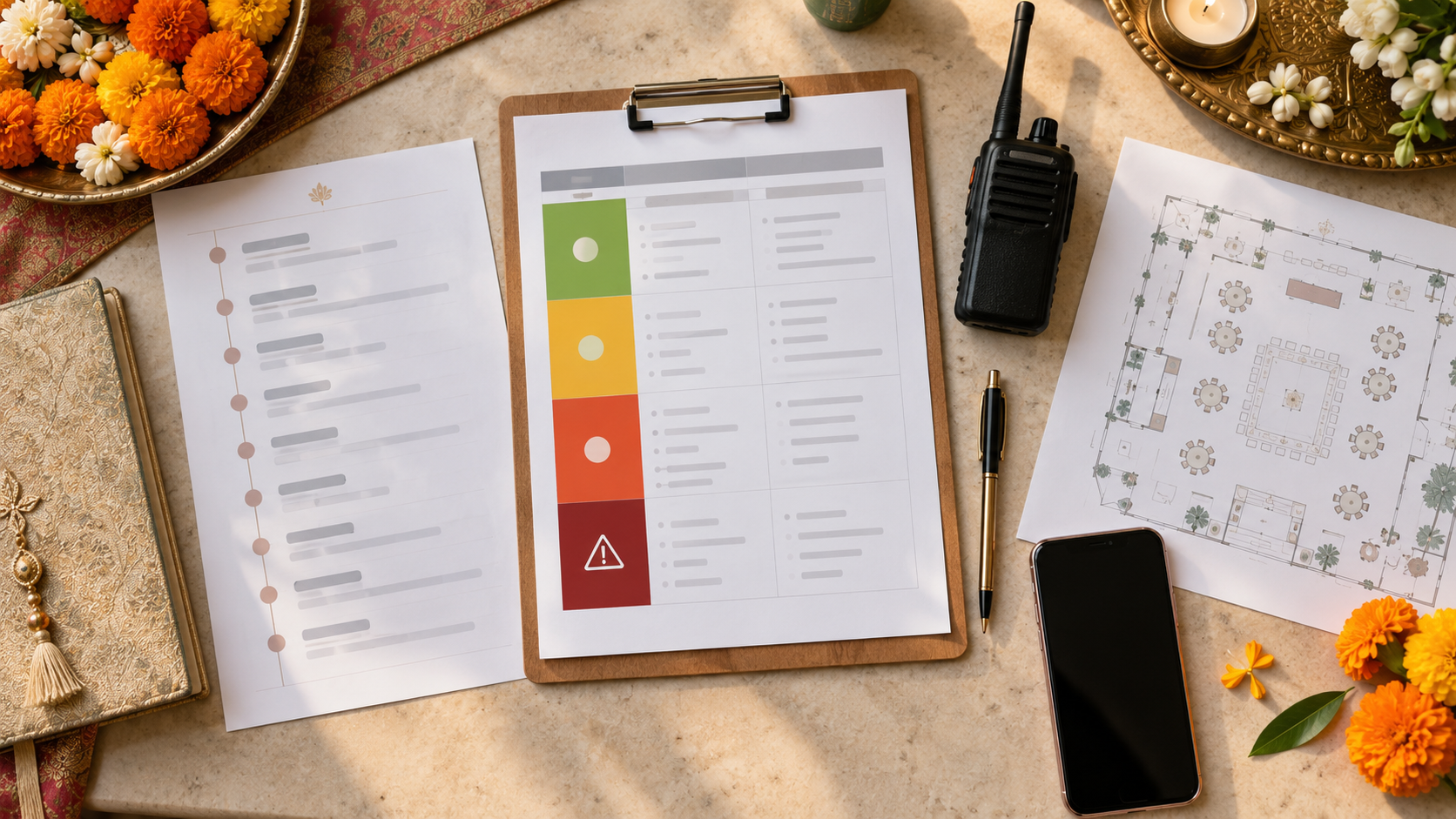
At 7:10 PM, the baraat is late, rain is moving toward the outdoor varmala, and three relatives are giving the planner different instructions. The danger is not the number of problems. It is that nobody knows who has authority to decide.
Use this wedding planner escalation matrix before event week. The fast rule is: the person closest to a routine problem handles it; the person with authority over its consequence decides it; only safety threats and high-impact changes jump the queue.
What is a wedding planner escalation matrix?
A wedding planner escalation matrix is a pre-agreed table that assigns each issue a severity, response time, first owner, decision owner, backup, and communication route. It turns “call someone senior” into a specific rule the team can follow under pressure.
The matrix complements the wedding day run sheet. The run sheet says what should happen; the escalation matrix says what to do when reality stops matching the plan.
What are the four wedding escalation levels?
Use four levels: green for routine requests, amber for operational risks, red for major disruption, and emergency for an immediate threat to health, safety, or security. Define levels by impact and urgency—not by how loudly someone complains.
| Level | Meaning | First response | Decision deadline | Example | | --- | --- | --- | --- | --- | | Green | Routine request with no event impact | Assigned coordinator | Within 30 minutes | Guest asks for the shuttle time | | Amber | Risk to one activity, vendor, or guest group | Function captain | Within 10 minutes | Makeup is 25 minutes behind | | Red | Likely disruption to an event, budget, or many guests | Lead planner plus decision owner | Within 5 minutes | Rain makes the outdoor venue unusable | | Emergency | Immediate health, safety, security, or fire risk | Emergency services or venue safety lead | Immediately | Medical emergency, fire, crowd danger |
Emergency means act first, notify second. Call local emergency services or the venue's trained response team where required. A planning document never replaces qualified medical, fire, security, or law-enforcement help.
Copy this wedding planner escalation matrix
Replace every role below with a real name and phone number. Print an offline copy for each function captain and keep one with the operations pack.
| Issue | Level | First owner | Final decision owner | Escalate when | | --- | --- | --- | --- | --- | | Routine schedule, attire, venue, or transport question | Green | Guest helpdesk | Guest-experience lead | Approved answer is missing or conflicting | | VIP arrival or accessibility help | Amber | Hospitality captain | Lead planner | Movement affects ceremony or security | | Shuttle late beyond the agreed buffer | Amber | Transport captain | Lead planner | Guests may miss an event | | Vendor absent at final call time | Amber to red | Vendor captain | Lead planner | Recovery threatens event start | | Unapproved charge or payment demand | Amber | Vendor captain | Finance owner | Vendor threatens to withhold service | | Ceremony item or key person missing | Amber to red | Ceremony captain | Planner and family representative | Muhurat or sequence is at risk | | Weather threatens an outdoor function | Red | Production lead | Planner, venue, family representative | Pre-agreed trigger is reached | | Major power, sound, catering, or venue failure | Red | Department lead | Planner and venue lead | Backup fails inside the buffer | | Injury, fire, violence, unsafe crowding, or missing child | Emergency | Qualified emergency or safety lead | Qualified responder | Immediately |
The final decision owner should be one person wherever possible. “Couple and both families” is not a usable escalation path at 7:10 PM.
Who should own decisions during an Indian wedding?
Assign authority by consequence: the lead planner owns event operations, the venue owns its safety and property rules, the finance owner controls unplanned spending, and one family representative handles sensitive family decisions. The couple should receive only decisions nobody else is authorised to make.
- Lead planner: sequence changes, vendor recovery, staff deployment, and approved backups.
- Function captain: execution inside one event or venue zone.
- Venue lead: access, capacity, fire, alcohol, power, noise, and property rules.
- Family representative: ritual priorities and sensitive guest decisions.
- Finance owner: spending beyond the planner's approved limit.
- Emergency lead: qualified medical, fire, security, or public response.
Set these roles during wedding planner client onboarding, not in the middle of the sangeet.
How should wedding planners set decision limits?
Give each role a written limit for money, timing, scope, and communication. A coordinator who can approve a ₹5,000 recovery or a ten-minute adjustment can solve real problems; a coordinator told only to “use judgement” may freeze or overstep.
Define four limits:
- Money: maximum recovery spend they may approve.
- Time: delay they may absorb without escalation.
- Scope: vendors, spaces, guests, or tasks they control.
- Message: what they may tell guests or vendors without approval.
For example: “The transport captain may add one backup cab up to ₹3,000, hold a shuttle for ten minutes, and update only affected passengers.” That is a decision rule. “Handle transport” is not.
When should a vendor issue be escalated?
Escalate when a vendor issue threatens safety, a contractual deliverable, a critical deadline, the event sequence, or the approved budget. Keep routine clarifications with the vendor captain so the lead planner is not dragged into every chair count and cable request.
Escalation triggers include:
- A critical vendor misses confirmation or final call time.
- Setup will not finish inside the recovery buffer.
- Delivered quantity, quality, or scope differs materially from the brief.
- A substitution affects safety, guest experience, ritual needs, or timing.
- A vendor requests unapproved payment or threatens to stop work.
- Two vendors have an unresolved dependency.
Attach the trigger to the wedding vendor brief, including the captain, backup contact, recovery option, and deadline.
What should an escalation message contain?
An escalation message should state the problem, impact, deadline, options, recommendation, and required decision in six short lines. Do not forward a hundred-message WhatsApp thread and make the owner reconstruct the incident.
Issue: The outdoor varmala cannot proceed safely due to rain.
Impact: Seating and sound are exposed; planned start is 8:00 PM.
Decision by: 7:20 PM.
Option A: Move to Ballroom B; 25-minute reset; approved backup.
Option B: Delay outdoors; weather clearance unknown.
Recommendation: Activate Option A; family representative to confirm now.
The recommendation matters. Senior people should decide, not repeat analysis the on-ground team has already done.
How do you keep guest questions out of the escalation chain?
Separate information requests from incidents. Guests asking about timings, locations, dress codes, rooms, shuttles, food, or rituals need a trusted answer—not the lead planner. Escalate only when approved information is absent, contradictory, or connected to a real service failure.
Load confirmed details into Mandap Chat for wedding planners so routine questions have one answer path. Reserve the escalation channel for exceptions: a stranded group, inaccessible route, missed shuttle, or changed venue.
| Guest situation | Route | | --- | --- | | “What time is the haldi?” | Approved guest-information source | | “Where does my shuttle leave?” | Approved transport answer | | “The shuttle has not arrived and 30 guests are waiting” | Transport captain, amber escalation | | “The venue pin opens the wrong property” | Guest-experience lead, amber until corrected | | “A guest has collapsed” | Emergency response immediately |
How should the team practise the escalation plan?
Run a 20-minute tabletop drill during the final production meeting. Give each captain one realistic scenario, require a level and owner within 30 seconds, then test the call tree and backup. Any argument about authority reveals a gap worth fixing before guests arrive.
Test rain before an outdoor ceremony, an unreachable vendor, a late shuttle, an unapproved program addition, a power loss, and a medical or security emergency. Record changes in the wedding planner SOP and include open risks in every handover.
Wedding escalation checklist
- [ ] Every issue category has a first owner and final decision owner.
- [ ] Green, amber, red, and emergency examples match this wedding.
- [ ] Response times and deadlines are explicit.
- [ ] Spending and timing limits are written for each captain.
- [ ] One family representative is authorised and reachable.
- [ ] Venue, security, medical, fire, and emergency contacts are verified.
- [ ] The couple's true escalation triggers are agreed.
- [ ] The call tree works when a primary contact does not answer.
- [ ] Each shift receives open red and amber issues in writing.
- [ ] Routine guest questions have a separate answer path.
FAQ
What is a wedding planner escalation matrix?
A wedding planner escalation matrix defines issue severity, response time, first owner, decision owner, backup, and communication route before the wedding begins.
What are the four escalation levels for a wedding?
Use green for routine requests, amber for operational risks, red for major disruption, and emergency for immediate health, safety, security, or fire threats.
Who should make final decisions during an Indian wedding?
Name owners by category: lead planner for operations, a family representative for sensitive decisions, a finance owner for extra spending, the venue lead for venue rules, and qualified responders for emergencies.
When should a planner escalate a vendor issue?
Escalate when a vendor misses a critical deadline, changes scope, creates a safety risk, requests unapproved payment, or threatens the event timeline.
How do planners prevent every problem reaching the couple?
Give coordinators clear limits, route issues through one operations lead, nominate one family representative, and separate routine guest questions from operational incidents.
An escalation matrix is how a planner buys back decision time when the wedding becomes noisy. Name the owner, define the trigger, set the deadline, and let the team solve the right problem at the lowest competent level.
Frequently asked questions
What is a wedding planner escalation matrix?+
What are the four escalation levels for a wedding?+
Who should make final decisions during an Indian wedding?+
When should a planner escalate a vendor issue?+
How do planners prevent every problem reaching the couple?+
Continue the series
Wedding planner quality control is a separate verification pass that checks whether approved details match across contracts, run sheets, vendor briefs, venue plans, and guest communication before execution begins.
An NRI wedding budget in India should be built in INR around guest count, city, event count, room nights, and production complexity—then protected with separate currency and contingency buffers.
Wedding plus-one wording should state exactly who is invited, where the guest adds their companion's name, and whether the rule applies to every function. Clear language feels kinder than a vague invitation followed by an awkward refusal.
Wedding vendor meals keep photographers, planners, drivers, decor, sound, and hospitality teams working through long Indian wedding functions. Count crew by event, confirm dietary needs, schedule service before the guest rush, and give one caterer captain the final list.
A wedding planner SOP turns repeat work into a clear operating system: each task has a trigger, owner, deadline, proof of completion, and escalation rule, so the team can execute consistently without routing every decision through the founder.