
Wedding Vendor Meals: Who to Feed, How Many and When
Plan wedding vendor meals without guesswork: who gets fed, meal counts, service timing, dietary needs, contract wording, and a copy-ready tracker.
Wedding vendor meals keep photographers, planners, drivers, decor, sound, and hospitality teams working through long Indian wedding functions. Count crew by event, confirm dietary needs, schedule service before the guest rush, and give one caterer captain the final list.
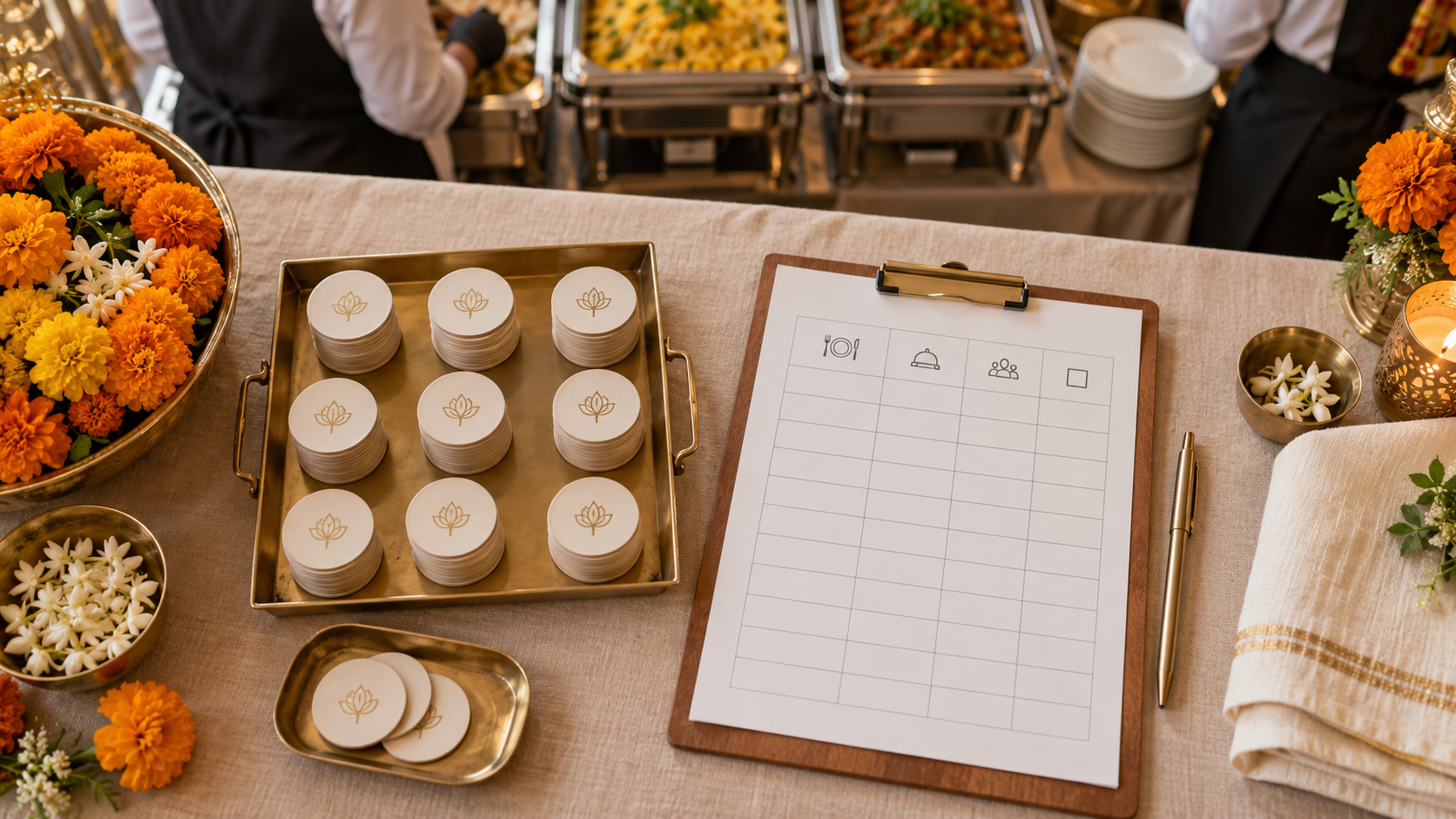
The photographer has been shooting since 7 AM. The sound crew is holding the next performance cue. Three drivers are waiting for airport pickups. Then dinner opens—and nobody counted them.
Wedding vendor meals are easy to ignore because every vendor appears on a different contract. The fastest fix is one rule: if a crew member works through a meal period or cannot reasonably leave the venue, count one proper meal for that person at that function.
Use the tracker below to decide who eats, how many meals to order, when each team can take a break, and who approves the final number. It prevents hungry crews, surprise catering bills, and critical staff disappearing during the busiest 20 minutes of the wedding.
What are wedding vendor meals?
Wedding vendor meals are meals provided to the on-site professionals who work during a wedding function, such as planners, photographers, drivers, sound crews, makeup teams, and hospitality staff. They are counted separately from guest plates and scheduled around each team's operational responsibilities.
A vendor meal is not a leftover plate promised after service. It is a planned meal with a confirmed headcount, service location, eating window, dietary options, drinking water, and one person responsible for telling each team when food is ready.
For a multi-day Indian wedding, count vendor meals per event. A decorator may need dinner during overnight setup but not attend the reception. A photographer may need breakfast, lunch, and dinner. A driver may work only the airport-arrival shift.
Which wedding vendors should you feed?
Feed vendors who remain on-site through a normal meal period, work a long continuous shift, or cannot leave without disrupting the event. Short-drop delivery teams usually do not need meals unless their contract requires them, while production, hospitality, transport, and creative crews usually do.
| Vendor team | Usually needs a meal when | Common counting miss | | --- | --- | --- | | Planners and assistants | Working through setup and the function | Freelancers and runners | | Photographers and videographers | Coverage spans a meal period | Second shooters and drone operators | | Sound, light, DJ and AV | On-site for rehearsal or live cues | Console operators and technicians | | Decor and production | Crew remains after setup or works overnight | Installation crew differs from show crew | | Makeup and hair | Call time overlaps breakfast or lunch | Assistants and sari drapers | | Drivers and transport | Waiting between movements | Different hotel and airport shifts | | Hospitality staff | Desk stays open through a meal | Relief staff and luggage runners | | Priests and assistants | Present through ceremony and meal time | Fasting or ritual food requirements | | Security and housekeeping | Dedicated event staff work the function | Venue package may include their meals | | Performers and choreographers | Rehearsal or show call spans a meal | Artist riders may specify food |
Ask for the people actually attending each function, not the size of the vendor company. Capture the decision-maker and on-site lead in your wedding vendor contact list so a last-minute change reaches the right person.
How many vendor meals should you order?
Order one meal for every confirmed crew member working through that meal period, then apply only the small buffer agreed with the caterer. Build the count by function and dietary category; never multiply the number of vendor companies by an assumed team size.
Vendor meals for one function = confirmed on-site crew during the meal window + approved shift overlap + agreed buffer.
| Function | Vendor team | Crew | Veg | Jain | Non-veg | Allergy note | Meal window | | --- | --- | ---: | ---: | ---: | ---: | --- | --- | | Haldi breakfast | Photo/video | 6 | 4 | 1 | 1 | None | 8:15-8:35 AM | | Sangeet dinner | Sound/light | 12 | 8 | 2 | 2 | 1 nut allergy | 7:15-7:45 PM, staggered | | Wedding lunch | Planning | 9 | 7 | 2 | 0 | None | 1:00-1:30 PM, staggered | | Reception dinner | Drivers | 18 | 15 | 3 | 0 | None | 8:30-9:15 PM in waves |
Reconcile this with the master wedding food count sheet. Keep vendor meals visible as their own line rather than hiding them inside the guest buffer.
Reconfirm counts at three points:
- Contract stage: record expected crew and meal clauses.
- Seven days out: request function-wise crew, shifts, and dietary needs.
- Forty-eight hours out: freeze the final number with the caterer captain.
When should wedding vendors eat?
Serve vendor meals before the guest buffet rush or during a natural break, with critical teams eating in staggered groups. The right time is when a team can step away without leaving the ceremony, performance, transport desk, sound console, or guest-help point uncovered.
| Team | Avoid | Better window | | --- | --- | --- | | Photography | Couple entry, varmala, speeches, pheras | Before the key sequence or after formal coverage | | Sound and lights | Rehearsal, performance cues, speeches | Rotate operators before doors open | | Planners | Guest arrival and major transitions | Half eat while half cover | | Drivers | Pickup and drop waves | Between movement banks | | Hospitality desk | Check-in rush | Stagger one person at a time | | Makeup and hair | Bride or family call times | After the final scheduled look |
Put meal windows into the wedding day run sheet, not just the catering spreadsheet. A meal count answers "how many?"; the run sheet answers "when can they leave their post?"
Should vendors get the same food as wedding guests?
Vendors can receive the same food as guests when the caterer and contract allow it, often through a separate staff counter or back-of-house service area. A simpler staff menu is also reasonable if agreed beforehand, but it should still be a proper meal—not scraps after the buffet closes.
| Meal setup | Best for | Watch out for | | --- | --- | --- | | Same buffet, early access | Smaller weddings | Vendors moving through guest areas | | Same food, separate counter | Large Indian weddings | Counter must open early enough | | Separate hot staff menu | Large crews | Dietary options can be forgotten | | Packed meals | Drivers and remote crews | Delivery time, labels, water, cutlery |
If meals are packed, label dietary types clearly and assign a delivery owner. For caterer licensing and food-safety checks in India, refer to the Food Safety and Standards Authority of India and confirm the venue or caterer's service process.
What should the vendor contract say about meals?
The contract should state whether meals are required, which crew members are covered, which functions or working hours trigger a meal, and whether the vendor accepts a staff meal instead of guest buffet access. Clear wording prevents inflated headcounts and awkward arguments during production week.
Use this clause as a planning prompt:
The client will provide one staff meal to each confirmed crew member working on-site through the applicable meal period. The vendor will submit the function-wise crew count and dietary requirements by [date]. The final count is capped at [number] unless a change is approved in writing by [name]. Meal timing and location will be shared in the final run sheet.
Check existing contracts first. Some venues include staff meals, some artists have hospitality riders, and some vendors price meals into their fee. The goal is not to pay twice; it is to make ownership explicit.
What is the easiest vendor meal workflow?
The easiest workflow uses one form, one tracker, one freeze date, and one on-site meal captain. Collect crew numbers and dietary needs once, merge them into the catering count, publish staggered meal windows in the run sheet, and send only the relevant instructions back to each team.
- [ ] Review contracts for meal terms.
- [ ] Ask for function-wise crew counts.
- [ ] Collect vegetarian, Jain, vegan, allergy, and fasting needs.
- [ ] Remove short-delivery staff leaving before the meal.
- [ ] Check whether venue staff meals are already included.
- [ ] Agree on the food and service location.
- [ ] Add meal windows to the run sheet.
- [ ] Freeze counts seven days out and reconfirm 48 hours out.
- [ ] Name one caterer captain and one planner meal owner.
- [ ] Tell each vendor where and when their team will eat.
Add these questions to your wedding vendor brief template so meal data sits beside arrival, setup, dependencies, access, and escalation details.
How can Mandap Chat reduce vendor-meal confusion?
Mandap Chat can hold approved guest-facing food information—meal timings, Jain availability, breakfast hours, venue locations, and dietary-contact instructions—so planners are not answering repeated questions while coordinating vendor breaks. Private crew counts and vendor phone numbers should stay in the production tracker.
Upload the final itinerary and guest FAQ to Mandap Chat for wedding planners. Guests get consistent answers while the planning team focuses on live execution.
FAQ
Do you have to feed wedding vendors?
Feed vendors who work through a normal meal period or remain on-site for several hours. Confirm each obligation in the contract and count the actual on-site crew.
Which wedding vendors need meals?
Common teams include planners, photo/video crews, DJs, sound and lighting operators, makeup and hair teams, drivers, hospitality staff, priests and assistants, security, and decor staff who remain on-site.
When should wedding vendors eat?
Serve meals before the guest rush or during a natural break. Stagger critical teams so photography, transport, guest help, performance cues, and technical operations stay covered.
Can wedding vendors eat the same food as guests?
Yes, if the caterer and contracts allow it. Use the guest buffet, a separate counter serving the same food, a hot staff menu, or labelled packed meals—whichever is agreed in advance.
How many vendor meals should you order?
Order one meal per confirmed crew member working through that meal period, separated by function and dietary type. Reconfirm the count seven days and 48 hours before the wedding.
Vendor meals are a small line in the budget and a huge part of keeping the wedding running. Count the real crew, schedule breaks around live responsibilities, serve proper food on time, and put one person in charge.
Frequently asked questions
Do you have to feed wedding vendors?+
Which wedding vendors need meals?+
When should wedding vendors eat?+
Can wedding vendors eat the same food as guests?+
How many vendor meals should you order?+
Continue the series
Wedding planner quality control is a separate verification pass that checks whether approved details match across contracts, run sheets, vendor briefs, venue plans, and guest communication before execution begins.
An NRI wedding budget in India should be built in INR around guest count, city, event count, room nights, and production complexity—then protected with separate currency and contingency buffers.
Wedding plus-one wording should state exactly who is invited, where the guest adds their companion's name, and whether the rule applies to every function. Clear language feels kinder than a vague invitation followed by an awkward refusal.
A wedding planner SOP turns repeat work into a clear operating system: each task has a trigger, owner, deadline, proof of completion, and escalation rule, so the team can execute consistently without routing every decision through the founder.
A wedding venue change message should put the new venue, affected function, date, reporting time, map link, and transport change in the first screen. Send it from one official channel, mark the old venue as cancelled, and ask guests to acknowledge urgent changes.