
Wedding Food Count Sheet for Indian Weddings
A practical wedding food count sheet for Indian weddings: function-wise plate counts, Jain meals, kids meals, staff meals, buffers, and caterer handoff.
A wedding food count sheet turns RSVP data into event-wise catering numbers: total plates, Jain meals, vegan or halal needs, kids meals, staff meals, buffers, and named exceptions that the caterer can execute without guessing.
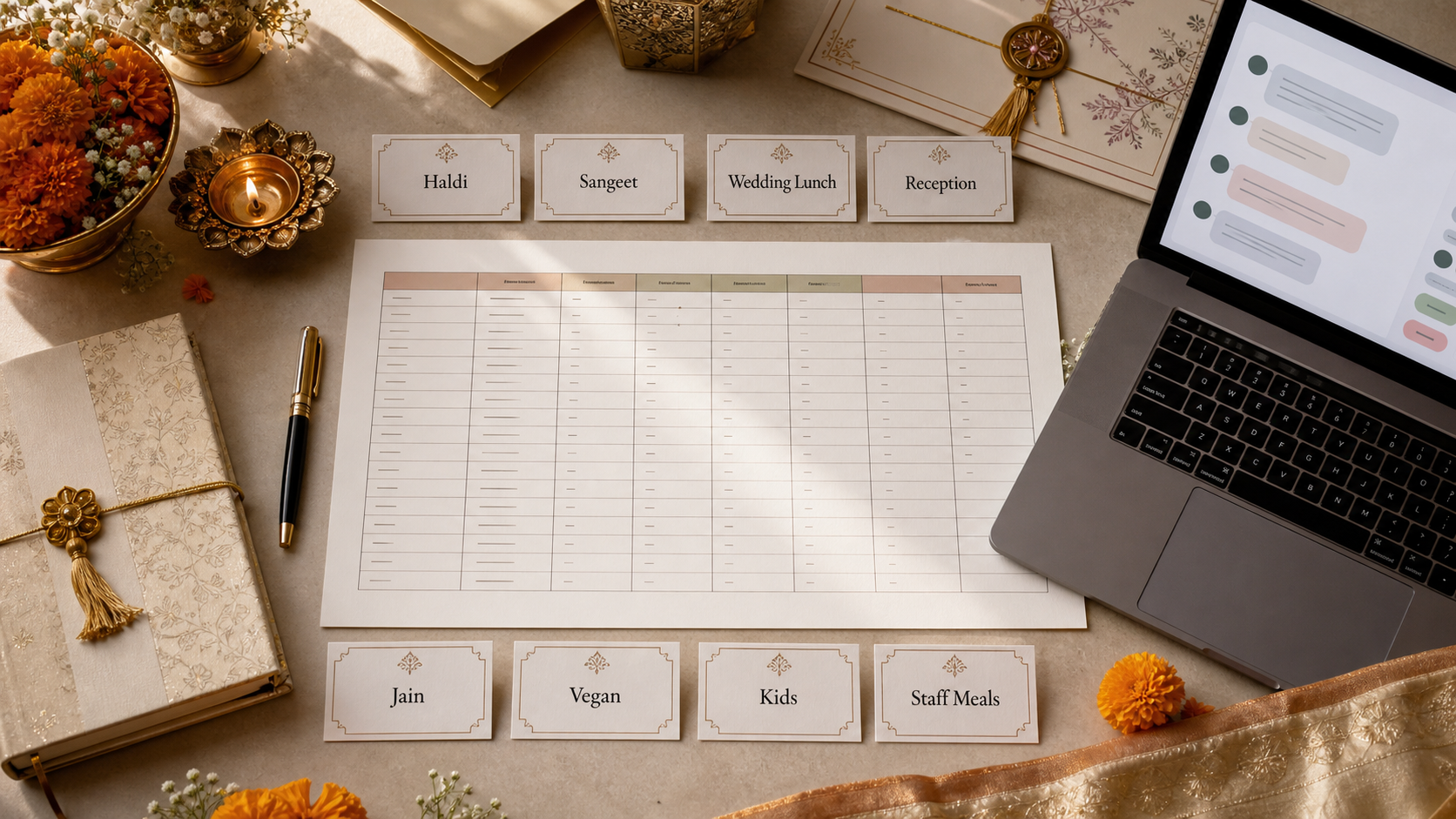
The catering problem in an Indian wedding is rarely "not enough food" in the abstract. The real problem is uglier: 520 people are expected for wedding lunch, but nobody knows whether that includes hotel guests, drivers, priests, Jain meals, kids, senior-friendly food, or the photographer's team.
A wedding food count sheet fixes that by turning RSVP chaos into one caterer-ready sheet. The fast rule is simple: count food by function and category, not by invitation total.
This guide is for couples, planners, and family hosts managing multi-event weddings where haldi breakfast, mehendi lunch, sangeet dinner, wedding lunch, reception, brunch, and hotel meals all have different attendance patterns.
What is a wedding food count sheet?
A wedding food count sheet is an event-wise catering control sheet that lists expected guests, guaranteed plates, dietary categories, staff meals, buffer rules, and named exceptions for each function. It is the bridge between the RSVP form and the caterer's final production plan.
The sheet has one job: make sure the caterer is not guessing from the master guest list.
Use it to answer:
| Question | Why it matters | | --- | --- | | Who is eating at each function? | Prevents over-ordering and under-ordering | | Which meals need separate handling? | Protects Jain, vegan, allergy, kids, and senior needs | | How many vendor staff need food? | Keeps production teams on-site and functional | | What buffer is approved? | Stops last-minute plate-count fights | | Who can change the count? | Prevents five relatives from editing catering numbers |
A food count sheet is not the same as a menu. The menu says what is served. The count sheet says how much, for whom, at which event, under which service rule.
How do you calculate food count for an Indian wedding?
Calculate food count by function first, then split each function into guest categories. Do not use the total invite list as the catering count because Indian wedding attendance changes sharply by event, time, venue, family side, travel schedule, and ritual importance.
Use this simple formula:
Function food count = confirmed attendees + approved local buffer + hotel-stay meals + special meal counts + vendor staff meals.
Build the sheet in this order:
- List every hosted meal. Haldi breakfast, mehendi lunch, sangeet dinner, late-night snacks, wedding lunch, reception dinner, brunch, and hotel breakfast.
- Add confirmed attendance by function. Pull this from the RSVP, not from the invitation list.
- Separate local guests from hotel guests. Hotel breakfasts and late-night tea depend on the rooming list.
- Add dietary categories. Jain, no-onion-no-garlic, vegan, halal, fasting, allergies, kids, and senior-friendly food.
- Add vendor staff meals. Count every vendor team expected to stay through service.
- Agree on buffer. Decide who can approve extra plates and what the caterer will charge.
For RSVP collection, use a wedding meal preference RSVP template before you build the final count sheet. The count sheet is only as good as the food data guests submit.
What columns should the food count sheet include?
A useful wedding food count sheet should be short enough for the caterer to read quickly and detailed enough to prevent service mistakes. If the sheet becomes a 40-column spreadsheet nobody trusts, it will fail during production week.
Start with these columns:
| Column | Example | Owner | | --- | --- | --- | | Function | Sangeet dinner | Planner | | Date and service time | 8:30 PM dinner open | Planner | | Confirmed guest count | 380 | RSVP owner | | Guaranteed plates | 400 | Family payment owner | | Buffer rule | +10% only if approved by planner | Caterer and family | | Jain/no-onion count | 22 | RSVP owner | | Vegan count | 7 | RSVP owner | | Halal/non-veg count | 31 | Caterer | | Kids meals | 16 | RSVP owner | | Senior-friendly meals | 9 | Family owner | | Allergy notes | 2 nut allergies, named separately | Planner | | Vendor staff meals | 42 | Planner | | Caterer captain | Name + phone | Caterer | | Final confirmation | Date, time, confirmed by | Planner |
Add named exceptions in a separate tab. Do not bury severe allergy notes inside a generic count. The caterer needs names, event, ingredient, service rule, and a contact person.
How should you split counts by function?
Split counts by the way guests actually behave at each event. A guest who attends the sangeet may skip haldi. A local relative may attend only the wedding lunch. A hotel guest may need breakfast every day but no airport pickup. A vendor may need lunch before guests arrive.
Use this decision table:
| Function | Count from | Common miss | | --- | --- | --- | | Haldi breakfast | Hotel guests, close family, early vendors | Elders and kids needing food before ritual starts | | Mehendi lunch | RSVP event attendance | Guests with mehendi on hands need easy food | | Sangeet dinner | Confirmed evening attendance | Late buffet opening after performances | | Late-night snacks | Younger guests, after-party group, vendors | Counting every guest instead of the active group | | Wedding lunch | Ceremony attendance plus local buffer | Walk-in relatives and priest team meals | | Reception dinner | Reception RSVPs, photo-queue timing | Guests delayed by stage photos | | Brunch | Rooming list and check-out time | Guests waking in waves |
This is where broad wedding catering advice breaks down. Indian weddings are not one meal. They are a sequence of meals with different attendance certainty.
For the broader food planning view, pair this with the Indian wedding catering checklist. That checklist handles menu, service timing, counters, bar rules, and final caterer questions; this sheet handles the count math.
How much buffer should you add to catering counts?
There is no universal wedding catering buffer because every function has different RSVP discipline. Use a smaller buffer when attendance is tightly controlled and a larger operational buffer when local relatives, open-house rituals, or uncertain ceremony timing are involved.
Use this planning framework:
| Event type | Buffer logic | Why | | --- | --- | --- | | Ticketed or RSVP-only welcome dinner | Low buffer | Guest list is controlled | | Hotel breakfast | Rooming-list based buffer | Most demand comes from staying guests | | Haldi or mehendi | Moderate buffer | Family and local arrivals fluctuate | | Wedding ceremony meal | Higher local buffer | Relatives may attend without clean RSVP | | Reception | Moderate buffer | Stage photos and late arrivals shift eating waves | | After-party snacks | Small targeted buffer | Only a subset stays late |
Ask the caterer to separate three numbers:
- Estimated count: what the family currently expects.
- Guaranteed count: what the family commits to pay for.
- Extra plate rule: how extra plates are charged if the buffer is used.
Do not let "we will manage" become the buffer policy. It sounds comforting until the caterer and family disagree on the bill after midnight.
How should Jain, allergy, kids, and staff meals be counted?
Special meals should be counted as service categories, not notes. "Jain available" is not enough. "Wedding lunch: 46 Jain, separate counter, separate spoons, label in English and Hindi, confirmed by caterer captain" is usable.
Use this category sheet:
| Category | Count by | Service note | | --- | --- | --- | | Jain | Event and guest name where possible | Separate prep, separate spoons, clear labels | | No-onion-no-garlic | Event and family rule | Confirm whether it shares Jain counter | | Vegan | Event and dairy exclusion | Dessert and tea/coffee alternatives matter | | Halal | Event and non-veg service | Confirm sourcing and label wording | | Allergy | Named guest and ingredient | Give a caterer contact, avoid casual promises | | Kids | Age band and event | Mild food, smaller portions, earlier service | | Seniors | Family group and event | Low-spice, soft food, seating access | | Fasting | Specific fast or family rule | Confirm ingredients before menu freeze | | Vendor staff | Vendor team and event | Serve before or after guest rush, by role |
For food safety and vendor due diligence in India, ask the caterer for FSSAI licence or registration details and their food-handler process. FSSAI runs India's food-safety licensing system, and FoSTaC is its training ecosystem for food handlers. Sources: FSSAI and FoSTaC.
When should the final food count be sent to the caterer?
Before freezing the staff line, use the wedding vendor meals guide to confirm each team's function-wise headcount, dietary needs, and staggered eating window.
Send food counts in waves so the caterer can plan without pretending the first RSVP export is final. The timeline should create useful certainty, not fake certainty.
| Timing | What to send | | --- | --- | | 30 days out | Early estimate by function, cuisine direction, major dietary constraints | | 21 days out | RSVP chase list and preliminary meal categories | | 14 days out | Event-wise count, dietary count, hotel breakfast count, vendor staff estimate | | 7 to 10 days out | Guaranteed plates, approved buffer, final menu categories | | 48 hours out | Caterer captain, setup time, count changes, allergy notes, payment status |
Use the same freeze date in your wedding RSVP reminder message. If RSVP closes on Monday but food changes stay casual until Friday, guests will keep treating the count as flexible.
What should the 48-hour caterer handoff say?
The 48-hour handoff should be short, written, and confirmed by the person who will actually run catering on-site. It should not be a new negotiation.
Copy this:
Final food count confirmation for [Wedding Name], [Dates]. Please confirm:
- Function-wise confirmed guest count and guaranteed plates.
- Jain, no-onion-no-garlic, vegan, halal, allergy, kids, senior, fasting, and staff meal counts.
- Approved buffer rule and extra plate charge.
- Service time, counter opening time, and late-night snack timing.
- Caterer captain name and phone number.
- Separate-label and separate-spoon rules for special meals.
- Staff meal service time and location.
- Balance payment amount, due time, and receiver.
- Escalation contact if guest count changes on-site.
Save the reply in the wedding folder. Voice notes and "haan ho jayega" are not enough when the buffet opens late.
How does Mandap Chat reduce food-count chaos?
Mandap Chat helps after the food count sheet is approved because guest questions do not stop when the caterer gets the numbers. Guests still ask whether Jain food is available, when dinner opens, whether kids meals exist, whether alcohol is served, and what to do about allergies.
Upload the final food FAQ, event itinerary, RSVP deadline, hotel breakfast rules, alcohol note, and dietary policy into Mandap Chat for wedding planners. Guests can ask in natural language, while the planner and family keep the count sheet protected.
This matters most during production week. The planner should be confirming vendors, rooms, shuttles, rituals, photos, and payments, not answering "Will there be Jain at lunch?" 70 times.
Wedding food count sheet template
Use this starter sheet when you need a clean handoff today.
| Function | Confirmed guests | Guaranteed plates | Buffer | Jain | Vegan | Halal | Kids | Seniors | Allergies | Staff meals | | --- | ---: | ---: | --- | ---: | ---: | ---: | ---: | ---: | --- | ---: | | Haldi breakfast | 210 | 225 | +10 if approved | 18 | 4 | 0 | 12 | 8 | 1 peanut allergy | 24 | | Mehendi lunch | 260 | 275 | +15 plates | 20 | 5 | 0 | 14 | 7 | Same named allergy | 28 | | Sangeet dinner | 380 | 400 | +10% cap | 22 | 7 | 31 | 16 | 9 | 2 nut allergies | 42 | | Wedding lunch | 520 | 560 | local walk-in buffer | 46 | 5 | 0 | 21 | 18 | 1 gluten-free, 1 peanut allergy | 36 | | Reception dinner | 610 | 625 | +25 plates | 28 | 8 | 44 | 19 | 12 | same named allergy guests | 48 | | Brunch | 180 | 190 | rooming-list based | 14 | 3 | 0 | 10 | 6 | none | 18 |
Add one approval line under the table:
Final count owner: [Name]. No catering count changes after [date/time] unless approved by [name + phone]. Serious allergy corrections go directly to [planner/caterer captain].
FAQ
What is a wedding food count sheet?
A wedding food count sheet is an event-wise catering sheet that converts RSVP answers into confirmed plates, special meal counts, staff meals, buffers, and caterer instructions for each function.
How do you calculate food count for an Indian wedding?
Calculate by function, not by total invite list. Start with confirmed attendees, then add event-specific buffers, hotel-stay meals, dietary categories, kids meals, senior-friendly meals, fasting meals, allergy notes, and vendor staff meals.
How much buffer should you add to wedding catering counts?
Use a different buffer by event. RSVP-only dinners need less buffer, wedding lunches often need more local walk-in flexibility, and hotel breakfasts should follow the rooming list. Confirm the guaranteed count and extra plate rule with the caterer.
Should vendor staff meals be included in wedding food counts?
Yes. Count photographers, decorators, sound teams, priests, drivers, makeup artists, hospitality teams, and planner staff separately. Vendor meals should not quietly come out of the guest buffet count.
When should the final food count be sent to the caterer?
Send a preliminary count 14 days out, freeze normal counts 7 to 10 days before the first event, and send a final 48-hour confirmation with only approved changes, allergy notes, staff meal counts, and escalation contacts.
Can Mandap Chat answer food questions from guests?
Yes. Once the approved food FAQ and itinerary are uploaded, Mandap Chat can answer guest questions about Jain food, dinner timing, alcohol, kids meals, breakfast, and allergy contacts without sending every question to the planner.
The food count sheet is the quiet operational layer behind a smooth wedding meal. Keep RSVP data clean, freeze the right numbers at the right time, give the caterer a written handoff, and put guest-facing food answers into Mandap Chat so the planner's phone does not become the buffet control room.
Frequently asked questions
What is a wedding food count sheet?+
How do you calculate food count for an Indian wedding?+
How much buffer should you add to wedding catering counts?+
Should vendor staff meals be included in wedding food counts?+
When should the final food count be sent to the caterer?+
Can Mandap Chat answer food questions from guests?+
Continue the series
A wedding planner escalation matrix assigns each type of problem a severity, response time, first owner, final decision owner, and communication route before the wedding begins.
Wedding planner quality control is a separate verification pass that checks whether approved details match across contracts, run sheets, vendor briefs, venue plans, and guest communication before execution begins.
An NRI wedding budget in India should be built in INR around guest count, city, event count, room nights, and production complexity—then protected with separate currency and contingency buffers.
Wedding plus-one wording should state exactly who is invited, where the guest adds their companion's name, and whether the rule applies to every function. Clear language feels kinder than a vague invitation followed by an awkward refusal.
Wedding vendor meals keep photographers, planners, drivers, decor, sound, and hospitality teams working through long Indian wedding functions. Count crew by event, confirm dietary needs, schedule service before the guest rush, and give one caterer captain the final list.