
Indian Wedding Catering Checklist: Menu, Drinks, Guest Counts
A practical Indian wedding catering checklist for menu planning, guest counts, Jain meals, drinks, service timing, and final caterer confirmations.
Plan Indian wedding catering by locking guest count, meal format, dietary tags, bar rules, tasting notes, service timing, staff meals, and a 48-hour caterer confirmation sheet before the first event.
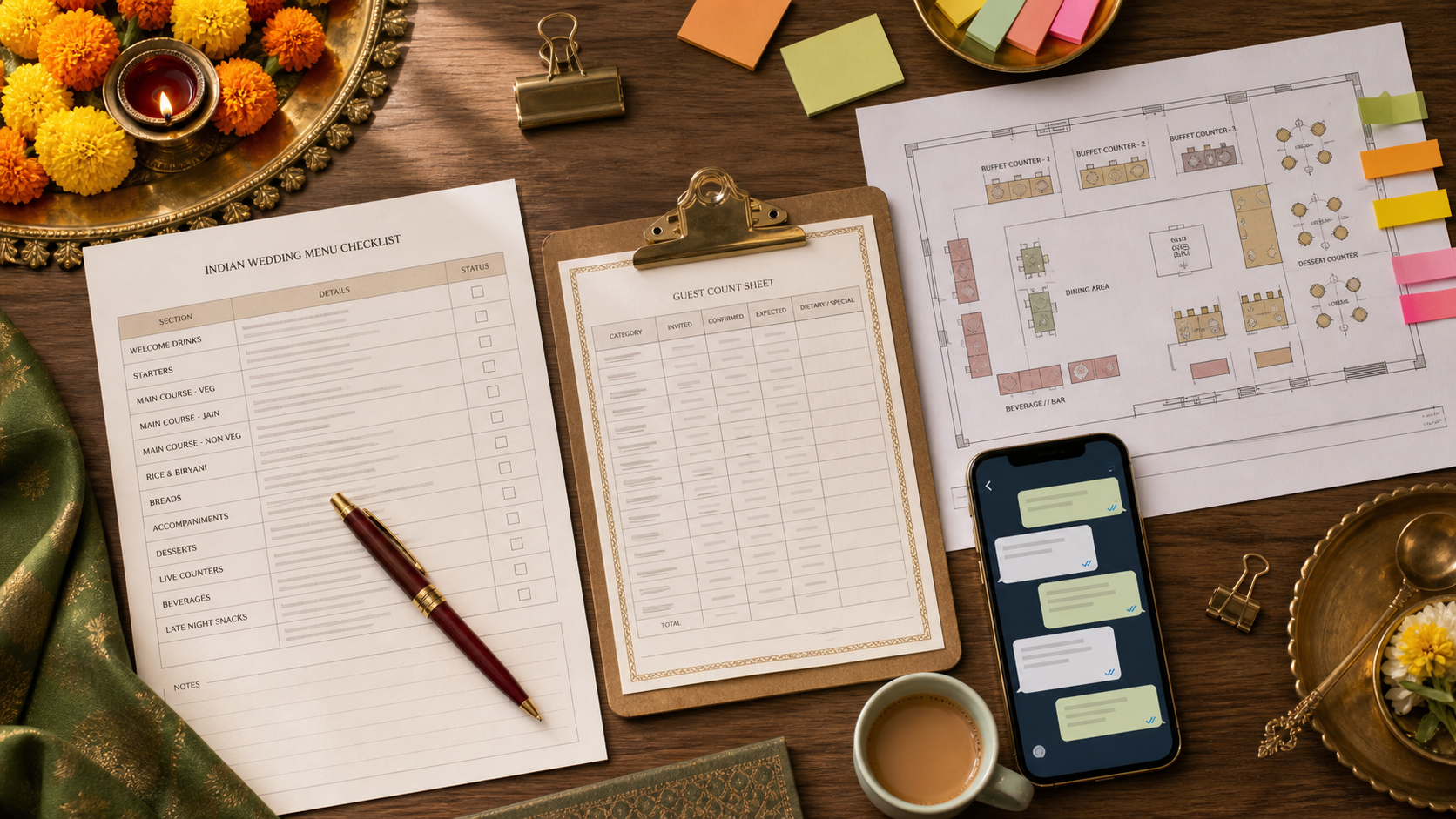
An Indian wedding catering checklist should do one job: stop food decisions from becoming event-day phone calls. Lock the guest count by function, dietary categories, menu format, bar plan, service timing, staff meals, counter layout, and final caterer contact sheet before the first event starts.
This is for couples and planners handling 300 to 800 guests across haldi, mehndi, sangeet, wedding, reception, brunch, and hotel meals. The fast rule is simple: plan catering by event and guest type, not by the total invitation list.
What is an Indian wedding catering checklist?
An Indian wedding catering checklist is a function-by-function control sheet for food, drinks, dietary needs, service timing, and caterer accountability. It is not just a menu wishlist. A good checklist tells the caterer what to serve, when to serve it, who is eating, who is paying, who is allowed to change the count, and who to call if something breaks.
The practical version has seven blocks:
| Block | What it controls | Owner | | --- | --- | --- | | Guest count | Plates, buffet pressure, bar stock | Couple or planner | | Menu | Cuisine, courses, live counters, snacks | Couple, parents, caterer | | Dietary tags | Jain, vegan, allergies, fasting meals | RSVP owner | | Drinks | Mocktails, alcohol, water, tea, coffee | Venue, bar vendor, caterer | | Service | Counter layout, waiters, refill timing | Caterer captain | | Back-of-house | Staff meals, storage, power, water | Planner and venue | | Confirmation | Final count, arrival, setup, escalation | Caterer owner |
If the checklist does not name an owner, it is just a document. Indian wedding catering needs ownership because food touches every family group at once.
How should you calculate food for each wedding event?
Calculate food by function, attendance certainty, and eating behavior. The same guest behaves differently at a 10 AM haldi, a cocktail-heavy sangeet, a wedding muhurat, and a late reception. One master guest count will over-order some meals and under-order the meals that matter.
Use this count model:
- Confirmed event count. Count only guests expected at that function, not everyone invited to the wedding.
- Local walk-in buffer. Add a realistic buffer for relatives who may attend without RSVP, especially for wedding ceremony meals.
- Hotel-stay count. Separate guests staying in the hotel from guests driving in; breakfast and late-night tea depend on this.
- Dietary count. Track Jain, vegan, no-onion-no-garlic, fasting, allergies, and kids meals separately.
- Vendor staff count. Feed photographers, decorators, sound crew, makeup team, drivers, and planner staff.
- VIP timing count. Identify parents, grandparents, priests, and close family who may need food before the buffet opens.
The easiest failure to avoid is the vendor staff meal. If 40 people are working your wedding and nobody has budgeted their food, they either disappear to eat outside or start asking the planner at the worst possible time.
When the RSVP data is ready, move these numbers into a wedding food count sheet before the guaranteed plate freeze. That keeps event-wise plates, Jain meals, kids meals, staff meals, and buffer approvals in one caterer-ready view.
What should go on the wedding menu?
A wedding menu should match the event mood, service speed, and guest mix before it tries to impress anyone. Too many counters create queues, cold food, and decision fatigue. Fewer counters with disciplined refill timing usually beat a giant menu that photographs well and serves badly.
Use this starting point:
| Event | Menu logic | Watch-out | | --- | --- | --- | | Haldi | Light, fast, bright food; chaas, nimbu pani, chaat, simple mains | Turmeric stains and outdoor heat | | Mehndi | Grazing food, snacks, tea, mocktails, finger-friendly plates | Guests have mehndi on their hands | | Sangeet | High-energy snacks, dinner buffet, late-night bites | Buffet opens too late after performances | | Wedding ceremony | Regional comfort food, quick service, senior-friendly options | Muhurat delays change eating time | | Reception | Polished buffet or plated service, desserts, coffee | Long photo queues delay dinner | | Brunch | South Indian, parathas, eggs where appropriate, fruit, tea, coffee | Guests wake up in waves |
Wedding menu is a broad search term, but the real planning question is narrower: "Will this menu survive the actual event?" A live pasta counter may be pointless at a traditional morning wedding. A chaat counter may be perfect for mehndi and a mess for a formal reception entrance.
How many dishes are enough for 300 to 600 guests?
For most Indian weddings, quality and throughput matter more than dish count. A 600-guest reception with 26 dishes and weak service feels worse than a 12-dish menu with hot food, short queues, clear signage, and fast refills.
A practical base menu for a large function:
- 2 welcome drinks or mocktails.
- 2 to 3 live or snack counters.
- 2 Indian mains plus 1 regional specialty.
- 1 dal or kadhi.
- 1 paneer or vegetarian hero dish.
- 1 non-veg counter if the family serves it.
- Rice, pulao, or biryani.
- Rotis, naan, or regional breads.
- 2 desserts plus tea or coffee.
- 1 late-night snack for sangeet or after-party.
Add dishes only when they solve a real guest need: Jain counter for a Jain-heavy family, millet or light food for seniors, a kid-friendly pasta or dosa station, or a regional counter that actually matters to the families.
How should Jain, vegan, allergies, and kids meals be handled?
Dietary meals need labels, counts, and service rules, not vague promises. "Jain food available" is not enough. The caterer needs to know how many Jain plates, whether no-onion-no-garlic applies to all events, whether Jain food has a separate counter, and who can answer guest questions on-site.
Use this dietary grid:
| Need | Confirm this | Service rule | | --- | --- | --- | | Jain | Count by event, separate prep, separate serving spoons | Label clearly and keep away from mixed counters | | Vegan | Dairy-free items, dessert option, tea/coffee substitute | Do not assume "veg" means vegan | | Allergies | Nut, gluten, dairy, shellfish, other declared allergies | Give guests a named caterer contact | | Kids | Mild food, small portions, early service | Serve before the main buffet rush | | Seniors | Low-spice, soft, easy seating access | Keep near family tables | | Fasting | Sabudana, fruit, vrat-friendly food if needed | Confirm festival or family-specific rules |
For safety and compliance, ask the caterer for their FSSAI licence or registration details and food-safety process. FSSAI's official portal is the source for food licensing, and its FoSTaC programme includes training for catering and food handlers. Sources: FSSAI and FoSTaC.
How much alcohol do you need for a wedding?
Start with one drink per drinking guest per hour, then adjust for event length, guest profile, weather, and bar format. A 4-hour cocktail night with 200 drinking guests needs a very different plan from a 90-minute reception toast after dinner.
Use this simple planning table before asking the bar vendor for the final stock plan:
| Input | Conservative wedding | High-consumption wedding | | --- | --- | --- | | Drinking guests | RSVP-tagged adults only | Most adults plus after-party group | | Event length | 2 to 3 hours | 4 to 6 hours | | Baseline | 1 drink per guest per hour | 1.25 drinks per guest per hour | | Buffer | 10% | 15% to 20% | | Mix | More beer, wine, mocktails | More spirits and cocktails |
Do not treat an online wedding alcohol calculator as the final answer for an Indian wedding. It will not know your state permit rules, venue restrictions, dry-day risk, family preferences, or whether alcohol is served before, during, or after dinner. In India, alcohol permissions vary by state and venue; the National Portal of India lists temporary permit services for private parties and weddings in some states, such as Punjab's L-50A permit. Source: National Portal of India.
What should you ask the caterer before booking?
Ask questions that expose execution risk, not just menu taste. A tasting can tell you whether the paneer is good. It does not tell you whether the caterer can serve 500 people hot food in a 40-minute window after the jaimala.
Ask these before paying the advance:
- What is the maximum guest count you have served at a similar venue?
- Who is the on-site caterer captain, and will they attend the final walkthrough?
- How many service staff are assigned per 100 guests?
- What is included in the per-plate quote and what is extra?
- How are Jain, allergy, and kids meals prepared and labelled?
- What happens if the guest count changes 7 days before the wedding?
- Who handles bar setup, license coordination, bartender staffing, and glassware?
- What power, water, gas, storage, and loading access do you need from the venue?
- How do you handle leftovers and food wastage?
- What is the escalation number during service?
If the caterer cannot answer logistics cleanly, do not be distracted by a good tasting. At scale, service discipline is the product.
When should catering decisions happen?
Catering should be finalized in waves: broad vendor first, tasting next, count freeze near the wedding, and operational confirmation 48 hours out. Trying to finalize everything at once creates fake certainty. Leaving everything open creates chaos.
Use this timeline:
| Timing | Decision | | --- | --- | | 3 months out | Caterer shortlisted, quote range, menu direction, venue kitchen constraints | | 60 days out | Caterer booked, service format chosen, alcohol/bar responsibility clarified | | 30 days out | Tasting complete, regional counters selected, dietary approach confirmed | | 14 days out | Guest count by function, staff meals, kids meals, breakfast count | | 7 to 10 days out | Guaranteed plates, bar stock estimate, service staff count, counter layout | | 48 hours out | Arrival time, setup-complete time, on-site captain, payment status, escalation |
For the full production-side operating model, pair this with the vendor communication checklist. Catering is one vendor category, but it depends on decor, venue, transport, photography, and family timing more than people expect.
What food questions should go in the wedding FAQ?
Add every food question guests will ask before they ask it. Food questions feel small until 200 guests start messaging the couple, planner, and parents in the same week.
Add these to your wedding website, WhatsApp note, or Mandap Chat for wedding planners:
- Is Jain food available at every function?
- Are vegan, gluten-free, or allergy-safe options available?
- Will alcohol be served? At which events?
- Is there a kids meal or mild-food counter?
- What time does dinner open at the sangeet?
- Is breakfast included for hotel guests?
- Can guests bring outside food for babies or seniors?
- Is late-night food available after the after-party?
- Who should guests tell about a serious allergy?
This is where a catering checklist turns into guest experience. The caterer needs the count; guests need the answer. If both go through the planner's phone, production week becomes a mess.
The 48-hour final catering confirmation
The final confirmation should be short, written, and impossible to misunderstand. Send it 48 hours before the first function and ask the caterer to reply "confirmed" with any corrections.
Copy this:
Final catering confirmation for [Wedding Name], [Dates]. Please confirm:
- Event-wise guest count and guaranteed plates.
- Jain, vegan, allergy, kids, senior, and staff meal counts.
- Arrival time and setup-complete time for each function.
- On-site caterer captain name and phone.
- Counter layout and live-counter requirements.
- Bar responsibility, permit status, dry-day check, and bartender staffing.
- Power, water, gas, storage, and loading requirements.
- Balance payment amount, due time, and receiver.
- Escalation contact for service delays.
Save the reply in the wedding folder. "Discussed on call" is not enough when the buffet opens late and everyone wants to know who approved the timeline.
The simplest catering system is one shared source of truth: event count, dietary count, menu, service plan, and guest food FAQs. Use a wedding meal preference RSVP template before the count freeze so Jain, vegan, halal, allergy, kids, and senior-friendly meals are collected per guest instead of guessed from family WhatsApps. Upload those details into Mandap Chat once, and guests can ask about Jain food, dinner timing, alcohol, kids meals, and breakfast without pulling the planner into another WhatsApp thread.
FAQ
What should be included in an Indian wedding catering checklist?
Include guest count by event, menu format, dietary tags, bar plan, service timing, counter layout, staff meals, payment status, and the caterer's on-site captain. Every item should have an owner and a final confirmation timestamp.
How do you calculate food for an Indian wedding?
Calculate food by function instead of by total invite list. Separate confirmed guests, likely walk-ins, hotel guests, Jain meals, kids meals, senior meals, and vendor staff meals.
How many dishes should be on an Indian wedding menu?
Most weddings need fewer dishes than families think. For 300 to 600 guests, start with 2 to 3 snack counters, 3 to 5 mains, breads, rice, desserts, tea or coffee, and one strong late-night snack for party events.
How much alcohol do you need for a wedding?
Use one drink per drinking guest per hour as a starting point, then adjust for event length, season, bar type, guest profile, and after-party plans. Always confirm state and venue rules before buying or serving alcohol.
When should catering be finalized before an Indian wedding?
Book the caterer 2 to 3 months out, complete tasting around 30 days out, freeze guaranteed plates 7 to 10 days out, and send the final catering confirmation 48 hours before the first event.
What food questions should couples add to their wedding FAQ?
Add Jain food, vegan options, allergies, alcohol availability, kids meals, dinner timing, breakfast, outside food, and serious-allergy contacts. These questions should be answered before guests start messaging parents and planners individually.
Frequently asked questions
What should be included in an Indian wedding catering checklist?+
How do you calculate food for an Indian wedding?+
How many dishes should be on an Indian wedding menu?+
How much alcohol do you need for a wedding?+
When should catering be finalized before an Indian wedding?+
What food questions should couples add to their wedding FAQ?+
Continue the series
A wedding planner escalation matrix assigns each type of problem a severity, response time, first owner, final decision owner, and communication route before the wedding begins.
Wedding planner quality control is a separate verification pass that checks whether approved details match across contracts, run sheets, vendor briefs, venue plans, and guest communication before execution begins.
An NRI wedding budget in India should be built in INR around guest count, city, event count, room nights, and production complexity—then protected with separate currency and contingency buffers.
Wedding plus-one wording should state exactly who is invited, where the guest adds their companion's name, and whether the rule applies to every function. Clear language feels kinder than a vague invitation followed by an awkward refusal.
Wedding vendor meals keep photographers, planners, drivers, decor, sound, and hospitality teams working through long Indian wedding functions. Count crew by event, confirm dietary needs, schedule service before the guest rush, and give one caterer captain the final list.