
Tools for Wedding Planners: Vendor Communication Checklist for Indian Weddings
A practical vendor communication checklist for Indian wedding planners: what to confirm, when to message each vendor, and how to prevent production-week chaos.
The best tools for wedding planners do one boring job well: they keep every vendor working from the same confirmed facts. Use this checklist to lock owners, deadlines, escalation paths, and day-of messages before production week begins.
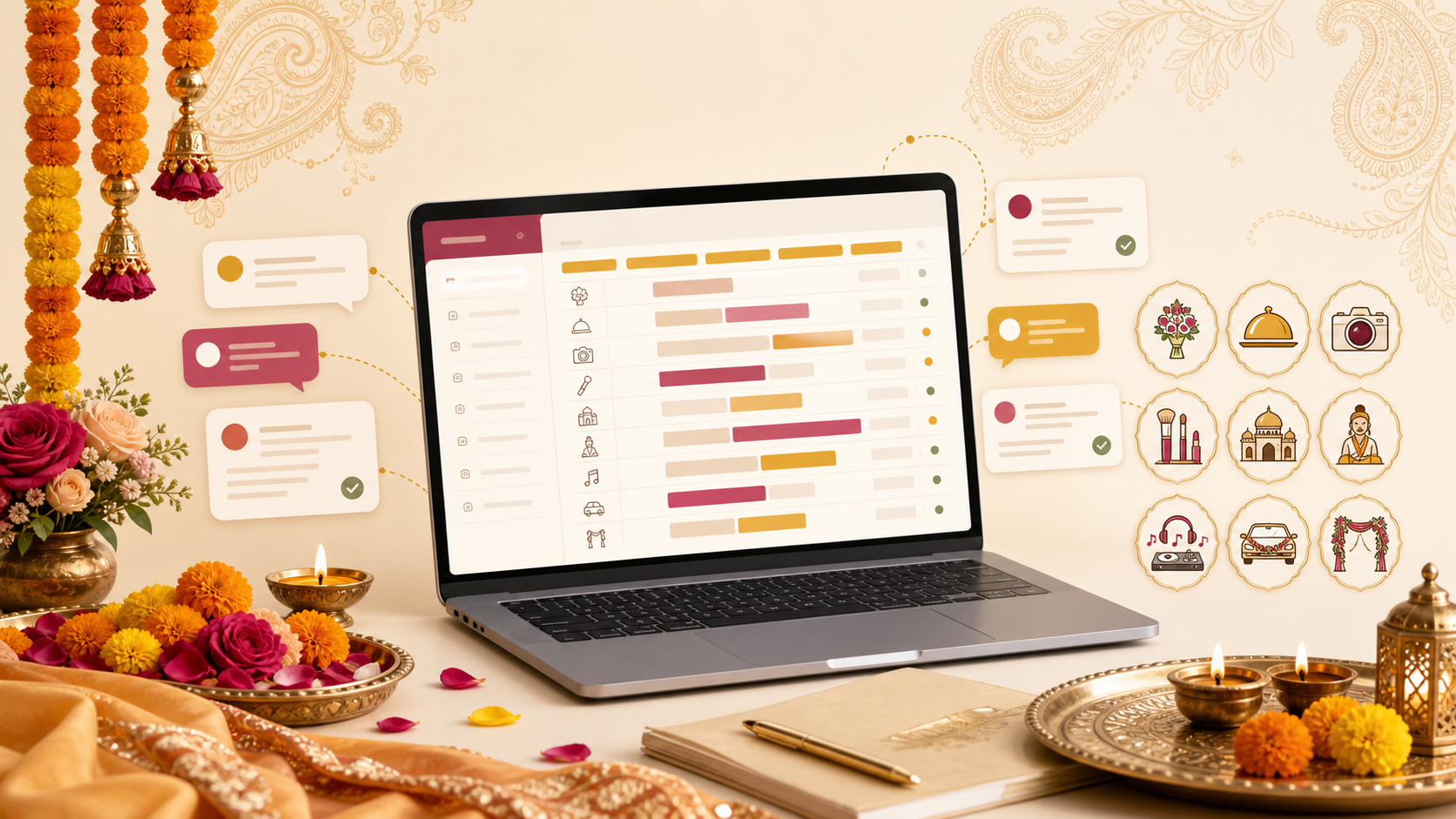
The painful version of wedding vendor management is not dramatic. It is 11:40 PM, two days before the mehendi, and the decorator, caterer, photographer, priest, transport captain, and bride's cousin are all messaging different people with different versions of the same schedule.
The outcome you want is simpler: every vendor knows where to be, when to arrive, who owns the decision, what has changed, and what not to bother the couple about. This checklist gives Indian wedding planners a production-ready communication system for getting there. For the full planning sequence around it, keep the wedding planner checklist open while you lock vendors, guests, payments, and production-week tasks.
What are the best tools for wedding planners?
The best tools for wedding planners are the ones that make confirmed information hard to lose: a CRM or vendor database, a master timeline, a budget tracker, WhatsApp Business, a shared file hub, and a guest FAQ system. If a tool does not reduce repeat questions or decision confusion, it is probably decoration.
Here is the fast decision rule:
| Job | Minimum tool | Upgrade when | | --- | --- | --- | | Vendor database | Google Sheet or Airtable | You handle 15+ weddings per year | | Master run sheet | Google Sheets | Multiple planners need role-based views | | Vendor communication | WhatsApp Business labels | You need templates, broadcasts, and saved replies | | Contracts and briefs | Google Drive folders | Clients need a polished portal | | Guest questions | Wedding FAQ link | Guest list crosses 200 or events cross 3 days | | Escalation | One phone tree | Destination or NRI weddings add time-zone risk |
Tools for wedding planners are workflow tools, not status symbols. A clean Google Sheet used by every vendor beats a premium CRM that only the founder understands.
What is wedding vendor management?
Wedding vendor management is the process of selecting, briefing, confirming, coordinating, and closing out every external supplier involved in a wedding, from the venue and caterer to the priest, makeup artist, photographer, decorator, transport team, sound vendor, and hospitality desk.
In Indian weddings, vendor management is harder than in single-event weddings because one vendor's delay breaks five other teams. If the decorator misses the haldi setup window, the photographer loses light, the caterer waits on service, the priest's ritual timing shifts, and the family WhatsApp group explodes.
The planner's job is not to remember everything. The planner's job is to design a communication system that remembers for them.
Start that system with a role-specific wedding vendor brief template so every supplier receives the same control fields without being buried in irrelevant project notes.
Before you start sending confirmation waves, build a private wedding vendor contact list with the decision-maker, on-site lead, backup number, arrival time, setup-complete time, payment status, and escalation owner for every critical vendor.
What should your vendor communication checklist include?
A useful wedding vendor communication checklist answers one question: "Can this vendor execute without calling the couple?" If the answer is no, the checklist is incomplete.
For every vendor, confirm these fields:
- Vendor owner: one senior contact with authority, not a general office number.
- Assistant contact: the person who will actually be on-site.
- Scope: exact deliverables, quantities, event names, and exclusions.
- Arrival time: separate load-in, setup-complete, and guest-ready times.
- Venue access: gate, lift, loading dock, parking, and security rules.
- Power and space needs: sockets, generator backup, table sizes, green rooms.
- Payment status: paid, balance due, who will release balance, and when.
- Dependencies: what this vendor needs from another vendor before starting.
- Escalation rule: who to call if the answer is urgent after midnight.
- Final confirmation timestamp: when the vendor last acknowledged the plan.
The final timestamp matters. "Shared in group" is not confirmation. "Acknowledged by Rohit from Sound, May 28, 6:42 PM" is confirmation.
For the food side specifically, use the Indian wedding catering checklist to separate guest counts, Jain meals, bar rules, staff meals, and service timing before the caterer gets folded into the master run sheet.
When should planners message vendors before the wedding?
Vendor communication should happen in four planned waves: 30 days, 14 days, 7 days, and 48 hours before the first event. Each wave has a different job. Repeating the same generic "please confirm" message four times is how details still get missed.
30 days out: lock scope
This is where you stop scope creep.
Send each vendor a one-page brief with event dates, venues, deliverables, quantities, and exclusions. Ask them to confirm the exact scope in writing. This is also the moment to catch mismatches like "decor quote includes stage flowers, not entry arch" or "photography team is 2 shooters, not 4."
14 days out: lock logistics
This is the load-in and access check.
Confirm arrival gates, vehicle permits, parking, setup areas, room numbers, elevators, backup power, and security contact. For destination weddings, add hotel rooming, staff meals, airport transfers, and local vendor passes.
7 days out: lock staffing
This is where many weddings quietly break.
Ask for the names and phone numbers of the people actually coming on-site. The founder you sold to may not be the person running the event. Build a vendor roster with senior owner, on-site lead, assistant lead, and emergency contact.
48 hours out: lock arrival and escalation
This is the final operational check.
Send a short message with event-by-event arrival time, setup-complete time, venue pin, on-site planner number, and escalation rule. Ask for a clear "confirmed" reply. Screenshot or save the reply in the vendor folder.
How do you write vendor messages that get answered?
The best vendor messages are short, numbered, and impossible to misunderstand. Long emotional messages get ignored. Voice notes create ambiguity. Screenshots get lost.
Use this format:
Hi [Name], final confirmation for [Event] on [Date]. Please confirm:
- Arrival at venue: [time]
- Setup complete by: [time]
- On-site lead: [name + phone]
- Deliverables: [exact scope]
- Balance payment: [amount/status]
- Escalation after arrival: call [planner name + phone]
Do not ask five vendors five different versions of the same thing. Templates make you faster, and they make vendor replies easier to audit.
Which vendor details should go into the master run sheet?
The master run sheet should include only facts that affect execution. It is not a scrapbook, not a mood board, and not a dumping ground for every client note.
Include these columns:
| Column | Why it matters | | --- | --- | | Event | Haldi, mehendi, sangeet, wedding, reception | | Vendor | Company and category | | Owner | The person accountable | | On-site lead | The person physically present | | Load-in | When the vendor can enter | | Setup complete | When the area must be guest-ready | | Dependency | What must happen first | | Payment note | Whether balance can block execution | | Escalation | Who makes the decision if there is conflict |
For a deeper end-to-end operating model, pair this with the Indian wedding planner workflow. The client-side facts should come from a clean wedding planner questionnaire, decisions should be reported through a weekly client update template, and vendor-side confirmations should move into the wedding day timeline template so the production team is not working from scattered vendor chats. If you are still picking software, read the wedding coordinator tools comparison.
Keep the guest-facing version separate. A wedding itinerary template for guests should show arrival time, venue pin, dress code, food, and transport, while this vendor sheet keeps load-in, setup, dependencies, and escalation details private.
How does guest communication affect vendor management?
Guest communication affects vendor management because it steals the planner's attention during the exact week vendors need disciplined coordination. If the planner is answering "what time is the sangeet" 80 times, vendor confirmations become sloppy.
This is the hidden failure mode in Indian weddings. The planner builds a perfect vendor sheet, then production week becomes guest support:
- "Where do I park?"
- "Is the haldi at the hotel or farmhouse?"
- "Can I wear black to the reception?"
- "What time does the bus leave?"
- "Is Jain food available?"
Those questions are valid. They just should not go to the person handling decorator load-in and caterer timing.
That is where Mandap Chat for wedding planners fits. Upload the schedule, venue details, dress codes, transport plan, dietary notes, and FAQs once. Guests ask the AI concierge in their own words, while the planner keeps production week focused on vendors.
What can go wrong if vendor communication is informal?
Informal vendor communication feels faster until the first conflict. Then nobody knows which message was final.
The common failure modes:
- Two schedules: family has one timeline, vendors have another.
- Founder gap: the vendor founder promised one thing, the on-site team heard another.
- Payment surprise: balance payment becomes a setup blocker on event day.
- Venue access mismatch: trucks arrive at the wrong gate or during a blocked window.
- Dependency miss: sound arrives after choreography rehearsal, or decor finishes after photo call.
- Guest noise: planner misses vendor calls while answering guest questions.
The fix is not more meetings. The fix is one written source of truth and scheduled confirmation waves.
The 20-minute planner checklist
If you are already in production week, do this today:
- Make one vendor roster with owner, on-site lead, assistant, and emergency contact.
- Put every vendor's arrival time and setup-complete time into one run sheet.
- Mark every dependency in plain English: "decor before photo", "sound before rehearsal", "transport before baraat".
- Send the 48-hour confirmation template to every vendor.
- Assign the wedding emergency kit, document pouch, and guest comfort pouch to named owners.
- Move guest FAQs to a link, wedding website, or AI wedding concierge.
- Assign one planner phone for vendors and one family phone for guests.
- Save every vendor's "confirmed" reply in the wedding folder.
That last split is the real leverage. Vendors need a calm command center. Guests need instant answers. Trying to run both from the same WhatsApp inbox is how good planners become unavailable exactly when they are needed.
FAQ
What are the most important tools for wedding planners?
The most important tools for wedding planners are a vendor CRM, shared timeline, budget tracker, WhatsApp Business, contract file hub, and guest FAQ system. Start with simple tools the whole team will actually use, then upgrade only when volume demands it.
How should wedding planners manage vendor communication?
Use one written brief per vendor, one master run sheet for the full vendor team, and one escalation channel for urgent decisions. Every major vendor should confirm scope, arrival, on-site lead, payment status, and dependencies in writing.
What should be in a wedding vendor communication checklist?
Include vendor owner, assistant contact, scope, arrival time, setup-complete time, venue access, power needs, payment status, dependencies, staff meal needs, escalation contact, and final confirmation timestamp.
When should vendor confirmations happen?
Run confirmations 30 days, 14 days, 7 days, and 48 hours before the first event. Each checkpoint should confirm a different layer: scope, logistics, staffing, then arrival and escalation.
Can an AI wedding concierge help planners with vendors?
It helps indirectly by removing guest FAQs from the planner's phone. The AI concierge answers guest questions about schedule, dress code, venues, transport, and food so the planner can focus on vendor execution.
Frequently asked questions
What are the most important tools for wedding planners?+
How should wedding planners manage vendor communication?+
What should be in a wedding vendor communication checklist?+
When should vendor confirmations happen before an Indian wedding?+
Can an AI wedding concierge help planners with vendors?+
Continue the series
A wedding planner escalation matrix assigns each type of problem a severity, response time, first owner, final decision owner, and communication route before the wedding begins.
Wedding planner quality control is a separate verification pass that checks whether approved details match across contracts, run sheets, vendor briefs, venue plans, and guest communication before execution begins.
An NRI wedding budget in India should be built in INR around guest count, city, event count, room nights, and production complexity—then protected with separate currency and contingency buffers.
Wedding plus-one wording should state exactly who is invited, where the guest adds their companion's name, and whether the rule applies to every function. Clear language feels kinder than a vague invitation followed by an awkward refusal.
Wedding vendor meals keep photographers, planners, drivers, decor, sound, and hospitality teams working through long Indian wedding functions. Count crew by event, confirm dietary needs, schedule service before the guest rush, and give one caterer captain the final list.