
Wedding Planner Client Update Template for Indian Weddings
A weekly client update template Indian wedding planners can use to keep families aligned on decisions, risks, vendors, guest communication, and next steps.
A wedding planner client update should tell the couple what changed, what needs approval, what is blocked, which risks need attention, and what happens next. For Indian weddings, the update also needs family-side owners, event-wise guest impact, vendor payment status, and guest communication notes.
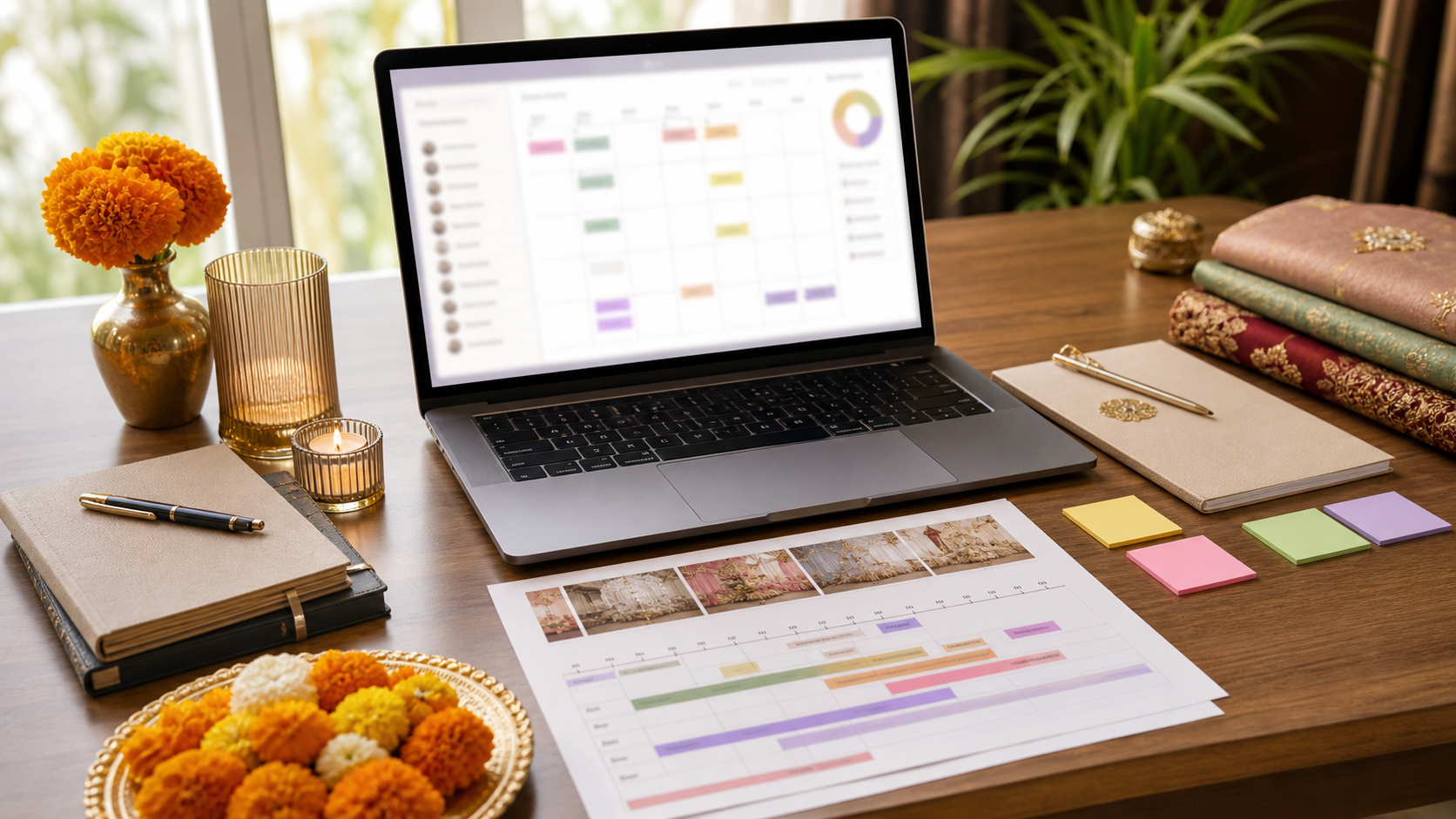
The fastest way to lose client trust is not a bad vendor quote. It is silence.
Indian wedding families can tolerate complexity when they can see the plan moving. What makes them anxious is the feeling that decisions, advances, guest questions, and vendor promises are floating inside private WhatsApp chats. A good client update turns that mess into one calm operating note: what moved, what needs approval, what is at risk, and what happens next.
Use this wedding planner client update template as your weekly note for Indian weddings. It is built for multiple events, two family sides, vendor dependencies, payment deadlines, and guest communication chaos.
What should a wedding planner client update include?
A wedding planner client update should include five things: completed work, decisions needed, open risks, guest impact, and next steps. For Indian weddings, it should also show the family-side owner for each approval because the couple, parents, siblings, and hosts may control different decisions.
Here is the simple rule: if a decision can change money, timing, guest experience, or vendor scope, it belongs in the update. If it is just background activity, summarise it in one line and move on.
What is a wedding planner client update?
A wedding planner client update is a recurring status note that keeps the couple and family decision makers aligned on planning progress, approvals, risks, vendor status, and guest communication. It is not a dump of every task the planner completed.
For Indian weddings, the update has a second job: it prevents family-side confusion. The bride may approve decor, the groom's father may approve payments, the mother may approve food, and an NRI sibling may own guest travel. If the update does not name the owner, the planner will keep re-asking the same questions in different chats.
The fast decision rule
Use this format when you have less than 15 minutes:
| Section | Include | Skip | | --- | --- | --- | | Done | Work completed since last update | Internal planner admin | | Needs approval | Decisions blocking progress | Nice-to-have opinions | | Risks | Anything that can affect budget, time, guests, or vendor scope | Mild preferences | | Guest impact | Changes guests need to know | Private vendor negotiation detail | | Next steps | What happens before the next update | Long task lists with no owner |
If the family reads only the first screen, they should still know exactly where the wedding stands.
Weekly client update template
Copy this structure into email, WhatsApp, Notion, or your client portal.
Subject line
Wedding update: [Couple names] | [Event dates] | Week of [date]
For WhatsApp:
Weekly wedding update: 5 decisions, 2 risks, next steps for this week
Opening summary
Use three bullets. No essay.
This week we locked the mehendi decor direction, shortlisted two photographers, and updated the rooming list. The main decision needed is the sangeet dinner menu by Friday. The only current risk is airport pickup timing for outstation guests arriving after 11 PM.
Done this week
Group completed work by planning area:
- Vendors: Photographer shortlist reduced from five to two options. Decorator revised the mehendi quote with the lower floral ceiling.
- Guest logistics: Rooming list updated for 42 outstation guests. Elderly guest support marked for six rooms.
- Events: Haldi timing moved from 10:30 AM to 9:30 AM after priest confirmation.
- Budget: Catering estimate updated after adding late-night snacks for sangeet.
- Guest communication: Drafted new FAQ answers for dress code, kids policy, airport pickup, and alcohol rules.
This section proves momentum. Keep it factual and short.
Decisions needed
This is the section clients actually need.
| Decision | Owner | Needed by | Why it matters | | --- | --- | --- | --- | | Final sangeet menu | Bride's parents | Friday | Caterer needs the count before tasting changes | | Airport pickup cutoff | Groom's sibling | Saturday | Transport team must size late-night cars | | Mehendi seating style | Couple | Monday | Decor layout cannot close without it | | Alcohol service for reception | Both families | Tuesday | Bar vendor quote and guest FAQ depend on it |
Never write "please advise" and leave it there. Name the decision, owner, deadline, and consequence.
Risks and blockers
Indian wedding planning fails quietly before it fails loudly. Call out the small risks early.
Use this wording:
- Risk: Reception guest count is still moving after the seating chart draft.
- Impact: Catering, chair count, table layout, and invitation follow-ups may need rework.
- Recommended action: Freeze the family add-on list by Thursday evening.
Good risk updates do not sound dramatic. They sound useful.
Budget and payment movement
Do not paste the whole budget sheet into the update. Tell the family what changed.
- Decor estimate reduced by 8% after removing the second floral arch.
- Photographer advance due on 28 June.
- Caterer tasting cost will be adjusted against the final invoice if the vendor is confirmed.
- Transport estimate may increase if airport pickups extend past midnight.
Link to the live budget sheet separately if the client wants detail.
Vendor status
Use a quick status table:
| Vendor | Status | Next action | | --- | --- | --- | | Decor | Revised quote received | Family approval | | Catering | Tasting scheduled | Menu freeze after tasting | | Photographer | Two finalists | Couple portfolio review | | Transport | Awaiting arrival list | Groom's sibling to update flights | | Priest | Muhurat confirmed | Add ceremony timing to run sheet |
If vendor details are still scattered, first build the wedding vendor contact list so every phone number, payment owner, escalation contact, and contract link is in one place.
Guest communication notes
This is where Indian weddings get expensive in time.
Write the guest-impact section in plain language:
- Guests should now be told that mehendi starts at 4 PM, not 5 PM.
- Dress code for sangeet is jewel tones; avoid black if the family prefers.
- Airport pickup is confirmed only for guests who submit arrival details by Sunday.
- Kids are welcome at reception, but not during the late-night after-party.
Then put approved answers into your wedding details card, WhatsApp broadcast, wedding website, or Mandap Chat. The goal is simple: guests should hear one approved answer everywhere.
How often should planners send updates?
Send updates weekly during active planning, twice a week in the final month, and daily during wedding week. The cadence should tighten as decisions become more expensive to change.
Use this schedule:
| Wedding stage | Update rhythm | Format | | --- | --- | --- | | 8-12 months out | Every 2 weeks | Email summary | | 3-8 months out | Weekly | Email plus tracker link | | Final month | Twice weekly | WhatsApp summary plus decision table | | Wedding week | Daily | Production note and next-day call sheet | | Event days | As needed | Vendor/team channels, not family spam |
For NRI-heavy weddings, send the update at a time that works for the paying decision makers, not just the local planner team.
What should the final-month update include?
The final-month update should focus on frozen details, not ideation. By then, the family needs certainty: final guest counts, rooming list, transport, vendor balances, run sheet, emergency owners, and guest FAQ answers.
Use this checklist in the final four weeks:
- Final event-wise guest count.
- RSVP exceptions and VIP additions.
- Room block and check-in list.
- Airport, station, and local transport plan.
- Event-wise dress code.
- Food restrictions and allergy notes.
- Vendor balance payments.
- Run sheet ownership.
- Rain or backup plan.
- Emergency family contacts.
- Guest FAQ answers.
This is also the right time to connect the update to the wedding day run sheet. The client update explains decisions; the run sheet tells vendors what to do minute by minute.
How do you stop scattered WhatsApp approvals?
Scattered WhatsApp approvals stop when there is one rhythm, one owner, and one decision log. Do not try to ban WhatsApp; Indian weddings run on it. Instead, make WhatsApp the notification layer and keep the approved source of truth elsewhere.
Use these rules:
- One weekly update thread for client decisions.
- One approval owner from each family side.
- One live decision log with date, decision, owner, and status.
- No vendor scope change is final until it appears in the decision log.
- Guest-facing answers move into the FAQ, website, or Mandap Chat after approval.
This keeps WhatsApp useful without letting it become the planning system.
Client update example for Indian weddings
Here is a complete short version you can reuse.
Weekly wedding update: Riya and Arjun
This week we confirmed the haldi timing, received the revised decor quote, and updated the outstation guest list. The key decisions needed are sangeet menu approval by Friday and airport pickup cutoff by Saturday. Current risk: reception guest count is still moving, so seating and catering cannot freeze yet.
Done: Decorator sent the revised mehendi and reception quote. Priest confirmed the wedding ceremony muhurat. Rooming list now includes 42 confirmed outstation guests. Photographer shortlist is down to two teams.
Decisions needed: Bride's parents to approve sangeet menu by Friday. Groom's sibling to confirm airport pickup cutoff by Saturday. Couple to approve mehendi seating layout by Monday.
Guest impact: Guests should be told mehendi starts at 4 PM. Airport pickup is confirmed only for guests who submit arrivals by Sunday. Dress code for sangeet is jewel tones.
Next steps: Once decisions are approved, we will update the guest FAQ, finalise vendor payment dates, and move confirmed timings into the run sheet.
Notice what this does not include: every internal task, every vendor negotiation, or every creative option. The update exists to create movement.
Where Mandap Chat fits
Mandap Chat works best after your client update has approved facts. Upload the schedule, venue rules, hotel details, food notes, dress codes, transport instructions, RSVP rules, and family-approved FAQ answers. Guests can then ask questions in natural language instead of messaging the planner for the same details.
For planners, this changes the client update from a private status note into a guest communication engine. Once a detail is approved, it can become a guest answer. That means fewer repeat WhatsApps, fewer family-side contradictions, and a cleaner production week.
If you manage Indian weddings professionally, start with your planner workflow, run this client update every week, and use Mandap Chat for wedding planners when the approved answers are ready for guests.
FAQ
What should a wedding planner include in a client update?
Include completed work, decisions needed, risks or blockers, budget movement, vendor status, guest communication notes, and next steps. For Indian weddings, add the owner from each family side so approvals do not disappear into multiple WhatsApp chats.
How often should a wedding planner update clients?
Weekly is enough during normal planning, twice weekly is better in the final month, and daily production notes are useful during wedding week. Send fewer updates only when the wedding is genuinely quiet.
Should client updates be sent by email or WhatsApp?
Use both when needed. Email works for the full weekly record, while WhatsApp works for the short decision summary. The mistake is using WhatsApp as the only source of truth.
How do client updates improve guest communication?
Client updates turn scattered planning facts into approved answers. Once the family confirms timings, dress codes, transport rules, and food notes, those answers can go into the wedding website, details card, WhatsApp broadcast, and Mandap Chat.
What is the biggest client update mistake?
The biggest mistake is reporting activity instead of decisions. "We spoke to vendors" is weak. "Decorator needs reception floral approval by Friday or the quote changes" is useful.
Frequently asked questions
What should a wedding planner include in a client update?+
How often should a wedding planner update clients?+
What is the best format for a wedding client update?+
How do planners stop clients from sending scattered WhatsApp messages?+
Can Mandap Chat use the client update to answer guest questions?+
Continue the series
An international wedding guest arrival plan should lock flight details, document reminders, airport pickup rules, hotel check-in, welcome desk ownership, and one guest question channel before the first overseas guest boards.
A wedding details card should give guests the few details they need before they ask: schedule, venue, dress code, RSVP, hotel, transport, food notes, and the best place to get updated answers. For Indian weddings, the smartest version is a short printed or digital card plus a live guest information hub.
A wedding vendor contact list should make the right person reachable in under 30 seconds. Use this Indian wedding template to track owners, on-site leads, assistants, arrival times, dependencies, payment blockers, and escalation rules.
A wedding emergency kit should solve small problems before they become production delays: outfit fixes, first aid, stains, phone charging, weather, hunger, printed documents, vendor handoffs, and guest comfort.
An NRI wedding guest travel form should collect only the details that prevent real day-of problems: passport-name, country, arrival flight, pickup need, hotel nights, visa or OCI status, diet, accessibility, children, language, and emergency contact.