
Wedding Details Card Template for Indian Weddings
A practical wedding details card template for Indian weddings, including what to include, what to move online, wording examples, QR code rules, and guest FAQ structure.
A wedding details card should give guests the few details they need before they ask: schedule, venue, dress code, RSVP, hotel, transport, food notes, and the best place to get updated answers. For Indian weddings, the smartest version is a short printed or digital card plus a live guest information hub.
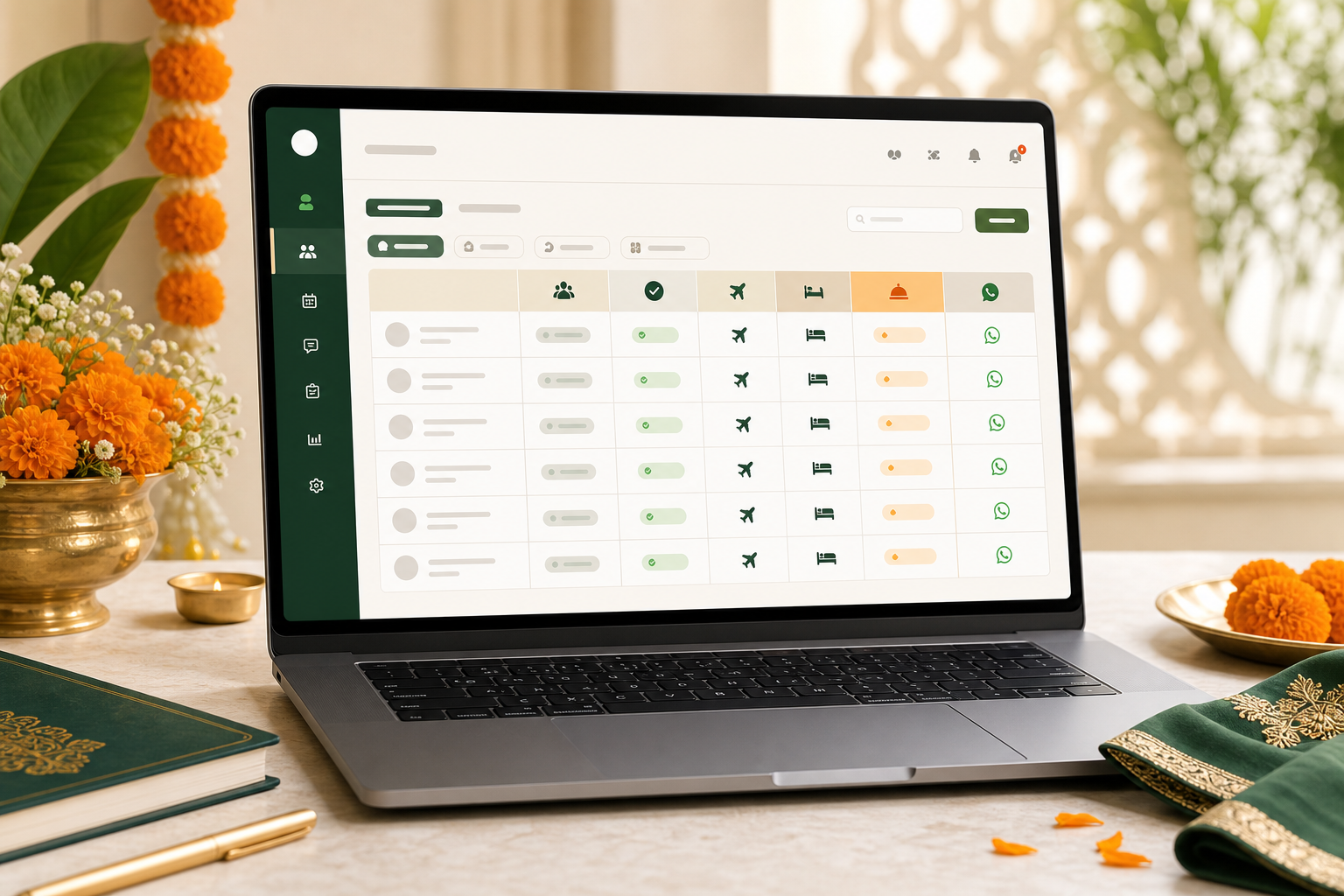
The painful version of a wedding details card is beautiful and useless. It has a floral border, the couple's hashtag, and a QR code nobody understands. Then guests still text the bride's sister asking, "Which hotel?", "What do I wear for haldi?", "Is transport arranged?", "Can I bring my child?", and "Where exactly is the pheras venue?"
The outcome you want is simple: one card that reduces questions instead of creating new ones. Guests should know what to do next, where to find current information, and whom to ask if they are stuck.
The fast rule: keep the wedding details card short, put changeable information behind a QR code, and make the QR destination useful enough that guests stop texting five different family members. For Indian weddings, that usually means a printed or digital card connected to Mandap Chat, your itinerary, RSVP form, hotel notes, and transport plan.
If the same information lives on your wedding website, start with a clear wedding website welcome message and then link to this card-style detail page from the first screen. Guests should not have to guess whether the card, website, or WhatsApp screenshot is current.
Use the same QR destination on printed signage too. A wedding welcome sign should point guests to the same live itinerary, dress-code note, transport update, and guest-help path as the details card.
What should a wedding details card include?
A wedding details card should include the practical information guests need after receiving the invitation: RSVP deadline, schedule summary, venue address or pin, dress code, hotel or travel note, transport instructions, food or dietary note, and the best place to get updated answers.
Use this as the minimum template:
| Card section | What to write | Keep on card or online? | | --- | --- | --- | | RSVP | "Please RSVP by [date] at [short link]" | Card | | Schedule | "Mehendi, sangeet, wedding, reception details online" | Summary on card, full version online | | Venue | Main venue name, city, QR to map | Card plus map link | | Dress code | One-line rule per major event | Card for key events, full guide online | | Hotel | Hotel block or rooming note | Online if details may change | | Transport | Shuttle or airport pickup note | Online | | Food | Jain, vegan, allergy, bar, kids meal note | Online | | Help path | Mandap Chat or planner desk link | Card |
A wedding details card is the guest-facing information insert that explains logistics, RSVP, schedule, venue, dress code, travel, and help instructions that do not fit cleanly on the formal wedding invitation.
The mistake is treating the details card like a second invitation. The invitation creates excitement. The details card removes friction.
What is the best wording for an Indian wedding details card?
The best wording is warm, specific, and action-oriented. It should tell guests exactly where to RSVP, where to find the latest schedule, and how to ask logistics questions without messaging the couple.
Use this base wording:
We cannot wait to celebrate with you. Please RSVP by [date] at [link]. For the latest schedule, venue pins, dress codes, hotel details, transport timing, and food notes, scan the QR code or visit [short URL]. If you have questions before or during the wedding, ask the wedding concierge there anytime.
For a destination wedding:
Please scan for the complete wedding itinerary, hotel block, airport transfer details, packing notes, dress codes, and local help contacts. Because travel details may change, the online guide will always have the latest information.
For an NRI-heavy wedding:
International guests can find the itinerary, hotel information, airport arrival guidance, local transport, dress notes, SIM and currency tips, and family help contacts at [link].
For a planner-managed wedding:
For schedule, venue, dress code, transport, hotel, and RSVP questions, please use [link]. This keeps every guest on the latest version and helps the planning team respond faster.
If the card creates more than one next action, it is too busy. The best card says: RSVP here, details here, questions here.
Should the card include every Indian wedding function?
Do not print every function detail unless the schedule is locked and every guest is invited to the same events. Indian weddings often have event-specific invitations, family-only rituals, shifting venue rooms, and late transport changes, so the full schedule is usually safer online.
Use this decision table:
| Wedding type | What to put on the card | What to keep online | | --- | --- | --- | | Single-day local wedding | Ceremony and reception time, venue, RSVP | Map, parking, food notes | | Multi-day Indian wedding | Date range and key event names | Full event-by-event itinerary | | Destination wedding | City, hotel, arrival window, QR code | Shuttle, rooming, packing, weather | | NRI-heavy wedding | Date range, city, visa/travel note | Travel checklist, airport help, local guide | | Planner-run wedding | Short URL and concierge link | Full live guest guide |
The safest wording is:
Full event schedule and guest details are available at [link]. Please check the online guide before traveling because timing, rooms, and transport notes may be updated.
That line prevents a common failure mode: a guest screenshots an early card, misses an updated pickup time, and then blames the family because the printed insert looked final.
Use the wedding itinerary template for Indian wedding guests for the full schedule layer. The details card should point to that itinerary, not try to replace it.
What details should stay off the printed card?
Keep anything private, unstable, or too detailed off the printed card. Printed and forwarded cards travel far beyond the original guest list, especially in family WhatsApp groups.
Do not print:
- Private family phone numbers.
- Vendor contact numbers.
- Rooming list details.
- Pickup driver numbers for individual guests.
- Payment instructions.
- Full guest list or event access rules.
- Sensitive health, accessibility, or dietary notes.
- Any schedule that is likely to change.
Put those details behind a guest-specific form, planner-managed sheet, or AI concierge answer. A public card can say "transport details online." It should not expose the transport captain's personal number to 500 guests.
For private operational contacts, use the wedding vendor contact list template. For guest-facing help, keep the card clean and route guests to Mandap Chat or a help desk.
How should you use a QR code on a wedding details card?
Use a QR code only when it opens a mobile-friendly page that answers real guest questions. A QR code that opens a generic homepage or a PDF with outdated information is just decoration.
Follow this checklist:
- Put a short typed URL under the QR code.
- Test the code on iPhone and Android before printing.
- Send the QR destination in WhatsApp too, because guests forward messages more than they scan paper.
- Make the page load quickly on hotel Wi-Fi and mobile data.
- Put the latest update date near the top.
- Keep RSVP, schedule, venue, hotel, transport, and dress code easy to find.
- Give guests one question path, not five phone numbers.
WhatsApp's help center says labels can help organize and quickly find chats (WhatsApp Help Center). That can help a planner sort guest questions, but it does not solve the bigger problem: guests still need a reliable place to find answers before they message anyone.
The QR code should open that answer place.
What should the online guest information page answer?
The online page should answer the questions guests ask before they RSVP, travel, dress, arrive, eat, and leave. The printed card is the doorway. The online page is the actual help desk.
Build the page around these questions:
| Guest question | Answer to provide | | --- | --- | | Which events am I invited to? | Event access rules or personalized RSVP | | Where is the venue? | Address, map pin, entry gate, parking | | What should I wear? | Event-wise dress code and footwear note | | Where should I stay? | Hotel block, rooming process, booking deadline | | Is transport arranged? | Airport pickup, shuttle timing, pickup points | | What food will be available? | Veg, Jain, halal, vegan, allergy process | | Can I bring kids? | Event-wise kids policy | | Who do I contact? | Help desk, planner desk, or Mandap Chat link |
Google has described Maps lists as a way to create lists of places and share them with friends and family (Google Maps blog). For wedding guests, a shared map can be useful for venues, hotels, brunch spots, salons, pharmacies, and emergency stores. But the map should support the guest guide, not become the entire guide. If the venue has multiple gates, lawns, lobbies, or shuttle pickup points, create a dedicated wedding directions card instead of relying on one generic venue pin.
How do you connect the details card to RSVP reminders?
Connect the details card to RSVP reminders by using the same link everywhere. If the invitation card, WhatsApp reminder, website, and planner messages all point to different places, guests will reply in different places and the data will break.
Use this workflow:
- Put the RSVP link and Mandap Chat link on the details card.
- Send the same links in the first WhatsApp invitation message.
- Add the links to every RSVP reminder.
- Tell guests where to ask questions before they mark yes or no.
- Update one guest list when replies come in.
This is where the wedding RSVP reminder message becomes more effective. Instead of saying "please RSVP soon," the reminder can say:
Please RSVP by [date]. If you need schedule, hotel, transport, dress code, or food details before confirming, ask here: [Mandap Chat link].
That removes the blocker behind many delayed RSVPs. The guest is not ignoring you. They often just need one answer before committing.
What is the best format for a wedding guest information card?
The best format is a simple one-page card, printed or digital, with one QR code, one short URL, one RSVP deadline, and one help path. For Indian weddings, avoid crowding the card with every ceremony, dress note, hotel clause, and pickup instruction.
Use this layout:
| Area | Content | | --- | --- | | Header | "Wedding Details" or "Guest Information" | | First line | Couple names and wedding date range | | Action line | RSVP by [date] at [link] | | QR block | "Scan for schedule, venue, hotel, transport, dress code, and FAQs" | | Short URL | Typed URL below QR | | Help line | "Questions? Ask the wedding concierge at the same link" | | Tiny note | "Please check before traveling for latest updates" |
Do not use tiny type for the most important information. If elders, international guests, or non-technical guests are coming, readability beats aesthetic minimalism.
How does Mandap Chat make the card more useful?
Mandap Chat makes the wedding details card more useful by turning a static insert into a live guest concierge. Guests scan the card, then ask plain-language questions about schedule, venue, dress code, hotel, transport, food, kids policy, weather, gifts, and help desk instructions.
That matters because the card will never hold every answer. A multi-day Indian wedding may have five functions, three venues, hotel blocks, room-sharing rules, airport pickups, ceremony explanations, dress expectations, and family-side exceptions.
With Mandap Chat, the card can stay clean:
- "Scan for full details."
- "Ask the wedding concierge anytime."
- "Check before traveling for latest updates."
Behind that, the family or planner can upload the itinerary, FAQ, hotel notes, transport plan, guest policies, and event-wise wedding dress code wording once. Guests get consistent answers. The couple gets fewer repeated messages. The planner gets fewer avoidable escalations.
For destination weddings, connect the card to the destination wedding room block guide and the NRI wedding guest travel form. For local weddings, connect it to the guest list and RSVP flow.
The 15-minute setup checklist
If invitations are going out soon, build the practical version first.
- Pick one URL for guest details.
- Add RSVP deadline and RSVP link.
- Add the venue name, city, and map pin.
- Add a short schedule summary.
- Add dress code notes for the most confusing events.
- Add hotel and transport sections online.
- Add food, kids, and accessibility answers online.
- Add Mandap Chat as the question path.
- Put one QR code and one short URL on the card.
- Test the card with one elder, one friend, one NRI guest, and one planner.
The goal is not to design the prettiest insert. The goal is to stop the same ten questions from hitting the family WhatsApp group for the next six weeks.
FAQ
What should a wedding details card include?
A wedding details card should include the RSVP deadline, RSVP link, venue address or map pin, schedule summary, dress code, hotel or travel note, transport instructions, food or dietary note, and one place for questions.
What is the difference between a wedding invitation and a details card?
The invitation announces the wedding. The details card explains how guests should attend it. Put family names, couple names, date, and ceremony invitation on the invite. Put RSVP, schedule, venue, hotel, transport, dress code, and guest help information on the details card.
Should Indian wedding details cards list every function?
Only list every function if all guests are invited to every function and the schedule is final. Otherwise, print a short summary and send guests to a live itinerary where event access, timing, venue rooms, and transport can stay current.
Should a wedding details card have a QR code?
Yes, but only if the QR code opens a useful mobile page. Add the short URL below the QR code so guests can type it, forward it, or open it from WhatsApp without scanning.
How does Mandap Chat help with wedding details cards?
Mandap Chat gives the card a live answer layer. Guests can ask about schedule, venue, dress code, hotel, transport, food, kids policy, weather, and help instructions without texting the couple or planner for every small question.
Once the card content is approved, place it inside a 30-day wedding guest communication plan so guests receive each travel, itinerary, venue, and transport detail when they can act on it.
Frequently asked questions
What should a wedding details card include?+
What is the difference between a wedding invitation and a details card?+
Should Indian wedding details cards list every function?+
Should a wedding details card have a QR code?+
How does Mandap Chat help with wedding details cards?+
Continue the series
A wedding planner escalation matrix assigns each type of problem a severity, response time, first owner, final decision owner, and communication route before the wedding begins.
Wedding planner quality control is a separate verification pass that checks whether approved details match across contracts, run sheets, vendor briefs, venue plans, and guest communication before execution begins.
An NRI wedding budget in India should be built in INR around guest count, city, event count, room nights, and production complexity—then protected with separate currency and contingency buffers.
Wedding plus-one wording should state exactly who is invited, where the guest adds their companion's name, and whether the rule applies to every function. Clear language feels kinder than a vague invitation followed by an awkward refusal.
Wedding vendor meals keep photographers, planners, drivers, decor, sound, and hospitality teams working through long Indian wedding functions. Count crew by event, confirm dietary needs, schedule service before the guest rush, and give one caterer captain the final list.