
Wedding Hotel Block for Indian Destination Weddings: The Rooming List Playbook
A practical wedding hotel block guide for Indian destination weddings: room counts, booking deadlines, contract questions, rooming lists, guest messages, and AI concierge setup.
For an Indian destination wedding, block rooms by guest type first, negotiate the rate and deadline second, and publish one clear accommodation plan so guests stop asking the family for hotel codes, check-in rules, and shuttle details.
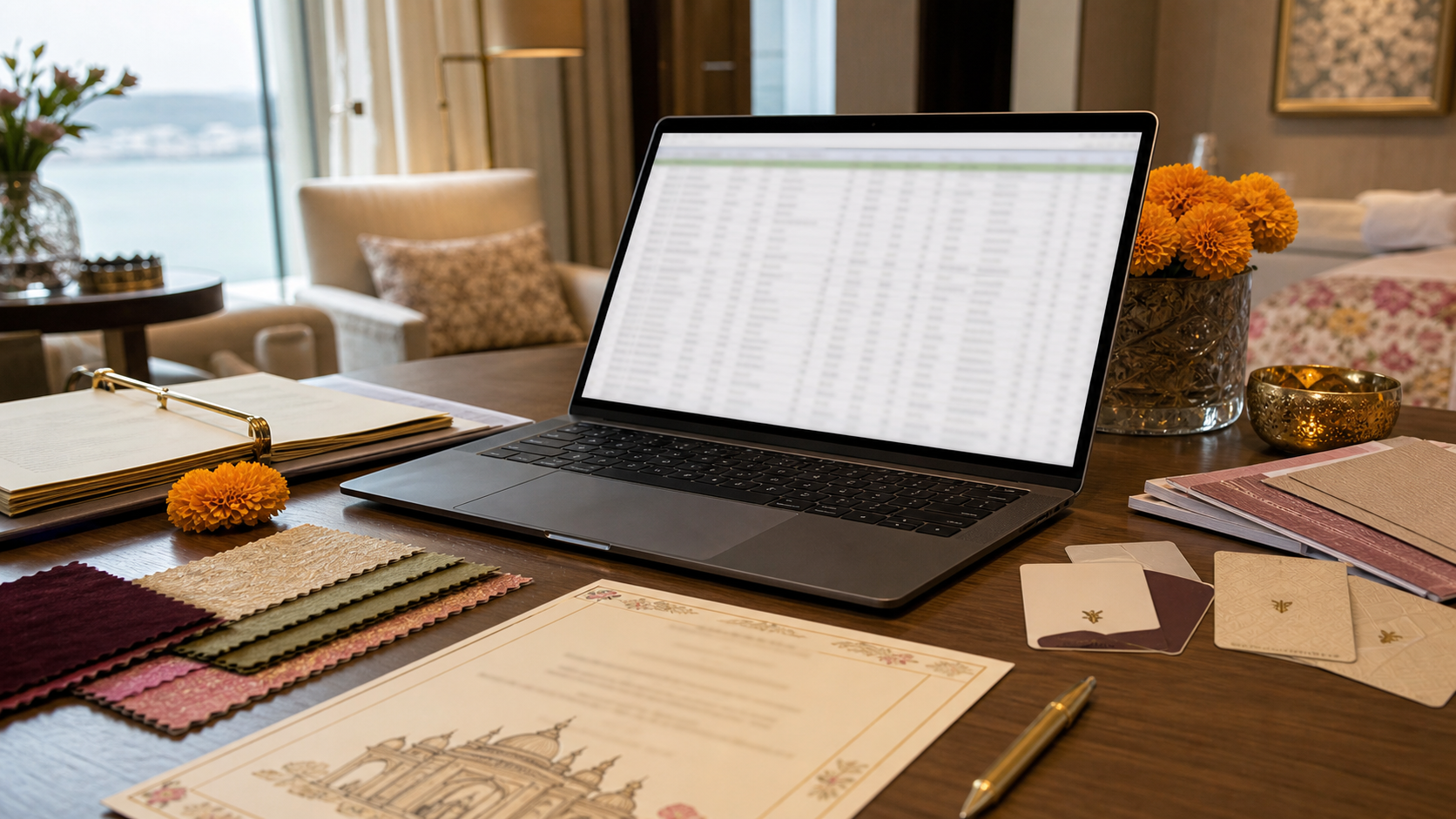
A destination wedding hotel block looks simple until 180 relatives start asking the same six questions: "Which hotel?", "What is the code?", "Is breakfast included?", "Can I share with my cousin?", "Who is paying?", and "Where does the shuttle leave from?"
The fast rule: treat accommodation like a guest-support system, not a hotel discount. Decide who stays where, what each guest pays, when bookings close, and how shuttle movement works. Then publish one answer source through your wedding website and Mandap Chat for destination weddings so the family is not forwarding hotel PDFs for three months.
If the room block is also driving your total spend, build it inside the destination wedding budget breakdown so room nights, breakfast, early check-in, shuttle pickups, and extra-night rules are priced before guests start booking.
Once the room block is stable, turn those hotel and shuttle details into a wedding weekend itinerary template for destination weddings. Guests should see the same check-in, breakfast, pickup point, and checkout rules in the itinerary that the hotel desk is using.
If the wedding uses multiple hotels, add a separate wedding shuttle schedule before the room block message goes out. Guests need to know which lobby they use, whether the backup hotel has its own vehicle, and what happens after late-night events.
What is a wedding hotel block?
A wedding hotel block is a reserved set of rooms that a hotel holds for your wedding guests at a negotiated rate until a deadline. For Indian destination weddings, the room block also becomes the base for check-in planning, welcome bags, breakfast counts, airport transfers, and venue shuttles.
The mistake is thinking a hotel block is only about price. Price matters, but the real value is predictability. If you know which guests are in which hotel, you can plan transport, elder assistance, meal counts, hospitality desks, and last-minute communication without guessing.
How many rooms should you block for an Indian destination wedding?
Block rooms by guest type, not by total invite count. A 400-person invitation list does not mean 200 rooms. Start with the guests who are actually travelling, split them by family priority and budget, then add a controlled buffer so the hotel block does not explode.
Use this room-count model:
| Guest group | Rooming assumption | Notes | |---|---:|---| | Immediate family | 1 room per couple or elder | Keep them in the main hotel | | Wedding party | 1 room per 1 to 2 people | Often arrives 1 day early | | Outstation relatives | 1 room per 2 adults | Ask for kids/elder needs in RSVP | | Friends | 1 room per 2 to 3 adults | Many will share if told early | | Vendors staying overnight | 1 room per vendor lead/team | Confirm with planner, not guests | | Buffer | 10 to 15 percent | For late additions and room changes |
Example: if 250 guests are likely to travel, you may need 125 rooms if everyone pairs neatly. Real life is messier. Elderly relatives need separate rooms, cousins want triples, some guests bring kids, and close family may arrive early. A smarter first block is 125 to 145 rooms, not 180 "just in case."
What should you negotiate before signing the hotel block?
Negotiate the operational terms before you negotiate another Rs. 500 off the room rate. A cheap block with a bad cancellation deadline can cost more than a slightly higher rate with flexible release terms.
Ask the hotel these questions before locking the block:
- What room categories are included in the block?
- Is breakfast included for every blocked room?
- Can guests book directly with a code or link?
- What is the last date to book at the negotiated rate?
- What happens to unbooked rooms after the deadline?
- Can immediate family check in early?
- Can guests extend one night before or after at the same rate?
- Is there a cancellation penalty for the couple?
- Can the hotel share a weekly pickup report of booked rooms?
- Will the hotel provide a dedicated reservations contact?
- Where will shuttles pick up and drop off?
- Can welcome bags be placed in rooms before check-in?
For the broader logistics stack around venue, transport, costs, and guest communication, read the destination wedding India guide. This article goes deeper on the accommodation layer because that is where most week-of confusion starts.
Once the block is negotiated, move into the wedding guest accommodation rooming-list template. It covers the final spreadsheet fields, roommate rules, hotel handoff timing, shuttle mapping, and the guest-facing answers to upload into Mandap Chat.
What should the rooming list include?
A rooming list is the master spreadsheet that maps guests to rooms, arrival dates, payment responsibility, dietary flags, accessibility needs, and shuttle requirements. It is the accommodation control panel for the wedding.
Do not let the rooming list live only with the hotel. Keep your own version with the planner or family logistics lead. At minimum, track:
- Guest name and side of family.
- Mobile number and WhatsApp country code.
- Arrival date, arrival time, and airport or station.
- Checkout date.
- Hotel name and room category.
- Number of adults and children.
- Payment owner: couple, family, guest, or sponsor.
- Breakfast included or not.
- Early check-in or late checkout request.
- Accessibility notes.
- Shuttle pickup group.
- Welcome bag count.
- Status: invited, confirmed, booked, cancelled, changed.
The status column matters. Most accommodation chaos comes from treating "told them the hotel code" as the same thing as "room booked." Those are different states.
When should you send hotel block details to guests?
Send the first accommodation message 4 to 6 months before the wedding, then a deadline reminder 75 to 60 days before the first event, then a final logistics reminder 10 to 14 days before travel. Earlier messages get ignored; later messages create panic.
Use this cadence:
| Timing | What guests need | |---|---| | 6 months out | City, dates, main hotel name, rough room rate | | 4 months out | Booking link/code, deadline, payment rule | | 75 days out | Deadline reminder, budget backup, room-sharing note | | 30 days out | Confirmed hotel, airport transfer form, check-in rules | | 10 days out | Shuttle pickup, breakfast timing, day-of contact |
If you are also managing RSVPs, connect the accommodation plan to the RSVP flow. Guests often delay their RSVP until they know the hotel cost, room-sharing option, kids policy, and travel plan. The Indian RSVP problem is often an information problem disguised as a commitment problem.
What should the guest-facing hotel block message say?
Write the message like an operations note, not like a wedding invitation. Guests need facts they can act on from their phone.
Copy this structure:
We have blocked rooms at [Hotel Name] for [Wedding Dates].
Rate: Rs. [amount] per night for [room type], including [breakfast/taxes/details].
Book by: [date].
Booking link/code: [link/code].
Payment: Guests pay the hotel directly / family covers immediate family rooms / please confirm with [name].
Check-in: [time]. Checkout: [time].
Shuttle: Wedding shuttles leave from [hotel pickup point] for each event.
Questions: Ask Mandap Chat here: [link], or contact [name] for urgent room changes.
Then put the same details in three places: the wedding website, the WhatsApp reminder, and Mandap Chat. If the answer differs across channels, guests will trust the most recent WhatsApp forward, even if it is wrong. For the broader guest-facing answer set, fold the hotel details into a destination wedding FAQ for guests so room, shuttle, dress-code, food, and arrival questions all point to the same source.
Should you use one hotel or multiple hotels?
Use one main hotel when possible, but add a second option if the guest list has mixed budgets or the main hotel cannot hold everyone. Multiple hotels are fine only if transport and communication are clean.
| Setup | Best for | Watch out for | |---|---|---| | One main hotel | 80 to 180 guests, same budget tier | Rate may be too high for some guests | | Main hotel + budget hotel | Mixed family/friend budgets | Shuttle routes become more complex | | Venue resort only | Luxury or elder-heavy weddings | Room inventory may be limited | | Open accommodation | Small weddings under 80 guests | Harder to coordinate airport pickups and shuttles |
For Indian destination weddings, one main hotel plus one budget backup is usually the sweet spot. Keep elderly relatives, immediate family, and ritual-heavy guests in the main hotel. Put friends and flexible travellers in the backup only if the shuttle plan is genuinely reliable.
What should guests ask before booking wedding accommodation?
Guests should ask about payment, room sharing, check-in time, breakfast, cancellation, airport transfer, and whether shuttles leave from their hotel. Couples should answer these before guests ask.
The essential guest checklist:
- Is this the official wedding hotel block?
- What is the booking deadline?
- Is breakfast included?
- Are taxes included in the quoted rate?
- Can I share a room with another guest?
- Can I extend my stay before or after the wedding?
- Is airport pickup arranged?
- Do wedding shuttles leave from this hotel?
- Who do I call if the hotel cannot find my booking?
- Is the room paid by me, the couple, or the family?
This is the exact kind of checklist that belongs inside your AI wedding concierge for destination weddings. Guests will phrase the same question ten different ways. The AI should still return the same approved answer.
How does Mandap Chat handle room block questions?
Mandap Chat turns the hotel block into a searchable guest helpdesk. Upload the hotel contract, booking code, rates, reservation deadline, rooming list, shuttle schedule, airport transfer notes, and room-sharing rules. Guests ask naturally; Mandap Chat answers from your approved details.
Useful uploaded documents include:
- Hotel proposal or room-block contract.
- Guest rooming list.
- Airport pickup form.
- Shuttle schedule.
- Event itinerary.
- Check-in and checkout policy.
- Payment responsibility note.
- Budget hotel alternative.
- WhatsApp contact list for urgent issues.
Then test it before sharing. Ask:
- "How do I book my room?"
- "Is breakfast included?"
- "Can I stay one extra night?"
- "Where does the shuttle leave from?"
- "My parents need a wheelchair-accessible room. Who should I call?"
- "Can I share a room with my cousin?"
If Mandap Chat cannot answer those, your guests will call the family. Fix the source documents before launch.
The final hotel block checklist
Before you publish the accommodation plan, confirm:
- Main hotel, backup hotel, and room categories are final.
- Booking code or link works from a guest phone.
- Booking deadline is visible in every message.
- Payment responsibility is unambiguous.
- Cancellation policy is written in plain English.
- Weekly hotel pickup report is assigned to one person.
- Rooming list has arrival, checkout, dietary, and accessibility columns.
- Welcome bag delivery count is tied to occupied rooms, not the original invite list.
- Shuttle pickup point is tied to the hotel, not just the venue.
- Mandap Chat has the same information as the hotel email.
- One human coordinator owns urgent room changes.
A wedding hotel block is not just a cheaper room rate. It is the backbone of destination wedding hospitality. Get it right and guests feel looked after before they land. Get it wrong and your family becomes a reservations desk.
Once the room block is stable, use the destination wedding welcome bag checklist to decide what reaches each room at check-in: itinerary card, shuttle notes, QR code, snacks, and emergency contacts.
For the easiest path, upload the hotel details, rooming list, itinerary, and transport plan into Mandap Chat. Guests get one place to ask accommodation questions; the family gets its evenings back.
FAQs
How many hotel rooms should I block for an Indian destination wedding?
Start with one room for every 2 confirmed travelling adults, then add 10 to 15 percent buffer for late family changes, elderly guests who need separate rooms, and wedding-party members arriving early. For 250 travelling guests, a practical first block is usually 125 to 145 rooms across one main hotel and one budget backup.
When should guests book rooms for a destination wedding?
Send the room block details 4 to 6 months before the wedding and set the booking deadline 60 to 75 days before the first event. That gives guests enough time to arrange leave and flights while giving the hotel enough time to release unused rooms without punishing the couple.
What should a wedding hotel block message include?
Include the hotel name, address, room rate, what the rate includes, booking code or link, booking deadline, cancellation policy, check-in and checkout times, breakfast details, shuttle pickup plan, and one contact for room issues. Put the same details on the website and in Mandap Chat.
Should couples pay for guest accommodation at an Indian destination wedding?
There is no single rule. Many couples pay for immediate family and wedding-party rooms, negotiate discounted blocks for everyone else, and clearly say what guests should pay for themselves. The mistake is being vague; guests need to know the payment rule before booking.
How does Mandap Chat help with hotel room block questions?
Upload the hotel contract, room rates, booking code, rooming list, shuttle schedule, and check-in rules to Mandap Chat. Guests can ask "how do I book my room", "is breakfast included", or "can I extend my stay" and get the approved answer instantly.
Frequently asked questions
How many hotel rooms should I block for an Indian destination wedding?+
When should guests book rooms for a destination wedding?+
What should a wedding hotel block message include?+
Should couples pay for guest accommodation at an Indian destination wedding?+
How does Mandap Chat help with hotel room block questions?+
Continue the series
A wedding help desk gives guests one place to ask routine questions and gives the family one way to stop answering the same logistics all day. For Indian weddings, the best setup combines a staffed desk, a pinned WhatsApp message, and Mandap Chat as the live answer layer.
Wedding planner email templates work best when each message has one job: collect an approval, confirm a fact, answer a guest question, or escalate a blocker. For Indian weddings, planners should keep email as the written record and use WhatsApp or Mandap Chat to distribute approved answers.
NRI wedding WhatsApp group rules should define who can post, which group owns each topic, what gets pinned, when decisions expire, and where guests should ask routine questions.
A wedding day contact list is the command sheet that tells planners, families, venue teams, and hospitality desks who to call when something changes. Use this Indian wedding template to keep routine guest questions, vendor issues, family decisions, and real emergencies from landing on the couple.
Wedding planner software should not be one overloaded app. For Indian weddings, the strongest stack is a simple client workspace, a vendor CRM, a budget and payment tracker, a run sheet, a guest communication layer, and one AI concierge for repeat guest questions.