
Wedding Dress Code Wording for Indian Weddings: Copy-Paste Guest Templates
Clear wedding dress code wording for Indian weddings, including Haldi, Mehendi, Sangeet, cocktail, pheras, reception, destination wedding, and NRI guest templates.
Good wedding dress code wording tells guests what to wear, what to avoid, how formal the event is, and what practical detail matters most. For Indian weddings, write one specific sentence per function instead of using vague labels like festive, traditional, or Indian formal.
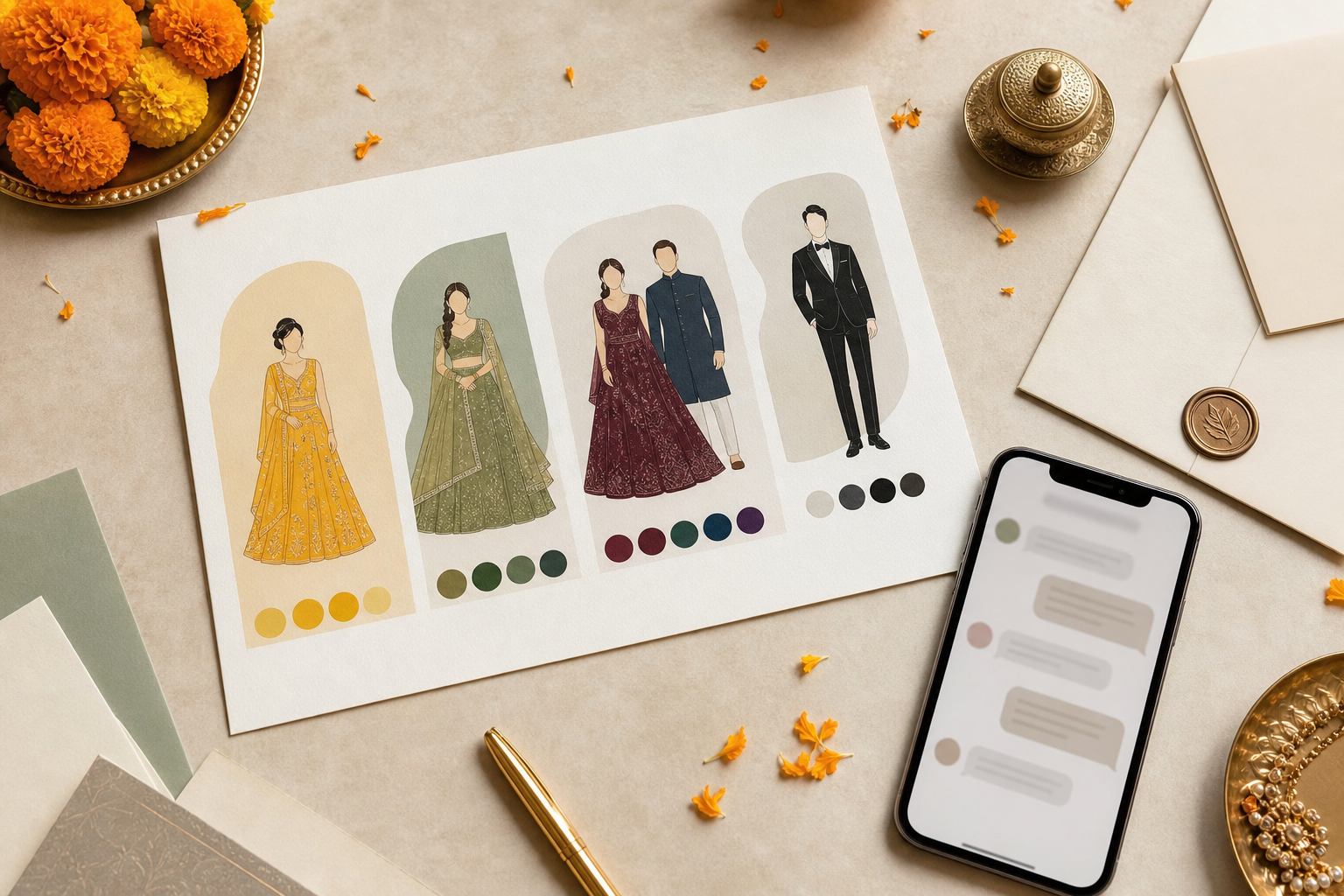
The dress code looks like a small line on the invitation until guests start messaging everyone: "What does festive Indian mean?", "Can I wear black?", "Is the Haldi messy?", "Do men need a sherwani?", "Can I wear heels on the lawn?"
Vague wedding dress code wording creates two problems. Guests feel underdressed or overdressed, and the couple spends the final month answering outfit questions instead of finishing the wedding. The fix is simple: write one clear sentence per event, with the formality, colors, outfit examples, and practical warning in the same place.
The fast rule: if a non-Indian friend, an NRI cousin, and a busy uncle can all understand the line without asking a follow-up, the wording works. If it says only "festive", "traditional", or "Indian formal", rewrite it.
If male guests need concrete outfit combinations rather than invitation copy, share the Indian wedding attire guide for men with them.
Repeat the same dress-code phrase on the wedding website, WhatsApp update, and welcome sign QR page. Guests trust the detail more when every touchpoint says the same thing.
What should wedding dress code wording include?
Wedding dress code wording should tell guests the event, the level of formality, the suggested outfit type, any color or fabric guidance, what to avoid, and the practical reason behind the instruction. For Indian weddings, the practical note often matters more than the style label.
Use this six-part formula:
- Event name: Haldi, Mehendi, Sangeet, pheras, cocktail, reception.
- Formality: casual, festive, semi-formal, formal, black tie, traditional.
- Outfit examples: lehenga, saree, kurta set, sherwani, suit, cocktail dress.
- Color note: yellow, pastels, jewel tones, ivory, no red, no black, no white.
- Comfort note: grass lawn, stairs, heat, temple seating, dancing, turmeric.
- Help path: link to the wedding website, details card, or Mandap Chat.
Wedding dress code wording is the short guest-facing instruction that explains what to wear to each wedding event, how formal it should be, and which practical constraints guests should know before choosing an outfit.
The best version is not fancy. It is specific.
Haldi: Wear yellow, white, or casual festive clothes you are comfortable getting turmeric on. Avoid delicate fabrics because Haldi can stain.
That one line prevents more guest confusion than "Haldi: traditional festive".
If your invitation suite already has too much information, put the full wording on a wedding details card and use a QR code or Mandap Chat link on the printed card.
How do you write an Indian wedding dress code?
Write an Indian wedding dress code as one clear line per function, not one generic rule for the whole wedding. Multi-day Indian weddings move from casual Haldi to dance-heavy Sangeet to ritual-heavy ceremony to formal reception, so guests need event-wise guidance.
Use this decision table:
| Event | Clear wording | Why it works | | --- | --- | --- | | Haldi | "Wear yellow, white, or casual festive clothes you are okay getting turmeric on." | Explains color and stain risk | | Mehendi | "Pastels, florals, or easy festive Indian outfits; keep hands and sleeves practical for mehendi." | Connects outfit to activity | | Sangeet | "Indo-western festive or cocktail Indian, jewel tones encouraged, comfortable shoes for dancing." | Clarifies formality and movement | | Pheras | "Traditional Indian formal; please avoid all-white and keep shoulders covered for the ceremony." | Handles cultural and ritual expectations | | Cocktail | "Cocktail Indian or western formal; suits, gowns, sarees, and statement lehengas all work." | Gives guests a range | | Reception | "Formal Indian or black-tie optional; dressy sarees, lehengas, bandhgalas, suits, and gowns welcome." | Raises formality without over-restricting | | Pool brunch | "Resort casual, light fabrics, flats or sandals; swimwear only if you plan to use the pool." | Prevents awkward over/under-dressing |
For a full multi-event schedule, pair this with the wedding itinerary template for Indian wedding guests. Guests decide outfits better when they can see time, venue, weather, food, and movement together.
What are copy-paste Indian wedding dress code templates?
Copy-paste wedding dress code templates should sound warm, practical, and specific enough that guests can act immediately. Use the template as-is, then adjust the colors, venue notes, and family preferences.
Haldi dress code wording
Haldi: Please wear yellow, white, or casual festive clothes that can handle turmeric. Haldi can stain, so avoid delicate fabrics, expensive embroidery, and anything you would be upset to get messy.
Short version:
Haldi: Yellow or white festive casual. Wear something you are comfortable getting turmeric on.
Mehendi dress code wording
Mehendi: Pastels, florals, and relaxed festive Indian outfits are perfect. Choose sleeves and fabrics that make it easy to get mehendi done and sit comfortably for a few hours.
Short version:
Mehendi: Pastel or floral festive Indian. Comfortable seating-friendly outfits recommended.
Sangeet dress code wording
Sangeet: Indo-western festive or cocktail Indian. Jewel tones are encouraged, and comfortable shoes are strongly recommended because there will be dancing.
Short version:
Sangeet: Cocktail Indian, jewel tones encouraged, dance-friendly shoes.
Wedding ceremony dress code wording
Wedding ceremony: Traditional Indian formal. Sarees, lehengas, sherwanis, bandhgalas, and formal kurta sets are welcome. Please avoid all-white unless the family has shared a white theme.
Temple or gurudwara version:
Ceremony: Traditional Indian formal. Please dress modestly for the ritual space, with shoulders covered and a scarf or dupatta available if needed.
Cocktail or reception dress code wording
Cocktail: Cocktail Indian or western formal. Gowns, sarees, statement lehengas, suits, tuxedos, and bandhgalas all work.
Reception: Formal Indian or black-tie optional. Dressy sarees, lehengas, bandhgalas, suits, tuxedos, and evening gowns are welcome.
Destination wedding dress code wording
Destination wedding note: Please choose breathable fabrics and comfortable shoes. Some events are outdoors on grass or sand, so block heels, wedges, flats, or juttis will be easier than stilettos.
If you are coordinating rooms, flights, and outfits together, add the dress code note to your destination wedding packing list so guests pack complete looks instead of asking the week before.
How should you explain Indian dress codes to non-Indian or NRI guests?
For non-Indian and NRI guests, explain the outfit category in plain language and give examples. Do not assume they know the difference between a lehenga, saree, anarkali, sherwani, kurta, bandhgala, or Indo-western outfit.
Use this wording:
Indian festive means dressy, colorful, and celebration-ready. Women can wear a saree, lehenga, anarkali, gown, or cocktail dress. Men can wear a kurta set, sherwani, bandhgala, suit, or dress shirt with trousers. If you are unsure, choose something colorful, comfortable, and formal enough for family photos.
For first-time Indian wedding guests:
You are welcome to wear Indian or western formal clothes. Please do not feel pressured to buy a full Indian outfit for every event. If you want to try Indian wear, the Sangeet or reception is usually the easiest event.
For NRI guests:
Most guests will wear Indian outfits for the ceremony and Sangeet, but western formal is also welcome. Pack comfortable shoes because events may involve lawns, stairs, dancing, and long standing periods.
This is especially useful for NRI-heavy weddings. Add the same wording to your NRI wedding guest communication timeline so overseas guests receive outfit guidance before they finish shopping and packing.
What dress code mistakes create the most guest questions?
The biggest dress code mistake is using a stylish phrase that means different things to different guests. "Indian formal", "wedding festive", "traditional", and "cocktail Indian" can all work, but only if you explain them once.
Avoid these mistakes:
- Writing "festive" without outfit examples.
- Giving one dress code for a three-day wedding.
- Forgetting footwear for lawns, sand, marble, stairs, or long walks.
- Mentioning a color theme but not saying whether it is optional.
- Not warning guests that Haldi can stain.
- Saying "traditional" to non-Indian guests without examples.
- Forgetting weather and venue conditions.
- Changing the dress code in a WhatsApp group without updating the official source.
- Letting different family members give different answers.
Use this checklist before publishing:
- Does every event have its own dress code line?
- Does each line include examples?
- Are avoid colors or required colors clear?
- Are comfort notes included for Haldi, outdoor venues, dancing, and rituals?
- Can a non-Indian guest understand it?
- Does the wording match the latest invitation and schedule?
- Is there one link guests can use for questions?
If the answer is no, fix the wording before the invitation goes out. It is much easier than answering 80 outfit questions later.
Should dress code wording go on the invitation, website, WhatsApp, or AI concierge?
Put the short dress code on the invitation or details card, then put the expanded version on the wedding website or Mandap Chat. WhatsApp is useful for reminders, but it should not be the only source of truth because messages get buried and forwarded out of context.
Use this channel split:
| Channel | What to include | | --- | --- | | Printed invitation | Short dress code or QR code to details | | Details card | Event-wise dress code summary | | Wedding website | Full examples, venue notes, photos, weather notes | | WhatsApp reminder | One timely note before each event | | Mandap Chat | Natural-language answers to specific guest questions |
For example, the invitation can say:
Dress codes and event details: scan the QR code or ask Mandap Chat.
The details card can say:
Sangeet: Cocktail Indian, jewel tones encouraged. Haldi: yellow or white festive casual, turmeric-safe clothes.
Mandap Chat then handles the long-tail questions:
- "Can I wear black to the Sangeet?"
- "Is a kurta enough for the reception?"
- "Do women need to cover their head?"
- "Can I wear heels at the outdoor venue?"
- "What should my American friend wear?"
This is the same principle as a clean wedding RSVP reminder message: one official answer source beats five family WhatsApp threads.
How can Mandap Chat answer dress code questions better?
Mandap Chat answers dress code questions better when you upload event-wise dress codes, venue notes, color themes, weather notes, and examples of acceptable outfits. Guests can ask in their own words, and the answer stays consistent with the approved wedding plan.
Upload these details:
- Event name, date, time, and venue.
- Dress code line for each event.
- Color themes and avoid colors.
- Footwear notes for grass, sand, marble, stairs, or dancing.
- Ritual modesty notes if relevant.
- Haldi stain warning.
- Photos or Pinterest board links only if they are genuinely helpful.
- Escalation contact for edge cases.
Then test the concierge with real guest questions:
Can I wear a black lehenga to the Sangeet?
What should a male guest wear to the pheras?
Is western formal okay for the reception?
Will my outfit get stained at Haldi?
Can I wear stilettos at the venue?
If the answer is vague, update the source wording. The goal is not to make guests fashion-perfect. The goal is to help them feel confident and stop the outfit panic before it reaches the couple.
For planners handling multiple families, this fits neatly into the wedding planner client update template: once the family approves dress codes, transport, food, and schedule, the same approved facts can power guest answers.
If you want one place for guests to ask about dress code, schedule, venue, hotels, food, and transport, set up Mandap Chat. Upload the wedding details once, share the link, and let guests ask the small questions without creating another family thread.
FAQ
What should wedding dress code wording include?
Wedding dress code wording should include the event name, formality level, suggested outfit type, colors or fabrics if relevant, what to avoid, and any comfort note such as outdoor lawns, temple rules, turmeric stains, or walking distance.
How do you write an Indian wedding dress code?
Write one clear line per function. For example: "Sangeet: Indo-western festive or cocktail Indian, jewel tones encouraged, comfortable shoes recommended for dancing." Avoid vague labels unless you also explain what they mean.
What is the best dress code wording for Haldi?
The best Haldi wording is practical: "Wear yellow, white, or casual festive clothes you are comfortable getting turmeric on. Avoid delicate fabrics because Haldi can stain."
Should a wedding invitation mention what guests should not wear?
Yes, if it prevents confusion. Say it politely and specifically: "Please avoid all-white for the ceremony" or "No stilettos; the event is on grass." Avoid long lists of restrictions unless the venue or ritual needs them.
How does Mandap Chat help with dress code questions?
Mandap Chat stores the event-wise dress code, photos, venue notes, weather notes, and cultural guidance so guests can ask natural questions such as "can I wear black to the Sangeet" or "what should my American friend wear to the pheras" without texting the couple.
Frequently asked questions
What should wedding dress code wording include?+
How do you write an Indian wedding dress code?+
What is the best dress code wording for Haldi?+
Should a wedding invitation mention what guests should not wear?+
How does Mandap Chat help with dress code questions?+
Continue the series
A wedding planner escalation matrix assigns each type of problem a severity, response time, first owner, final decision owner, and communication route before the wedding begins.
Wedding planner quality control is a separate verification pass that checks whether approved details match across contracts, run sheets, vendor briefs, venue plans, and guest communication before execution begins.
An NRI wedding budget in India should be built in INR around guest count, city, event count, room nights, and production complexity—then protected with separate currency and contingency buffers.
Wedding plus-one wording should state exactly who is invited, where the guest adds their companion's name, and whether the rule applies to every function. Clear language feels kinder than a vague invitation followed by an awkward refusal.
Wedding vendor meals keep photographers, planners, drivers, decor, sound, and hospitality teams working through long Indian wedding functions. Count crew by event, confirm dietary needs, schedule service before the guest rush, and give one caterer captain the final list.