
Wedding Website Welcome Message for Indian Weddings: Copy-Paste Examples That Set the Right Tone
Write a wedding website welcome message that actually helps guests: Indian wedding examples, wording templates, placement tips, FAQ links, and Mandap Chat setup.
A wedding website welcome message should welcome guests, name the couple and wedding dates, explain what guests can do next, and route routine questions to the right place. For Indian weddings, the best version points guests to the itinerary, RSVP, travel, dress code, hotel, and Mandap Chat link within the first screen.
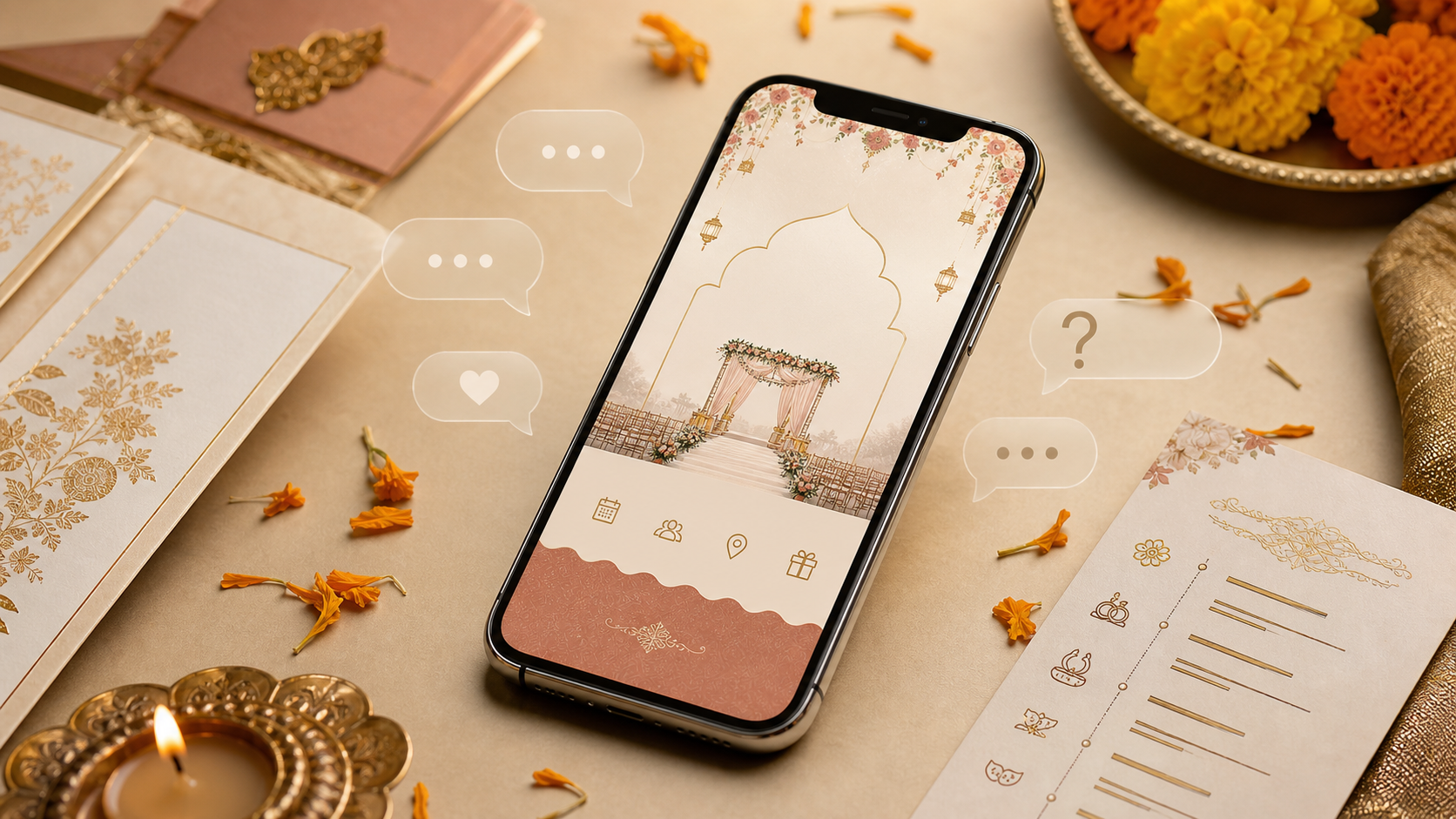
The welcome message on a wedding website looks like a tiny detail until guests start using the site. If the first screen says only "Welcome to our wedding website," guests still have to search for the RSVP link, ceremony time, hotel code, dress code, and the one person they should message with questions.
For an Indian wedding, that is how the family becomes a helpdesk.
The fast rule: write one warm paragraph, then give guests the next three actions immediately. A good wedding website welcome message should answer: who is getting married, when the wedding is, what the guest should do next, and where routine questions go.
If you already have a wedding website checklist, treat the welcome message as the front door. It should not contain every detail, but it should make the right details impossible to miss.
What should a wedding website welcome message say?
A wedding website welcome message should welcome guests, name the couple, show the wedding date or city, and point guests to the next action. The best version is warm enough for family and clear enough that a first-time guest can find RSVP, itinerary, hotel, dress code, and questions without messaging the couple.
Use this simple structure:
- A warm greeting from the couple or families.
- Couple names and wedding date or city.
- A promise that the site has the latest wedding details.
- Three quick actions: RSVP, view itinerary, ask questions.
- A note that guests should check back for updates.
A wedding website welcome message is the short homepage note that welcomes invited guests and tells them where to find the wedding schedule, RSVP, travel, dress code, hotel, and support details.
Here is the cleanest base version:
Welcome to [Name] and [Name]'s wedding website. We are so excited to celebrate with you in [city] from [dates]. This site has the latest itinerary, RSVP details, hotel and travel notes, dress codes, and guest FAQs. Please RSVP by [date], check your event details, and ask Mandap Chat if you need help with schedule, venue, dress code, or transport.
That message does two jobs. It feels personal, and it tells guests what the website is for.
What is the best wedding website welcome message for Indian weddings?
The best Indian wedding website welcome message is specific about multiple events. It should not make guests guess whether the mehndi, haldi, sangeet, ceremony, reception, hotel block, airport pickup, or meal preference form applies to them. The first screen should guide guests into the right next step.
Use this Indian wedding version:
With love from both families, welcome to [Name] and [Name]'s wedding weekend. We cannot wait to celebrate with you across [haldi/mehndi/sangeet/wedding/reception] in [city]. Please use this site to RSVP, check your invited events, view dress codes, confirm hotel and travel details, and ask Mandap Chat any guest questions before you message the family.
If the guest list includes overseas relatives, use a travel-forward version:
Welcome to [Name] and [Name]'s wedding in India. We are grateful you are travelling to celebrate with us. Start with the itinerary, hotel note, travel checklist, and RSVP form. For questions about airport pickup, dress code, ceremony timing, food, or local logistics, ask Mandap Chat here before your trip.
If a planner is managing the site, use a more operational version:
Welcome to the official wedding information hub for [Name] and [Name]. This page will stay updated with event timings, venues, RSVP deadlines, hotel details, transport notes, and guest FAQs. Please use the links below for your RSVP and travel details, and use Mandap Chat for routine questions.
The wording can be emotional. The layout has to be practical.
How long should a wedding website welcome message be?
Keep the homepage welcome message to 40 to 90 words. Guests do not come to the website to read a speech; they come to complete a task. If the message is longer than one phone screen, move the story lower on the page and keep the operational welcome short.
Use this decision table:
| Wedding website situation | Best welcome length | What to include | | --- | ---: | --- | | Local wedding | 40-60 words | Date, RSVP, itinerary, venue | | Destination wedding | 60-90 words | Date, hotel, travel, itinerary, questions | | NRI-heavy wedding | 70-100 words | Travel, document links, time zones, support | | Planner-managed wedding | 50-80 words | Official source, RSVP deadline, update rule | | Minimal invite site | 25-45 words | Couple names, date, RSVP button |
Do not bury the action buttons under a long love story. A 200-word "how we met" section is fine lower down, but the top of the page should help guests move.
For the rest of the site, use the wedding guest information card as your content filter. If a detail belongs on the card, it probably deserves a visible link near the welcome message too.
What should appear directly under the welcome message?
Directly under the welcome message, put the links guests need most: RSVP, itinerary, hotel or travel, dress code, and questions. These should look like clear buttons or cards, not hidden navigation. Guests opening the site from WhatsApp should not need to tap a menu first.
Use this homepage action block:
| Button or card | Link target | Why it matters | | --- | --- | --- | | RSVP now | RSVP form | Captures attendance before deadlines slip | | View itinerary | Event schedule | Reduces "what time is..." questions | | Hotel and travel | Room block or travel page | Helps out-of-town guests commit | | Dress codes | Event dress-code page | Prevents outfit confusion | | Ask a question | Mandap Chat | Keeps routine questions away from family WhatsApp |
Use the same language on entrance signage too. A wedding welcome sign should repeat the website's most important action: scan for itinerary, guest help, seating, or shuttle details.
For Indian weddings, "View itinerary" should usually come before "Our story." That may feel less romantic, but it is how guests actually use the site.
If your wedding has many guest types, connect the welcome section to a destination wedding FAQ for guests or an NRI travel page instead of forcing every guest through the same generic menu.
What wedding website welcome message examples can you copy?
Use the template that matches your guest list. Replace brackets with real details and keep the buttons directly below the paragraph.
Warm and simple
Welcome to our wedding website. We are so excited to celebrate with you on [date] in [city]. You will find the itinerary, venue details, RSVP form, dress codes, and travel notes here. Please check back for updates and use Mandap Chat if you have questions before the big day.
Indian family tone
With blessings from our families, we are happy to welcome you to [Name] and [Name]'s wedding celebration. Please use this website for event timings, venue directions, RSVP, dress codes, food notes, and travel details. Your presence means a lot to us, and we cannot wait to celebrate together.
Destination wedding
Welcome to our destination wedding weekend in [city]. This site has everything guests need before travel: itinerary, hotel block, airport pickup notes, dress codes, RSVP, packing reminders, and local contacts. Please start with the travel page, then ask Mandap Chat if you need help with any wedding detail.
NRI wedding in India
Welcome to our India wedding hub. We are grateful that family and friends are joining us from around the world. Please review the itinerary, hotel details, travel checklist, event access, and RSVP form before booking final plans. For routine questions about timing, attire, transport, or food, Mandap Chat has the latest answers.
Planner-managed wedding
This is the official guest information page for [Name] and [Name]'s wedding. All timings, venues, RSVP rules, room details, shuttles, and dress codes will be updated here. Please avoid relying on forwarded screenshots; use this site and Mandap Chat for the latest approved wedding information.
Short WhatsApp invite version
We are excited to celebrate with you. Please visit our wedding website for RSVP, itinerary, venue, hotel, dress code, and guest questions: [link]
That short version is useful when you send the website inside WhatsApp. If you use a WhatsApp click-to-chat link for help, follow WhatsApp's official click-to-chat format so the link opens correctly on mobile: WhatsApp Help Center.
What mistakes make a welcome message less useful?
The biggest mistake is making the welcome message beautiful but directionless. Guests may appreciate the sentiment, but they still need to know what to do next. The first screen should not be a poem with no RSVP button.
Avoid these mistakes:
- Saying "details coming soon" after invitations have gone out.
- Hiding RSVP in the top navigation only.
- Using vague copy like "join us for the celebrations" without dates or city.
- Publishing a long story before the schedule.
- Linking to a PDF invite instead of a mobile-friendly itinerary.
- Forgetting hotel, travel, dress code, or question links.
- Letting old WhatsApp screenshots conflict with the website.
- Sending guests to five different family members for routine questions.
Use this pre-launch checklist:
- Does the welcome message name the couple and wedding dates?
- Is the RSVP link visible on the first screen?
- Is the itinerary one tap away?
- Are hotel and travel details linked for out-of-town guests?
- Is there a dress-code link for each event?
- Is there a clear place for routine guest questions?
- Does the message say the website is the latest source of truth?
If the answer is yes, the welcome section is doing its job.
How should you handle multiple languages?
For multilingual Indian weddings, keep the main welcome message in the language most guests share, then make the question layer multilingual. A static homepage in five languages can become messy, but guests should still be able to ask basic questions in Hindi, Hinglish, Tamil, Telugu, Punjabi, Gujarati, Marathi, Kannada, Malayalam, or Bengali when relevant.
Use a short bilingual note if needed:
Wedding details are available here in English. Guests may ask Mandap Chat questions in Hindi, Hinglish, and family languages for schedule, venue, dress code, hotel, food, and transport help.
Do not machine-translate sensitive family instructions without review. Keep formal invite wording, religious ceremony notes, and family names checked by a human.
The welcome message should be simple. The support system behind it can be richer.
How does Mandap Chat fit into the welcome section?
Mandap Chat fits into the welcome section as the "ask a question" path. The wedding website gives guests the official pages. Mandap Chat answers natural questions when guests do not know which page to open or how to phrase the problem.
Set it up like this:
- Upload the invitation, itinerary, venue list, RSVP rules, hotel note, travel sheet, dress codes, food notes, shuttle plan, and FAQ.
- Test common guest questions before sharing the site.
- Add a button under the welcome message: "Ask a wedding question."
- Put the same link in RSVP reminders, WhatsApp updates, and printed itinerary cards.
- Keep one human contact for urgent exceptions only.
Test these before launch:
- "What time should I reach for the sangeet?"
- "Am I invited to haldi?"
- "What should I wear for the wedding ceremony?"
- "Where is the hotel booking link?"
- "Is airport pickup arranged?"
- "Can I bring my child?"
- "Who do I call if my flight is delayed?"
If guests cannot get those answers, the welcome message will not save you. Fix the source details first.
The final copy block to use
Here is the practical version most Indian weddings can use:
Welcome to [Name] and [Name]'s wedding website. We are so excited to celebrate with you in [city] from [dates]. This site has the latest itinerary, RSVP details, venue directions, hotel and travel notes, dress codes, and guest FAQs. Please RSVP by [date], check your invited events, and ask Mandap Chat if you need help with schedule, attire, food, transport, or venue details.
Put these buttons below it:
- RSVP now
- View itinerary
- Hotel and travel
- Dress codes
- Ask Mandap Chat
That is enough. The welcome message does not need to be clever. It needs to make guests feel invited and then get them to the right answer fast.
If your site is already live but guests are still messaging the family, set up Mandap Chat and add the guest question link right under the welcome message. One good button can remove a surprising amount of wedding-week noise.
FAQs
What should a wedding website welcome message say?
A wedding website welcome message should welcome guests, name the couple, show the wedding date or city, and point guests to the next action: RSVP, view itinerary, book hotel, check dress code, or ask questions. Keep it warm, short, and practical.
How long should a wedding website welcome message be?
Keep the homepage welcome message to 40 to 90 words. If the message is longer, guests will skip it and hunt for the schedule. Put emotional copy in one short paragraph and operational links directly underneath.
What is a good Indian wedding website welcome message?
A good Indian wedding website welcome message says that the families are excited to celebrate, then gives guests one place to find dates, venues, dress codes, RSVP, hotel, travel, and Mandap Chat answers. The message should reduce confusion, not just sound pretty.
Should the welcome message include RSVP and travel links?
Yes. The welcome message should sit above or beside links to RSVP, itinerary, hotel, travel, dress code, and questions. Guests usually arrive with a job to do, so the welcome message should quickly hand them to the right page.
How does Mandap Chat help after the wedding website welcome message?
Mandap Chat gives guests a natural-language place to ask follow-up questions after reading the welcome message. Upload the itinerary, RSVP rules, hotel note, dress codes, shuttle plan, and FAQ, then link Mandap Chat from the welcome section.
Frequently asked questions
What should a wedding website welcome message say?+
How long should a wedding website welcome message be?+
What is a good Indian wedding website welcome message?+
Should the welcome message include RSVP and travel links?+
How does Mandap Chat help after the wedding website welcome message?+
Continue the series
A wedding planner escalation matrix assigns each type of problem a severity, response time, first owner, final decision owner, and communication route before the wedding begins.
Wedding planner quality control is a separate verification pass that checks whether approved details match across contracts, run sheets, vendor briefs, venue plans, and guest communication before execution begins.
An NRI wedding budget in India should be built in INR around guest count, city, event count, room nights, and production complexity—then protected with separate currency and contingency buffers.
Wedding plus-one wording should state exactly who is invited, where the guest adds their companion's name, and whether the rule applies to every function. Clear language feels kinder than a vague invitation followed by an awkward refusal.
Wedding vendor meals keep photographers, planners, drivers, decor, sound, and hospitality teams working through long Indian wedding functions. Count crew by event, confirm dietary needs, schedule service before the guest rush, and give one caterer captain the final list.