
Wedding Guest Communication Plan: 30-Day Indian Wedding Schedule
Use this 30-day wedding guest communication plan to schedule invitations, travel updates, reminders, venue pins, and day-of messages without overwhelming guests.
A wedding guest communication plan defines what guests need to know, when they need it, where the approved answer lives, and who owns each update. Use this 30-day schedule to reduce repeated questions, missed transport, and contradictory family WhatsApp messages.
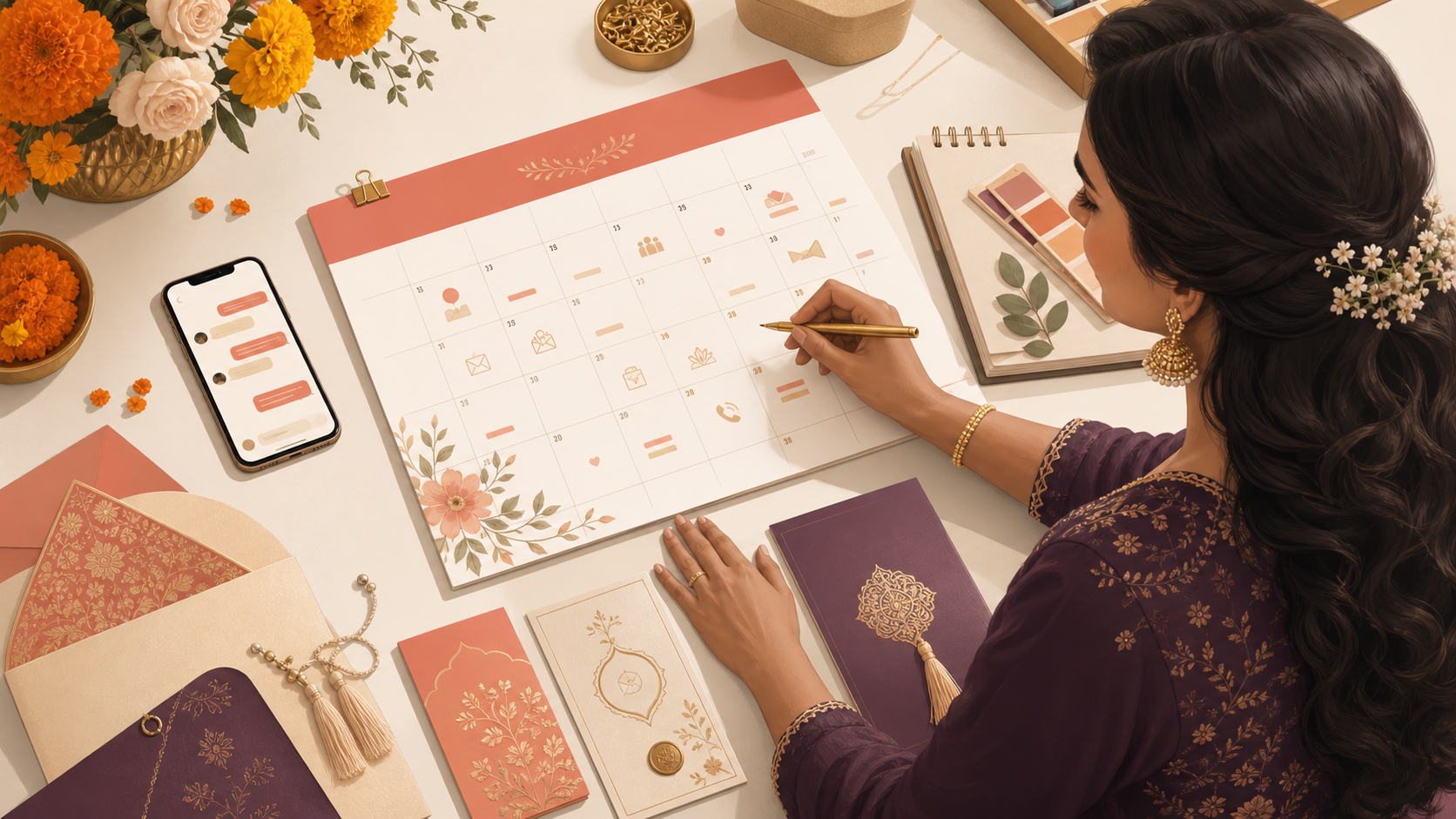
One outdated venue pin can send 40 guests to the wrong gate. One buried airport-pickup message can create ten calls while the planning team is running the sangeet. The fix is not another WhatsApp group. It is a wedding guest communication plan with one source of truth, a send schedule, and a named owner.
Use the 30-day schedule below to tell guests what they need before they have to ask. The fast rule is simple: send a message only when it helps the guest decide, prepare, travel, or act. Put reference details in one permanent place and use reminders to point back to it.
What is a wedding guest communication plan?
A wedding guest communication plan is a dated schedule of approved guest updates. It defines the audience, message, channel, send time, source link, and person responsible for every invitation, RSVP prompt, travel note, itinerary, venue pin, transport reminder, and urgent change.
Before filling the calendar, assign a primary owner, backup, and escalation rule with the wedding guest communication roles matrix. A send schedule cannot prevent conflicting answers if nobody knows who may approve or correct each detail.
A wedding guest communication plan is the operating system for getting the right wedding information to the right guest at the right time. It prevents different family members, planners, hotels, and vendors from circulating conflicting versions.
It is not the same as a content calendar. Its purpose is operational: fewer missed actions, fewer repeated questions, and fewer interruptions during production week.
What is the fastest way to build the plan?
Start with six moments: RSVP, travel booking, hotel confirmation, final itinerary, event reminders, and departures. For each moment, record who needs the information, what action they must take, the deadline, the permanent source, and one owner. This takes about 30 minutes when the wedding details are approved.
Copy this decision table into your planning sheet:
| Field | Question to answer | Example | | --- | --- | --- | | Audience | Who genuinely needs this? | Guests using airport pickup | | Outcome | What should they know or do? | Reconfirm flight number | | Send time | When can they act on it? | 14 days before arrival | | Channel | Is this reference or urgent information? | Form by email; reminder on WhatsApp | | Source | Where does the approved answer live? | Guest travel page | | Owner | Who approves and sends it? | Hospitality lead |
Use the wedding guest information card guide to collect the permanent details guests will refer to throughout the celebration.
What should you send 30 to 21 days before the wedding?
Send the complete logistics pack 30 to 21 days before the wedding. Guests should be able to confirm travel, hotel, attendance, dietary needs, accessibility requirements, and the broad function schedule without searching old chats or contacting the couple.
Include:
- Final RSVP deadline and edit link.
- City, dates, hotel, check-in, and check-out information.
- Airport or railway pickup form and deadline.
- High-level function itinerary with venue names.
- Dress code and weather guidance.
- Children, plus-one, dietary, and accessibility instructions.
- One guest-help contact or question channel.
Do not attach five files that will become stale. Publish the approved details on a wedding website or guest hub, then send one short summary with the link. Destination weddings should also use the guest travel checklist so passports, flights, baggage, transfers, and hotel deadlines are handled early.
30-day message template
We are one month away. Please review the updated wedding details here: [link]. Confirm your travel, hotel, dietary requirements, and pickup details by [date]. For wedding questions, use [guest help link/contact] so you receive the latest approved answer.
What should you send 14 days before the wedding?
At 14 days, communicate only unresolved actions and meaningful changes. Segment the list so local guests do not receive airport instructions, hotel guests do not receive irrelevant commute details, and confirmed respondents are not repeatedly asked to RSVP.
Create separate audiences for:
- Guests with incomplete RSVPs.
- Hotel and room-block guests.
- Airport or railway pickup guests.
- Local guests arranging their own transport.
- Families with children or accessibility needs.
- Vendors and internal team members, who should remain outside guest channels.
This is the right point to freeze arrival data and resolve exceptions. The NRI wedding guest travel form provides a practical field list for international arrivals, passport-name matching, transfers, and emergency contacts.
14-day message template
A quick action is still pending for your wedding travel: [specific action]. Please complete it by [deadline] at [link]. If your plans changed, update the same form rather than replying in a group so the hospitality team sees the latest details.
What should the final-week wedding message include?
Send one scannable final-week summary 7 to 10 days before the first function. Put the daily schedule, venue pins, reporting times, transport rules, dress codes, weather notes, and help channel in the order guests will use them.
The final-week message should answer:
- Where am I staying or checking in?
- What happens each day?
- When should I leave or board transport?
- What should I wear or carry?
- Who or what should I ask if I am confused?
Link to the wedding itinerary template for guests rather than pasting an unreadable multi-day schedule into WhatsApp. If a detail is not approved, label it as pending with a decision time; do not circulate a guess.
Final-week message template
Your final wedding guide is ready: [link]. It includes the day-by-day itinerary, venue pins, transport timings, dress codes, and guest help. Please save the link; any approved change will appear there first.
What should you send on each wedding day?
Send a short morning overview and a reminder 60 to 90 minutes before any transport departure or guest action. Day-of messages should be brief enough to understand from a lock screen and should never repeat the entire itinerary.
Use this format:
- Action: what the guest must do.
- Time: reporting time, not only event start time.
- Place: pickup point or venue name plus map pin.
- Exception: weather, security, footwear, ID, or access note.
- Help: one guest-facing contact or question channel.
Example:
Sangeet transport leaves the hotel lobby at 6:15 PM sharp. Please report by 6:00 PM. Venue pin: [link]. Carry your room key for the return shuttle. For help, ask here: [link].
Keep vendor arrivals, backstage movements, family approvals, and production problems in separate operational channels. Guests need confident instructions, not the planning team's working conversation.
Which channel should carry each wedding update?
Use a permanent page for reference information, email for formal or detailed updates, WhatsApp or SMS for timely actions, and calls only for urgent individual exceptions. Every short message should point to the same approved source instead of creating a new version of the truth.
| Information | Best channel | Why | | --- | --- | --- | | Invitation and formal confirmation | Email, card, or direct message | Personal and durable | | Full itinerary, FAQs, dress codes, hotel details | Wedding website or guest hub | Searchable and updateable | | RSVP, travel, meal, and pickup data | Structured form | Prevents details getting lost in chat | | Final-week summary | Email plus WhatsApp link | Reference plus visibility | | Departure or reporting reminder | WhatsApp or SMS | Timely and scannable | | Urgent individual change | Direct call plus written confirmation | Fast with an audit trail |
Avoid making one WhatsApp group the database. Chats are useful delivery pipes but poor sources of truth: newer messages bury older details, guests forward screenshots, and admins may answer from different file versions.
How do you stop contradictory wedding messages?
Choose one guest-information owner, require approval before schedule or venue changes are sent, timestamp the source page, and archive old files. Family members can help distribute an update, but they should forward the approved link and wording unchanged.
Use this five-step change protocol:
- Confirm the change with the decision owner.
- Update the permanent source first.
- Identify only the affected audience.
- Send a message stating exactly what changed and what did not.
- Log the send time and monitor acknowledgement when action is urgent.
Never silently edit a critical departure time. Write: “The Jaipur airport shuttle now leaves at 8:15 AM, not 8:45 AM. The pickup point is unchanged.” Guests should not have to compare two itineraries to find the difference.
How can you reduce repetitive wedding guest questions?
Make answers easy to find, write them in guest language, and log repeated questions. If three guests ask the same thing, improve the source instead of composing a fourth private answer. Common gaps include venue pins, dress codes, children, food, transport, check-in, luggage, and who to contact.
Mandap Chat acts as a guest-answer layer for approved wedding information. With Mandap Chat for wedding planners, planners can load schedules, venues, transport, hotel rules, and FAQs once; guests can ask in natural language without interrupting the production team for every repeated detail.
Before launch, test questions such as:
- “When should I leave the hotel for the haldi?”
- “Is transport provided after the sangeet?”
- “What should I wear to the morning ceremony?”
- “Can I bring my child to the reception?”
- “Which airport pickup form should I use?”
- “What changed in the latest itinerary?”
If the answer is missing or ambiguous, fix it before sharing the guest link.
What is the complete 30-day communication checklist?
The complete checklist has one logistics launch, one segmented action chase, one final-week summary, event-specific reminders, and a departure message. Assign an owner and approval deadline to every send, test all links on mobile, and remove obsolete documents before guests receive the next update.
- T-30 to T-21: publish full guest logistics and collect missing RSVPs, travel, rooms, meals, and accessibility needs.
- T-14: contact only guests with incomplete actions or audience-specific instructions.
- T-10 to T-7: send the final itinerary, venue pins, transport, dress codes, weather, and help link.
- T-2: send arrival, check-in, welcome-desk, and first-function instructions.
- Each morning: send a short daily overview.
- T-90 minutes: send only the next reporting or transport action.
- After the final function: send checkout, departure, lost-property, and thank-you information.
The desired outcome is not zero guest messages. It is zero avoidable confusion: every guest knows where to look, every update has an owner, and the planning team can focus on the wedding instead of searching chats.
FAQ
What is a wedding guest communication plan?
A wedding guest communication plan is a schedule that defines which approved information guests receive, when it is sent, which channel is used, and who owns each update. It usually covers invitations, RSVPs, travel, hotels, dress codes, itineraries, transport, venue pins, and urgent changes.
When should wedding guest communication begin?
Begin as soon as the date and location are firm, especially for destination or NRI weddings. Confirm travel and hotel details 30 days out, send the final itinerary 7 to 10 days out, and reserve day-of messages for immediate actions or genuine changes.
How many wedding reminders should guests receive?
Most guests need one complete information message, one final-week summary, and short event-specific reminders. Send additional messages only when a guest must act or information has changed; too many repeated updates make important details harder to notice.
For copy-paste RSVP, travel, hotel, dress code, shuttle, and day-before wording, use these wedding reminder message templates. They turn this schedule into short messages guests can act on from their phones.
Should wedding updates be sent by WhatsApp or email?
Use email or a wedding website for long reference information and WhatsApp or SMS for timely reminders. The channel matters less than maintaining one approved source of truth and linking back to it instead of rewriting details differently in every group.
How can Mandap Chat reduce repetitive guest questions?
Mandap Chat gives guests one place to ask questions about approved wedding information, including schedules, venues, dress codes, transport, and hotel details. Planners can update the source once instead of answering the same question across multiple WhatsApp groups.
Frequently asked questions
What is a wedding guest communication plan?+
When should wedding guest communication begin?+
How many wedding reminders should guests receive?+
Should wedding updates be sent by WhatsApp or email?+
How can Mandap Chat reduce repetitive guest questions?+
Continue the series
Wedding planner quality control is a separate verification pass that checks whether approved details match across contracts, run sheets, vendor briefs, venue plans, and guest communication before execution begins.
An NRI wedding budget in India should be built in INR around guest count, city, event count, room nights, and production complexity—then protected with separate currency and contingency buffers.
Wedding plus-one wording should state exactly who is invited, where the guest adds their companion's name, and whether the rule applies to every function. Clear language feels kinder than a vague invitation followed by an awkward refusal.
Wedding vendor meals keep photographers, planners, drivers, decor, sound, and hospitality teams working through long Indian wedding functions. Count crew by event, confirm dietary needs, schedule service before the guest rush, and give one caterer captain the final list.
A wedding planner SOP turns repeat work into a clear operating system: each task has a trigger, owner, deadline, proof of completion, and escalation rule, so the team can execute consistently without routing every decision through the founder.