
Wedding Guest Communication Roles: Who Answers What?
Assign wedding guest communication roles for an Indian wedding with a practical ownership matrix, escalation rules, WhatsApp boundaries, and handover checklist.
Wedding guest communication works when every question has one owner, one approved answer source, and one escalation path. Use this role matrix to keep routine questions away from the couple while urgent travel, accessibility, hospitality, and event issues reach the right person quickly.
The bride's cousin says the shuttle leaves at 6:00. The planner says 6:20. The hotel desk still has yesterday's sheet. Meanwhile, 70 guests are messaging the couple.
This is not a WhatsApp problem. It is an ownership problem.
Use this fast rule: one owner per question type, one approved answer source, and one named backup. Routine questions should never reach the couple. A genuine exception should never sit unanswered in a general group.
If you already have the message calendar, combine this guide with the wedding guest communication plan. If you are starting from scratch, the matrix below is the quickest way to decide who answers what.
Once the roles are assigned, use the wedding guest query tracker to give each exception one owner, deadline, and confirmed outcome.
Who should handle wedding guest communication?
One communication lead should control the approved guest information, broadcast calendar, and correction process. Specialists should own RSVP, travel, hotels, transport, accessibility, and on-site issues. The couple should receive only personal decisions that nobody else is authorised to make.
Wedding guest communication roles are the named responsibilities that determine who publishes information, who answers each type of guest question, and who handles an exception when the standard answer is not enough.
The smallest useful team has:
- One communication lead.
- One operational backup.
- One current guest-information source.
- One urgent-contact path.
- A short list of decisions reserved for the couple.
For a 50-person local wedding, the lead and backup may handle everything. For a 300-person destination wedding, split the work by question type. Do not split it by family branch; that creates several versions of the truth.
What is the wedding guest communication role matrix?
The role matrix assigns each guest question to a primary owner, backup, approved source, and escalation rule. It prevents the most available relative from becoming the default help desk and makes handovers possible when the planner, sibling, or hospitality captain is busy.
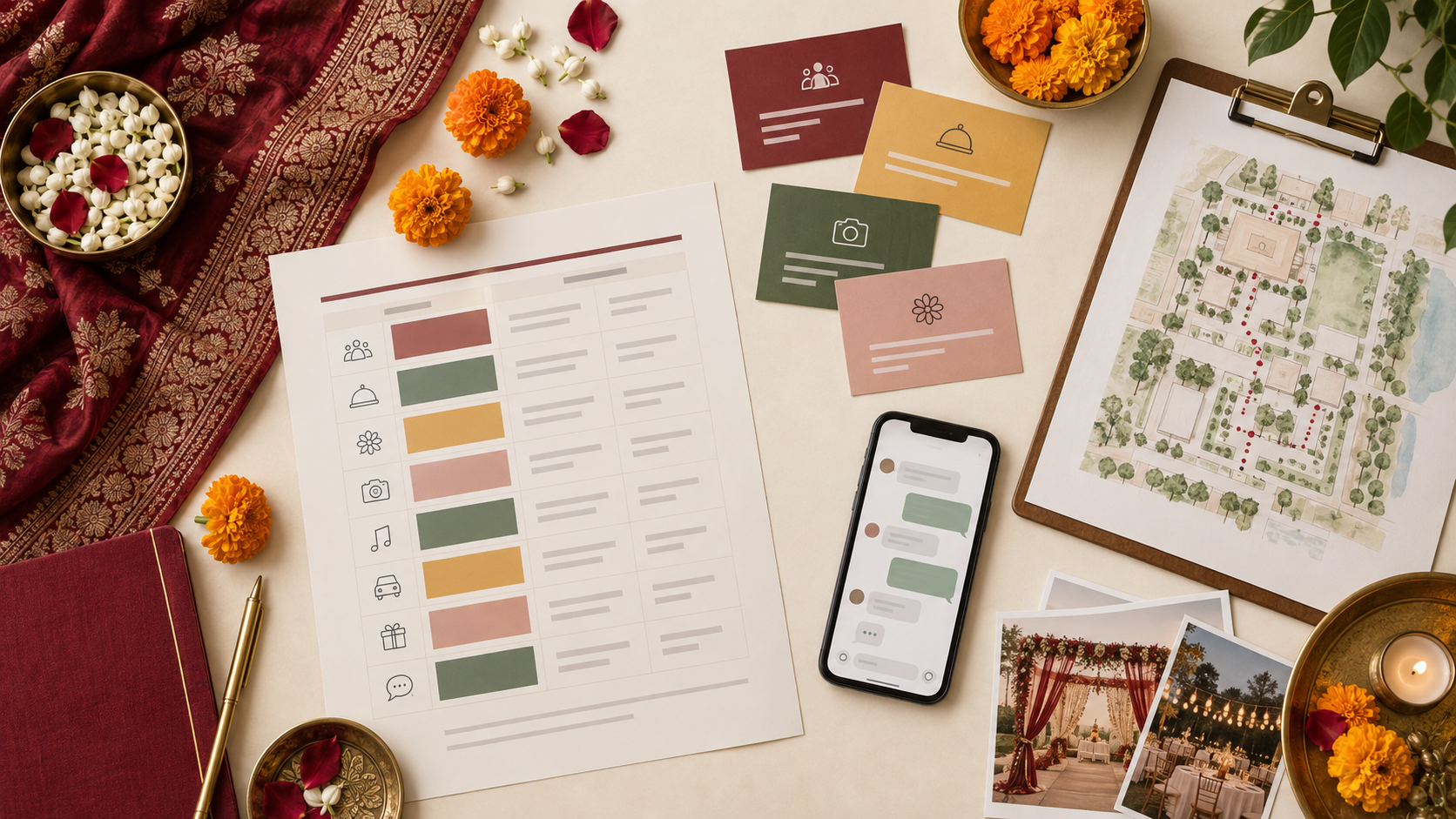
| Question or task | Primary owner | Backup | Escalate when | | --- | --- | --- | --- | | Invitations and RSVP status | RSVP owner | Communication lead | Invitation or plus-one decision is required | | Event time, venue, dress code | Communication lead or concierge | Planner coordinator | Approved schedule is unclear or changing | | Flights, trains, airport pickup | Travel owner | Transport captain | Guest is stranded, delayed, or missing | | Hotel room, check-in, welcome desk | Hospitality owner | Hotel liaison | Room is unavailable or payment is disputed | | Shuttle route and departure | Transport captain | Hospitality owner | Vehicle is late, full, or rerouted | | Food preference or allergy note | Hospitality owner | Catering liaison | Safety concern or unapproved exception arises | | Accessibility or elder support | Accessibility owner | On-site lead | Personal assistance or route change is needed | | Lost item or on-site confusion | Help desk | On-site lead | Safety, cash, identity, or transport is involved | | Family-sensitive request | Communication lead | Couple's named representative | Only the couple can approve it | | Medical or security emergency | On-site emergency lead | Venue security/medical contact | Immediately; do not use a general group |
Names and phone numbers belong in the private operations sheet, not in a public guest article or open group. Guests need one help route; the team needs the full matrix.
How many communication roles does an Indian wedding need?
A local single-day wedding may need two people. A multi-day Indian wedding usually needs five functional roles, even when the same person holds more than one: communication lead, RSVP owner, travel and transport owner, hospitality owner, and on-site escalation lead.
| Wedding setup | Minimum team | Practical setup | | --- | --- | --- | | Under 75 guests, one venue | 1 lead + 1 backup | One shared answer sheet and urgent number | | 75–200 guests, multiple functions | 1 lead + 3 owners | RSVP, hospitality, and transport ownership | | Destination wedding | 1 lead + 4 owners | Add hotel liaison and arrival tracking | | 300+ guests or several hotels | 1 lead + captains by operation | Separate transport routes and hotel desks | | NRI guest group | Existing team + timezone backup | Travel documents, arrival, and after-hours coverage |
Do not add a role merely to make the chart look professional. Add it when a question category has enough volume or risk to need a dedicated owner.
For destination weddings, build the operational details in a guest transportation plan and a hotel rooming list. The communication matrix should point to those records rather than duplicating them.
Which questions should reach the couple?
Only personal decisions should reach the couple: invitation exceptions, sensitive family requests, significant unplanned spending, ceremonial preferences, or a change that affects the wedding promise itself. Published logistics should be answered by the team from the current approved source.
Answer without escalating
- What time does the Sangeet start?
- Which hotel lobby does the shuttle use?
- Is the Mehendi outdoors?
- What is the dress code?
- Is Jain food available?
- Where is the welcome desk?
- Can the venue accommodate a wheelchair?
Escalate to an authorised decision-maker
- Can I bring a plus-one who was not invited?
- Can my family attend a function not listed on our invitation?
- Can you change the ceremony time for our arrival?
- Will the couple pay for a different hotel or flight?
- Can an unpublished family or ritual detail be shared?
The communication lead should protect the couple from volume, not hide meaningful decisions from them. Agree on these boundaries before invitations go out.
How should WhatsApp groups be managed?
Use WhatsApp for timely broadcasts and targeted actions, not as the master record. Every important message should identify the event, affected guests, action, deadline, and one current link. Questions should move to the assigned help route instead of creating competing answers in the group.
Set four rules:
- Only named admins publish official updates.
- The latest guest link outranks forwarded images and old PDFs.
- A correction begins with “Update” and states what changed.
- Personal room, travel, accessibility, and invitation matters move to direct messages.
For a clean group setup, adapt the NRI wedding WhatsApp group rules. The principle works for local guests too: the group is a noticeboard, not the operations room.
What should the communication lead prepare before the wedding?
The communication lead should prepare an approved answer bank, audience segments, message calendar, role matrix, escalation rules, and a handover note. The team should be able to answer routine questions without calling the planner or reading several conflicting documents.
Complete this checklist seven days before the first guest arrives:
- [ ] Confirm the latest itinerary, venue pins, reporting times, and dress codes.
- [ ] Assign a primary owner and backup for every question category.
- [ ] Segment guests by function, hotel, transport route, and travel status.
- [ ] Publish one current guest-information link.
- [ ] Test the guest link on a phone without planner access.
- [ ] List what the team may answer and what requires approval.
- [ ] Add the urgent medical, security, hotel, and transport contacts privately.
- [ ] Schedule the final-week and day-before messages.
- [ ] Write one correction template before a correction is needed.
- [ ] Hand the on-site lead a snapshot for internet or battery failure.
The wedding help desk guide explains how to place this system at a hotel or venue without turning the desk into another untracked message channel.
How do you hand over guest communication on the wedding day?
Use a written handover that lists current facts, unresolved cases, the next scheduled message, owner availability, and emergency contacts. The outgoing lead should not merely say “everything is in WhatsApp.” A useful handover lets the next person operate without reconstructing the day.
Handover these six items:
- Changes approved since the last briefing.
- Guests currently travelling, delayed, or unaccounted for.
- Open room, shuttle, food, or accessibility cases.
- The next broadcast and its intended audience.
- Decisions waiting for the planner, family, venue, or couple.
- The person who takes over each phone and help channel.
Use the wedding planner shift handover template for the larger production team. Guest communication should appear as one explicit section, not disappear inside a general “pending items” list.
How can Mandap Chat reduce repeat guest questions?
Mandap Chat can answer routine guest questions from approved wedding details, in one consistent guest experience, while the human team handles exceptions and urgent issues. It works best when a communication lead owns the source information and the escalation path is explicit.
The practical workflow is simple:
- Upload or enter the approved itinerary, venues, dress codes, hotel, transport, food, and FAQ details.
- Give every guest segment the same Mandap Chat link.
- Let guests ask routine questions in their own words.
- Route exceptions to the correct human owner.
- Update the approved information once when plans change.
For planners managing several functions and hundreds of repeated questions, Mandap Chat for wedding planners creates the self-service layer. It does not replace the role matrix; it makes the matrix manageable.
For a time-sensitive location update, assign one owner to send the approved wedding venue change message, track acknowledgement, and stop older venue details from being forwarded.
FAQ
Who should handle guest communication for a wedding?
One guest-communication lead should own the approved information and message calendar. Routine questions can go to a wedding concierge or help desk, while named specialists handle transport, hotel, accessibility, RSVP, and emergencies. The couple should receive only decisions that genuinely require them.
How many wedding guest communication roles do you need?
A small wedding may need one lead and one backup. A multi-day or destination Indian wedding usually needs five functions: communication lead, RSVP owner, travel and transport owner, hotel or hospitality owner, and on-site escalation lead. One person may hold several roles, but each role still needs a named backup.
What wedding questions should be escalated to the couple?
Escalate only questions that require a personal decision, such as adding an uninvited guest, changing an invitation, approving a sensitive family exception, or committing new money. Timings, venue pins, dress codes, transport, rooms, food, and published policies should be answered from approved information.
How do you stop relatives giving guests conflicting wedding information?
Publish one current guest link, label one person as the communication lead, and ask relatives to forward questions instead of answering from memory. Every broadcast should point back to the same source. When details change, update that source first and then send a short correction.
Can an AI wedding concierge replace the communication team?
No. An AI wedding concierge can answer repeat questions from approved wedding information, but people must approve the facts and handle exceptions, emergencies, accessibility needs, family decisions, and vendor coordination. It reduces interruptions; it does not replace operational ownership.
Frequently asked questions
Who should handle guest communication for a wedding?+
How many wedding guest communication roles do you need?+
What wedding questions should be escalated to the couple?+
How do you stop relatives giving guests conflicting wedding information?+
Can an AI wedding concierge replace the communication team?+
Continue the series
A wedding planner escalation matrix assigns each type of problem a severity, response time, first owner, final decision owner, and communication route before the wedding begins.
Wedding planner quality control is a separate verification pass that checks whether approved details match across contracts, run sheets, vendor briefs, venue plans, and guest communication before execution begins.
An NRI wedding budget in India should be built in INR around guest count, city, event count, room nights, and production complexity—then protected with separate currency and contingency buffers.
Wedding plus-one wording should state exactly who is invited, where the guest adds their companion's name, and whether the rule applies to every function. Clear language feels kinder than a vague invitation followed by an awkward refusal.
Wedding vendor meals keep photographers, planners, drivers, decor, sound, and hospitality teams working through long Indian wedding functions. Count crew by event, confirm dietary needs, schedule service before the guest rush, and give one caterer captain the final list.