
Destination Wedding Guest Travel Checklist for Indian Weddings
A practical destination wedding guest travel checklist for Indian weddings: documents, flights, hotel block, airport pickup, dress codes, baggage, and last-mile guest messages.
A destination wedding guest travel checklist should help every guest confirm documents, flights, hotel booking, airport pickup, event outfits, baggage rules, local transport, and one approved question channel before travel week.
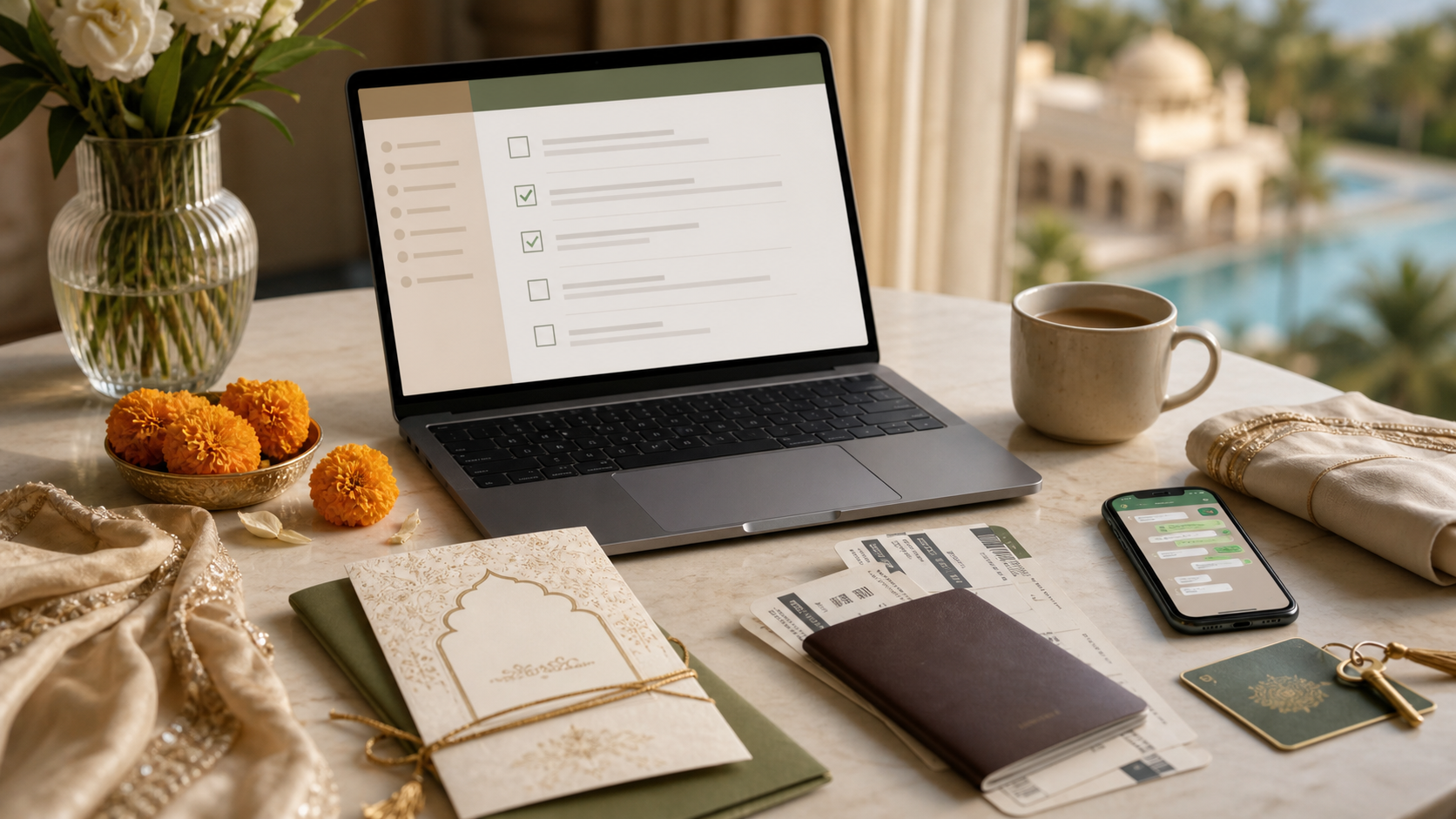
The dangerous part of a destination wedding is not one guest forgetting a charger. It is 140 guests making tiny assumptions at the same time: the hotel has their room, pickup is arranged, the first event is at the resort, heels are fine for haldi, the invitation has the latest timing, and someone in the family will answer WhatsApp at 1 AM.
The fast rule: split the guest travel checklist into three moments. Six to eight weeks out, collect travel and stay details. Three weeks out, chase missing answers and freeze pickup groups. Two to three days before travel, send each guest one short arrival message with hotel, transport, first event, and the Mandap Chat for destination weddings link for routine questions.
What is a destination wedding guest travel checklist?
A destination wedding guest travel checklist is the guest-facing control list for documents, flights, hotel booking, airport pickup, event outfits, baggage, medicines, payments, and arrival instructions. For Indian weddings, it must connect travel details to the wedding itinerary because guests may attend haldi, mehndi, sangeet, wedding, reception, and brunch across different times or venues.
It is more practical than a packing list. A destination wedding packing list tells guests what to bring. A travel checklist tells them what to confirm, where to go, when to leave, who is helping, and where to ask questions when they are tired, late, or confused.
Use this article if you are asking:
- "What should I send guests before an Indian destination wedding?"
- "How do I organize travel for outstation wedding guests?"
- "What should guests check before flying to a destination wedding?"
- "Why do guests keep asking the same hotel and pickup questions?"
- "What is the best way to share destination wedding travel details?"
What should guests confirm first?
Guests should confirm the details that can block travel or ruin the first event: ID, visa or OCI when relevant, flight or train timing, hotel booking, airport pickup rule, first-event outfit, medicines, phone connectivity, and emergency contact. Anything else can wait.
Use this priority order:
| Priority | Guest confirms | Why it matters | | --- | --- | --- | | 1 | Passport, Aadhaar, visa, OCI, or government ID | No document, no travel or check-in | | 2 | Flight or train booking, arrival time, terminal | Drives pickup, hotel desk, and first-day meals | | 3 | Hotel booking or room block status | Prevents check-in drama | | 4 | Pickup rule: confirmed car, shuttle, taxi, or self-arranged | Prevents the family becoming an airport desk | | 5 | First 24 hours of events | Guests need the first outfit and reporting time | | 6 | Medicines, power bank, charger, payment method | Solves common arrival-day problems | | 7 | Mandap Chat or wedding FAQ link | Keeps repeat questions out of family WhatsApp |
For international travel into India, point guests to official pages instead of giving immigration advice. India Visa Online publishes the e-Visa application route, the Bureau of Immigration publishes visa services information, and India Visa Online also hosts the e-Arrival Card page. The couple can confirm wedding facts; the guest must confirm their travel eligibility.
When should couples send the travel checklist?
Send the main checklist 6 to 8 weeks before the wedding, chase missing flight and hotel details 21 days out, lock routine pickup groups 7 to 10 days out, and send the final arrival message 48 to 72 hours before each guest travels.
This cadence is tight enough to be useful and early enough to prevent panic:
| Timing | Send or collect | Owner | | --- | --- | --- | | 8 weeks out | Guest travel form for flights, hotel, pickup, diet, children, accessibility | Hospitality lead | | 6 weeks out | Hotel block, itinerary, dress code, and question channel | Planner or couple | | 21 days out | Missing flight, train, room, and pickup details | Family logistics lead | | 10 days out | Pickup groups, hotel desk notes, welcome bag counts | Transport and hotel lead | | 72 hours out | Arrival message for each guest segment | Hospitality lead | | Wedding week | Late changes only through one transport lead | Planner |
If you already use an NRI wedding guest travel form, do not create a second spreadsheet. Add a status column: complete, missing hotel, missing arrival, self-arranged, or needs human follow-up.
What information should the guest travel form collect?
Collect only the details that change travel, hotel, food, accessibility, or communication. Asking for too much information lowers completion rates; asking for too little moves the problem to wedding week.
The useful fields are:
- Guest full name as used for hotel and pickup.
- WhatsApp number with country code.
- City and country of residence.
- Arrival date, arrival time, and airport, station, or city.
- Flight or train number if pickup is being arranged.
- Departure date and checkout plan.
- Hotel name or "needs room block help."
- Pickup need: confirmed car, shared shuttle, taxi instructions, self-arranged, or undecided.
- Dietary, allergy, kid, elder, or accessibility notes.
- Emergency contact.
- Whether they need a visa invitation letter.
For overseas guests, connect this to the international wedding guest arrival plan. That article covers flight grouping, e-arrival reminders, hotel desk ownership, and airport pickup for guests flying into India.
What should go in the guest-facing travel checklist?
The guest-facing checklist should be short enough to act on from a phone. Do not send the planner's internal sheet with vendor contacts, budget notes, and family politics. Guests need their own checklist.
Copy this structure:
- Confirm your travel booking and share flight or train details by [date].
- Book your hotel using the room block link or tell us where you are staying.
- Save the wedding itinerary offline.
- Check event dress codes and pack one outfit set per function.
- Keep ID, medicines, jewellery, charger, and one event outfit in cabin baggage.
- Check baggage, power-bank, and liquid rules with your airline.
- Save the pickup or taxi instruction before leaving home.
- Pin the Mandap Chat link for routine wedding questions.
- Save the urgent transport contact for arrival problems only.
- Recheck the final arrival message 48 hours before travel.
For airline rules, send links, not guesses. Air India publishes cabin baggage guidance and restricted baggage guidance, while IATA tells passengers to check airline-specific baggage rules through the operating carrier on its traveller baggage page. Power-bank and battery rules are especially worth checking before guests pack.
How should you handle hotel and room block details?
Give guests the hotel name, room rate, booking deadline, payment rule, check-in time, breakfast rule, shuttle pickup point, and one room-change contact. The mistake is sending a hotel brochure without the operational rules.
For Indian destination weddings, the hotel block is tied to everything else:
| Hotel detail | Travel impact | | --- | --- | | Check-in time | Decides whether early arrivals need a waiting plan | | Breakfast included | Changes food questions on the first morning | | Shuttle pickup lobby | Prevents guests waiting at the wrong entrance | | Room block deadline | Decides when to chase undecided guests | | Payment responsibility | Prevents awkward front-desk arguments | | Backup hotel | Adds transport complexity | | Welcome bag delivery | Needs room numbers, not guessed headcount |
Use the wedding hotel block playbook for the accommodation plan, then put the guest-facing version inside the travel checklist. Guests should not need to read a 12-page hotel contract to know where to sleep.
Who needs airport pickup and who can self-arrange?
Not every guest needs airport pickup. Promise confirmed pickup to elders, VIP family, guests with mobility needs, families with children landing late, and groups arriving inside official windows. Give everyone else clear taxi, hotel shuttle, or reimbursement instructions.
Use this decision table:
| Guest situation | Best travel instruction | Human owner | | --- | --- | --- | | Elder relative or mobility need | Confirmed car with driver name and number | Transport lead | | Family with kids arriving late | Confirmed car or hotel car | Transport lead | | 4 to 8 guests landing close together | Shared pickup group | Transport lead | | Friends arriving throughout the day | Airport taxi or app-cab instruction | Hospitality lead | | Guest staying outside the block | Self-arranged unless approved | Guest | | Flight delayed after departure | Message transport lead only | Transport lead |
The wording matters. "Pickup will be arranged" is vague. Write: "Official pickup is available for guests landing between [time] and [time] on [date]. Outside that window, please use the airport taxi counter or hotel transport unless we have confirmed your car separately."
If pickup is the main bottleneck, use the NRI wedding airport pickup message templates so each guest gets the right version instead of the whole transport sheet.
What should the final arrival message say?
The final arrival message should fit in one phone screen and answer what the guest does after landing or reaching the station. Send it 48 to 72 hours before travel and update it only if something materially changes.
Use this template:
Travel reminder for [Couple] wedding: please save your hotel pin before leaving. Hotel: [name + map link]. Check-in: [time]. Pickup: [confirmed car / shared shuttle / taxi instruction]. First event: [event, date, reporting time, venue]. Dress code: [short note]. Routine questions: ask Mandap Chat here [link]. Urgent arrival issue only: call [name + number].
For guests without pickup:
Please use the airport taxi counter or app cab to [hotel name]. The ride usually takes [time range], depending on traffic. The wedding shuttle leaves from [pickup point] for [first event] at [time]. Ask routine questions in Mandap Chat; call [name] only for urgent arrival issues.
This message is not the place for decorative copy. It is the place for clear movement.
How do you stop repeat guest questions?
Stop repeat questions by making one source of truth obvious, current, and easier to use than texting the family. If the PDF, website, WhatsApp message, and hotel desk all say slightly different things, guests will keep asking humans.
The clean setup is:
- A wedding website or itinerary page for browsing.
- A PDF only for printable summary details.
- A WhatsApp reminder for the next action.
- Mandap Chat for natural questions in guest language.
- One urgent contact for real travel problems.
Before sharing the link, test the questions guests will actually ask:
- "Is pickup arranged for me?"
- "What time should I leave the hotel?"
- "Where is the first event?"
- "Can I check in early?"
- "What should I wear after landing?"
- "Is breakfast included?"
- "Who do I call if my flight is delayed?"
- "Do I need to bring ID to the venue?"
If the answer is missing, fix the source document first. An AI wedding concierge makes clear information available instantly; it cannot make a vague plan reliable.
What changes for NRI and overseas guests?
NRI and overseas guests need extra reminders for passport validity, visa or OCI, e-arrival, international roaming, payment methods, power adapters, medicine documentation, and time-zone wording. Do not assume guests know India travel logistics just because they are attending an Indian wedding.
Add this overseas layer:
| Detail | Guest reminder | | --- | --- | | Visa or OCI | Check official route for your passport before booking final travel | | e-Arrival | Check current India e-arrival requirements before departure | | Roaming or SIM | Confirm WhatsApp works after landing | | Power adapter | Pack the right adapter for India or the wedding country | | Payments | Carry card plus some local cash; do not rely on one app | | Medicines | Keep essentials in cabin baggage with documentation where needed | | Jet lag | Arrive one day before heavy events if possible |
For a broader planning layer, pair this with the NRI wedding planning guide and the NRI wedding guest communication timeline. Travel reminders work best when they are not the first message guests receive.
What is the final 72-hour travel check?
The final 72-hour check should confirm only the items that affect movement, sleep, clothes, safety, and questions. Long checklists sent too late get ignored.
Use this final check:
- Flight, train, or drive timing is confirmed.
- Hotel booking and address are saved offline.
- Pickup, shuttle, or taxi rule is clear.
- First event timing and venue are saved.
- First event outfit is in cabin or easy-access baggage.
- ID, medicines, jewellery, charger, power bank, and payment cards are packed.
- Airline baggage and power-bank rules are checked.
- Weather and venue surface are checked for shoes and layers.
- Mandap Chat link is pinned.
- Urgent transport contact is saved.
The goal is not to remove every possible surprise. The goal is to make sure guests can reach the hotel, dress correctly for the first event, and get approved answers without turning the couple's family into a 24-hour travel desk.
Once arrivals are under control, finish the journey with a destination wedding checkout and departure message covering room deadlines, luggage storage, airport transfers, and the final guest reminder.
FAQ
What should a destination wedding guest travel checklist include?
A destination wedding guest travel checklist should include ID or passport, visa or OCI checks when relevant, flight and train details, hotel booking, airport pickup rule, event dress codes, baggage and power-bank rules, medicines, emergency contacts, and one approved place to ask wedding questions.
When should couples send travel details to destination wedding guests?
Send the main travel checklist 6 to 8 weeks before the wedding, chase missing flight and hotel details 21 days out, and send the final arrival message 48 to 72 hours before each guest travels. The final message should be short, specific, and synced with the latest itinerary.
How do you stop destination wedding guests from messaging the family repeatedly?
Give guests one source of truth for the itinerary, hotel block, transport, dress code, food, weather, and urgent contacts. Then point every reminder to that same source. Mandap Chat can answer guest questions from the approved wedding details instead of routing every repeat question to the couple or planner.
Should destination wedding travel information go in a PDF, website, or chatbot?
Use all three only if they stay synced. A PDF is useful for printing, a website is useful for browsing, and a chatbot is useful when guests ask natural questions from airports, hotels, and WhatsApp. If the details disagree, guests will trust the latest message, not the best-designed document.
What should guests confirm before flying to an Indian destination wedding?
Guests should confirm passport or ID, visa or OCI status when travelling internationally, airline baggage rules, power-bank rules, hotel booking, pickup instructions, event dress codes, medicines, payment methods, local transport, and the emergency contact before leaving for the airport.
Before guests leave home, share the destination wedding emergency kit checklist with the planner and hospitality lead. It separates couple, guest, and operations supplies so chargers, repair items, weather protection, and emergency contacts are available where problems actually happen. Before arranging airport or station transfers, collect exact itineraries with a destination wedding flight details form. One response per itinerary gives the transport team usable arrival times, terminals, passenger counts, luggage and hotel destinations instead of scattered ticket screenshots.
Frequently asked questions
What should a destination wedding guest travel checklist include?+
When should couples send travel details to destination wedding guests?+
How do you stop destination wedding guests from messaging the family repeatedly?+
Should destination wedding travel information go in a PDF, website, or chatbot?+
What should guests confirm before flying to an Indian destination wedding?+
Continue the series
A practical contract checklist for Indian destination weddings, designed to turn hotel promises into written commitments before the deposit becomes non-refundable.
A destination wedding lost luggage plan gives guests a carry-on backup, a clear airline reporting process, a local essentials kit, and one wedding-team contact who can solve event problems without taking over the airline claim.
A destination wedding flight details form collects one itinerary per traveller, while an arrival manifest turns those responses into pickup assignments, exception alerts, and guest-ready instructions.
A destination wedding hotel check-in message gives each guest the confirmed hotel, arrival window, booking or room-allocation rule, payment responsibility, luggage plan, and escalation contact before they reach reception.
A destination wedding save-the-date should tell guests the city, full wedding window, travel commitment, and where updates will live—without pretending every venue, hotel, or event detail is already final.