
Destination Wedding Emergency Kit Checklist for Indian Weddings
Build a destination wedding emergency kit for Indian weddings: exact supplies, event-wise kit locations, owners, refill rules, and guest emergency contacts.
Build three small kits instead of one giant box: a couple kit backstage, a guest-comfort kit at hospitality, and an operations kit with the planner. Assign one owner to each before guests arrive.
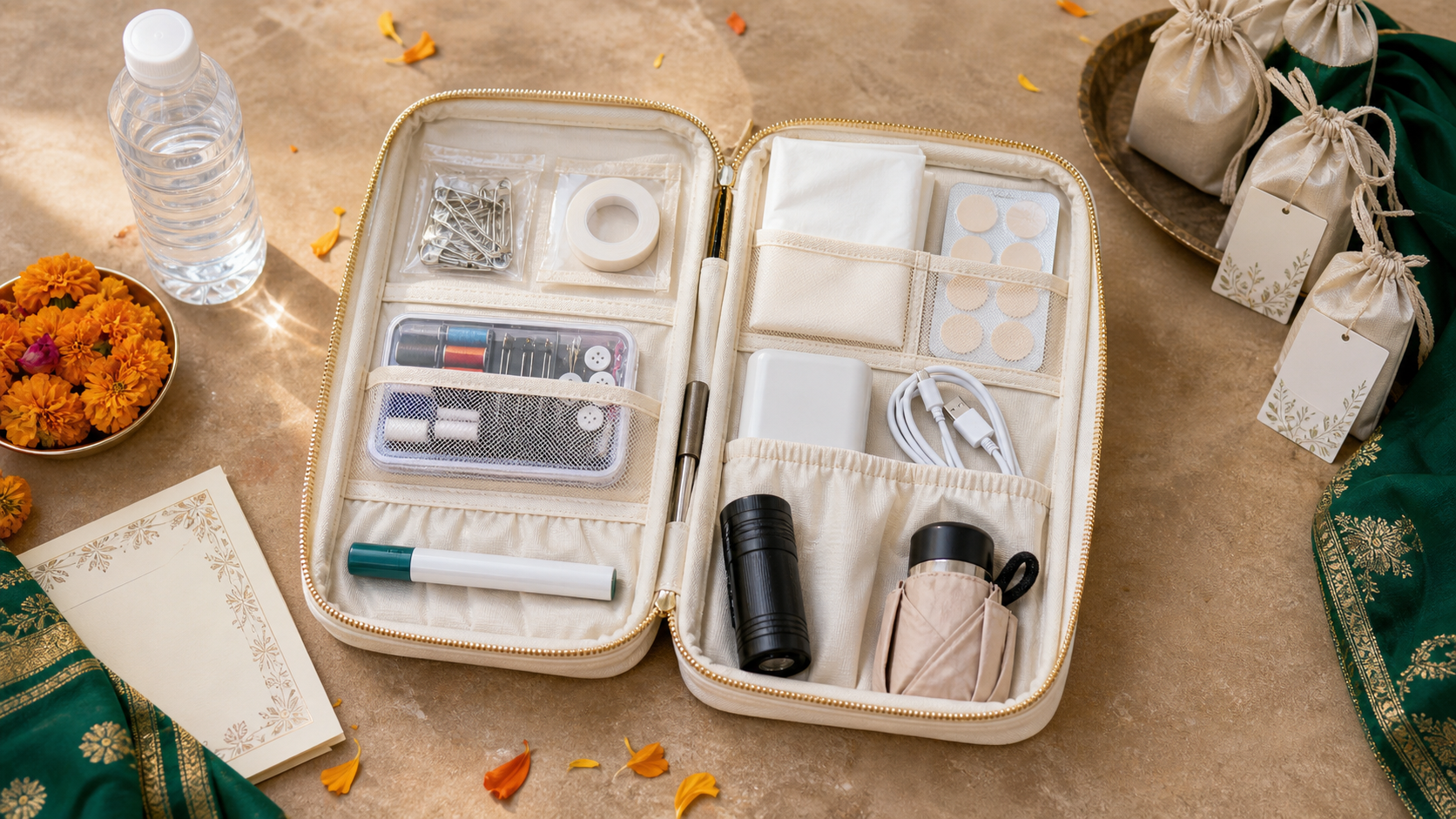
A destination wedding emergency kit fails when it becomes one giant suitcase locked in the bride's room. The useful version is three smaller kits placed where problems actually happen: backstage with the couple, at the guest hospitality desk, and with the planner or production team.
The fast rule is three kits, three owners, one refill check after every function. That gives a loose blouse hook, dead phone, stained kurta, blister, missing charger, wet walkway, or confused guest a clear next step without turning the couple's family into a help desk.
Pair the physical kits with the destination wedding guest travel checklist before guests leave home. The kit should solve genuine surprises, not replace sensible packing.
What is a destination wedding emergency kit?
A destination wedding emergency kit is a labelled set of clothing-repair, guest-comfort, communication, weather, and event-operation supplies kept close to the people who may need them. It is not a substitute for venue security, trained medical help, or a proper rain and transport plan.
For an Indian wedding, the kit has to cover multiple outfits, long functions, outdoor movement, ritual items, elderly guests, children, hotel rooms, shuttles, and several venues. A generic bridal pouch is helpful backstage, but it cannot solve a dead hospitality phone or a shuttle captain who has the wrong pickup list.
What should be in a destination wedding emergency kit?
Pack by problem, not by Pinterest aesthetic. Start with clothing repairs, grooming cleanup, foot comfort, phone power, weather protection, guest directions, and operational backups. Keep anything sharp, electrical, valuable, or restricted with a named adult owner.
Use this decision table:
| Problem | Pack this | Keep it with | | --- | --- | --- | | Loose hook, torn seam, fallen dupatta | Safety pins, needle and thread, fashion tape, small scissors | Couple kit | | Makeup or food mark | White cloths, tissues, stain-removal pen, cotton buds | Couple kit | | Shoe bite or sore feet | Sealed blister bandages, regular adhesive bandages, heel grips | Hospitality kit | | Dead guest phone | Two charged power banks, common cables, labelled charger-return pouch | Hospitality kit | | Heat or rain | Water, tissues, hand fans, compact umbrellas, dry towels | Hospitality + planner kits | | Missing event information | Printed mini itinerary, venue map, QR code, emergency contact card | All kits | | Sign or decor failure | Gaffer tape, zip ties, marker, clips, spare batteries, small torch | Planner kit | | Vendor cannot be reached | Printed vendor call sheet and escalation order | Planner kit |
Avoid decanting mystery liquids into unlabelled bottles. Keep every consumable sealed and labelled, and check the venue's rules before packing aerosols, blades, candles, batteries, or electrical tools.
How should you split the supplies across three kits?
The best setup is a private couple kit, a visible guest-comfort kit, and a controlled operations kit. Duplicating a few cheap essentials is better than moving one heavy box across a resort while the sangeet has already started.
Kit 1: couple and wedding-party kit
Keep this backstage, in the couple's suite, or with one trusted attendant:
- Safety pins in two sizes.
- Fashion tape and blouse tape.
- Mini sewing kit with outfit-matched thread.
- Small scissors in a zipped pouch.
- Stain-removal pen and clean white cloth.
- Lint roller.
- Bobby pins, hair ties, comb, and cotton buds.
- Tissues, blotting paper, and fragrance-free wipes.
- Heel grips and sealed blister bandages.
- Mints and straws.
- Phone charger and one charged power bank.
- Printed copies of vows, speech notes, and the ceremony order.
Match thread, buttons, hooks, and spare jewellery closures to the actual outfits during the final fitting. A beautiful generic sewing tin is useless if every thread inside is black and the sherwani is ivory.
Kit 2: guest hospitality kit
Keep this at the hotel help desk or a clearly marked hospitality table:
- Safety pins, tissues, wipes, and stain-removal pen.
- Sealed adhesive and blister bandages.
- Sanitary products in discreet pouches.
- Phone charging cables and numbered power banks.
- Compact umbrellas or rain ponchos when relevant.
- Dry towels, hand fans, or sunscreen based on the destination.
- Printed itinerary cards and venue maps.
- Spare room-key envelopes and luggage tags supplied by the hotel.
- Taxi, shuttle, venue security, clinic, and planner contact card.
- Lost-and-found envelopes, labels, and marker.
Place the kit where guests will ask for help, not behind a locked office door. Load the same hotel, shuttle, dress-code, and event answers into Mandap Chat for destination weddings so the desk does not repeat them 200 times.
Kit 3: planner and operations kit
Keep this with the planner, production manager, or event captain:
- Printed master timeline and vendor call sheet.
- Guest movement and shuttle lists.
- Gaffer tape, zip ties, cable labels, clips, and marker pens.
- Torch, batteries, power bank, and charging cables.
- Spare signage sheets and blank place cards.
- Umbrellas, towels, anti-slip floor markers, and garbage bags.
- Copies of venue approvals and critical vendor confirmations.
- A small cash float and sealed envelopes, if the planner's process requires them.
- Duplicate ritual checklist confirmed with the priest and family.
- Contact details for venue security, on-call maintenance, transport, and the nearest appropriate medical facility.
This is not a replacement toolkit for sound, power, decor, or catering vendors. Each vendor should carry its own professional spares. The planner kit bridges the first five minutes until the responsible team arrives.
What should not go in a shared wedding emergency kit?
Do not pack loose medicines, unlabelled products, alcohol, valuable jewellery, guest passports, or professional electrical tools in a public kit. Those items create more risk than convenience when ownership and instructions are unclear.
Use these boundaries:
- Guests carry their own prescription medicines and copies of prescriptions needed for travel.
- The venue or qualified medical provider controls any first-aid station under its own policy.
- Passports, cash, jewellery, and room keys stay in hotel-approved secure storage.
- Vendor crews control electrical, rigging, fire, kitchen, and sound equipment.
- Only named adults handle scissors, blades, batteries, cash floats, or private contact sheets.
For a serious or time-sensitive emergency in India, use trained local help rather than searching the kit. India's Emergency Response Support System uses 112 as the pan-India emergency number. Confirm the resort's internal emergency extension, nearest appropriate clinic, transport route, and escalation owner during the venue walkthrough.
Who should own each wedding emergency kit?
Name one owner and one backup for every kit before the wedding week. “The family will handle it” is not ownership. The couple and their parents should never be responsible for carrying, finding, or restocking supplies during a function.
| Kit | Primary owner | Backup owner | Handover point | | --- | --- | --- | --- | | Couple kit | Maid of honour, sibling, or dresser | Makeup or wardrobe assistant | At the couple's room before call time | | Hospitality kit | Guest-relations lead | Hotel front-desk liaison | At desk opening each morning | | Planner kit | Planner or production lead | Venue event manager | At venue setup sign-off |
Tape a short inventory inside each lid. The owner checks it after haldi, mehndi, sangeet, wedding, and reception, then restocks before the next guest call time.
How do you adapt the kit to the destination and season?
Change 20 percent of the kit for the actual location; keep the other 80 percent standard. A Goa beach resort, Udaipur palace, Kerala monsoon property, and Mussoorie hill hotel create different comfort and movement failures.
| Destination condition | Add | Confirm separately | | --- | --- | --- | | Hot outdoor venue | Hand fans, extra water station signs, blotting sheets | Shade, drinking-water supply, cooling room | | Monsoon or coastal rain | Umbrellas, dry towels, waterproof document pouch | Covered guest route and indoor backup | | Hill station or winter evening | Shawl reminder cards, hand warmers where appropriate | Indoor waiting area and road-delay plan | | Multiple hotels | Duplicate charger and directions pouch | Shuttle captain and hotel-wise guest list | | Palace or large resort | Printed map and zone-colour stickers | Buggy service and accessible route |
If rain is plausible, build the operational response with the rain on wedding day plan. Four umbrellas in a box cannot replace covered wiring, dry flooring, shuttle changes, and a confirmed indoor mandap.
When should you buy, pack, and check the kits?
Buy supplies two to three weeks out, customize them one week out, and perform a final check 24 hours before guest arrival. Waiting until the wedding morning guarantees missing cables, dead batteries, wrong thread colours, and supplies trapped in checked luggage.
Use this schedule:
- Three weeks before: confirm venue restrictions, medical escalation process, weather risks, and kit owners.
- Two weeks before: buy sealed consumables and labelled organizers.
- One week before: add outfit-matched repair pieces, print contacts, and split supplies by location.
- 48 hours before: charge power banks, test cables and torch, and confirm every owner.
- 24 hours before: check seals, expiry dates, counts, contact numbers, and venue placement.
- After each function: log what was used and refill before the next event.
Keep the kits in hand luggage or transport them with the planner's production material. Do not put every essential into one checked suitcase.
How should guests know where to get help?
Give guests one help path: ask Mandap Chat for normal questions, visit the hospitality desk for physical supplies, and call the named emergency contact for urgent help. Publishing ten family phone numbers creates noise and exposes private details without improving response time.
Put this on the welcome card and wedding website:
Need a charger, safety pin, itinerary, shuttle detail, or venue direction? Visit the hospitality desk in [location] from [hours], or ask Mandap Chat at [link]. For an urgent on-site issue, call [venue/security number]. For emergencies in India, call 112.
The same contact ladder should appear in the destination wedding FAQ for guests, hotel welcome message, and planner run sheet. Guests should not have to decide which cousin is “probably handling transport.”
For weddings with overseas guests, use the copy-ready NRI wedding emergency contact sheet to publish the contact ladder without exposing the couple's private numbers.
Final destination wedding emergency kit checklist
If the following is complete before guests arrive, the kit is operational rather than decorative.
- Three kits packed for couple, hospitality, and operations.
- One primary owner and one backup named for each.
- Outfit-matched repair items confirmed.
- Power banks charged and cables tested.
- Sealed guest-comfort supplies checked.
- Destination-specific weather items added.
- Emergency number, venue security, clinic, planner, and transport contacts printed.
- Valuables, passports, loose medicines, and professional tools excluded.
- Kit locations added to the hospitality plan.
- Refill check scheduled after every function.
- Normal guest questions routed to one live information source.
The goal is not to prepare for every imaginable disaster. It is to solve the ten predictable small failures fast, while giving real emergencies a clear route to trained help.
FAQ
What should be in a destination wedding emergency kit?
Pack clothing-repair items, stain and grooming supplies, phone power, weather protection, basic guest-comfort items, printed contacts, and event-operation backups. Split them into a couple kit, hospitality kit, and planner kit so the right supplies are close when needed.
Who should carry the wedding emergency kit?
Assign three named owners: one trusted attendant for the couple kit, the hospitality desk lead for guest supplies, and the planner or production lead for operational backups. The bride, groom, and parents should not carry or restock them.
Should a wedding emergency kit contain medicines?
Do not create a shared box of loose or unlabelled medicines. Guests should carry their own prescriptions. Keep sealed basic supplies only under the venue or qualified medical provider's policy, and display the nearest clinic, ambulance, venue security, and India's 112 emergency contact details.
How many emergency kits does a destination wedding need?
Most destination weddings need at least three: one backstage with the couple, one at the guest hospitality desk, and one with the planner or production team. Large resorts or events across multiple venues may need a small duplicate guest kit at each function.
When should you prepare the wedding emergency kit?
Buy and label supplies two to three weeks before the wedding, pack them by function one week before, and complete a seal, expiry, battery, and quantity check 24 hours before guest arrival. Restock after every major event.
Frequently asked questions
What should be in a destination wedding emergency kit?+
Who should carry the wedding emergency kit?+
Should a wedding emergency kit contain medicines?+
How many emergency kits does a destination wedding need?+
When should you prepare the wedding emergency kit?+
Continue the series
A practical contract checklist for Indian destination weddings, designed to turn hotel promises into written commitments before the deposit becomes non-refundable.
A destination wedding lost luggage plan gives guests a carry-on backup, a clear airline reporting process, a local essentials kit, and one wedding-team contact who can solve event problems without taking over the airline claim.
A destination wedding flight details form collects one itinerary per traveller, while an arrival manifest turns those responses into pickup assignments, exception alerts, and guest-ready instructions.
A destination wedding hotel check-in message gives each guest the confirmed hotel, arrival window, booking or room-allocation rule, payment responsibility, luggage plan, and escalation contact before they reach reception.
A destination wedding save-the-date should tell guests the city, full wedding window, travel commitment, and where updates will live—without pretending every venue, hotel, or event detail is already final.