
Rain on Wedding Day Plan for Indian Destination Weddings
A practical rain on wedding day plan for Indian destination weddings: backup venue, monsoon timeline, guest messages, vendor calls, and what to move indoors.
If rain is possible on your Indian destination wedding day, decide the indoor-or-covered backup trigger 30 days out, confirm it 7 days out, and make the final move/no-move call 24 hours before each outdoor function.
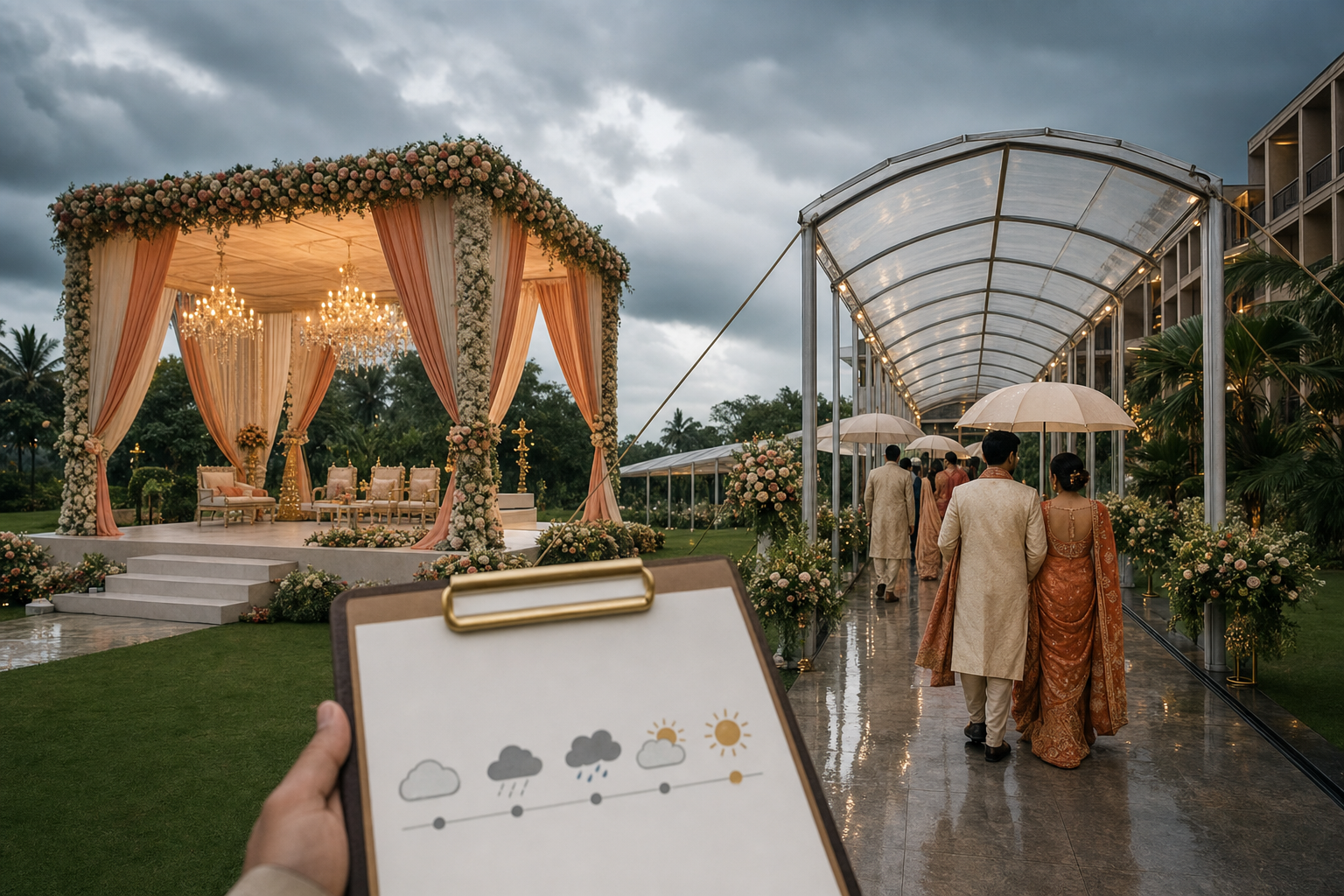
If rain is possible on your wedding day, the plan is not "we will see." The plan is: choose the covered backup space, set a decision deadline, pre-write the guest message, and tell every vendor what moves indoors before the wedding week begins.
This matters most for Indian destination weddings because one rain decision affects the mandap, baraat, varmala, pheras, sound, generator, catering, photography, elderly guests, shuttle timing, and 300 people who are already dressed. A calm rain plan makes the wedding feel managed. A last-minute rain scramble makes even a beautiful resort feel amateur.
Once the indoor or covered plan is confirmed, send one last-minute wedding update message with the new venue, arrival time, footwear note, shuttle change, and live itinerary link.
What should you do if it rains on your wedding day?
Use the backup plan you approved before the wedding week, then communicate one clean guest update. The family should not redesign the event in real time. The only real question on the day is whether Plan A or Plan B is active.
Rain on wedding day planning is the process of deciding, before the event, what moves indoors or under cover, who makes the weather call, when the call is made, and how guests and vendors receive the update.
Use this 10-minute decision rule:
| Situation | Decision | Why | | --- | --- | --- | | Light drizzle, covered guest seating, waterproof sound | Continue outdoors with umbrellas and aisle cover | Guest experience is still controlled | | Wet ground, exposed mandap, open wiring | Move to covered Plan B | Safety and rituals beat photos | | Thunder or lightning nearby | Move indoors | Do not debate outdoor safety | | Heavy rain forecast during guest arrival | Move before guests leave rooms | Arrival chaos is worse than a less scenic venue | | Rain expected after pheras only | Keep ceremony outside, move dinner or photos | Split the plan by event segment |
The mistake is treating rain as one yes/no decision for the whole wedding. For a multi-event Indian wedding, the mehndi, haldi, pheras, lunch, cocktail, and reception may each need a different threshold.
When should you make the rain call?
For a major outdoor Indian wedding function, make the final rain call 24 hours before guest arrival. Use a 7-day check to prepare vendors, a 48-hour check to confirm logistics, and the 24-hour call to activate the plan.
The decision timeline should look like this:
| Time before event | What to decide | Who owns it | | --- | --- | --- | | 30 days | Confirm backup venue, tent option, power, floor plan, and guest capacity | Planner + venue | | 14 days | Add rain notes to guest itinerary, welcome bag card, and vendor run sheet | Planner | | 7 days | Check forecast pattern and pre-alert vendors | Planner + venue | | 48 hours | Confirm shuttle route, decor move, sound placement, and covered entry | Planner + vendor leads | | 24 hours | Make Plan A/Plan B call and message guests | Couple-approved decision owner | | 3 to 4 hours | Only adjust small details: umbrellas, towels, aisle mat, photo timing | Day-of team |
Waiting until the sky opens looks flexible, but it is usually expensive. Decor teams need time to move florals and mandap pieces. Sound vendors need safe wiring. Caterers need service flow. Guests need enough notice to change footwear, leave rooms earlier, or carry umbrellas.
For India-specific weather context, the India Meteorological Department tracks the southwest monsoon and daily regional warnings through its monsoon information page. Use official forecasts for the decision, then use the venue's on-ground judgment for what the lawn, pathway, and power setup can actually handle.
What should be in the wedding rain backup plan?
A useful rain plan names the backup space, layout, vendor moves, guest path, communication owner, and non-negotiable safety rules. If it only says "indoor option available," it is not a plan.
Use this checklist before you sign the venue contract:
- Backup capacity. The covered space must fit the real guest count, not the optimistic RSVP count.
- Mandap placement. The priest, couple, fire rules, camera angles, and family seating all need to work indoors.
- Covered guest route. Guests should not walk 200 meters through rain between lobby, ceremony, dinner, and rooms.
- Dry floor. Wet marble, grass, and temporary ramps are a fall risk for lehengas, sarees, kids, and elders.
- Sound and power safety. Rain plus exposed wiring is not a romantic aesthetic. It is a shutdown trigger.
- Food service route. Caterers need a dry path from kitchen to buffet or plated service.
- Photo alternative. Pick two covered portrait spots before the wedding day.
- Baraat alternative. Decide whether the baraat becomes a covered lobby entrance, short indoor procession, or postponed segment.
- Umbrella and towel count. Keep umbrellas near room blocks, lobby exits, and shuttle points.
- Guest message template. Write it before anyone is emotional.
For destination weddings, connect this plan to the guest itinerary and hotel rooming list. Rain updates fail when the itinerary says one venue, the shuttle team has another, and the hotel desk is answering from yesterday's PDF.
What outdoor wedding details usually break in rain?
The parts that break first are not always the obvious ones. Couples worry about the mandap photo. Planners worry about guest arrival, exposed power, wet flooring, and vendors losing setup time.
Watch these failure points:
| Wedding detail | Rain risk | Better plan | | --- | --- | --- | | Baraat | Wet dhol, slippery dance path, late arrival | Short covered route or indoor welcome | | Varmala stage | Flowers sag, floor gets slippery | Covered stage with dry access from both sides | | Pheras | Sacred fire, priest seating, family seating exposed | Indoor mandap clearance and fire approval | | Haldi | Already messy, rain doubles cleanup | Semi-covered courtyard or poolside backup | | Mehndi | Artists need dry hands, good lighting, stable seating | Covered lounge with fans and lights | | Cocktail | Sound, lights, bar queue, wet heels | Indoor bar flow and covered photo point | | Dinner buffet | Food, guests, and service staff exposed | Covered buffet line or plated service switch | | Photography | Couple portraits lose golden hour | Covered arches, staircase, lobby, room balcony |
If lightning or thunder is involved, stop thinking like a photographer and start thinking like an event operator. The National Disaster Management Authority's thunderstorm and lightning guidance emphasizes preparedness, warning, and safe shelter planning for severe weather events (NDMA guidelines PDF). For a wedding, that means no exposed mandap, open lawn sound desk, or metal truss debate when a storm is active.
How do you tell guests about a rain plan?
Send one short, factual update from one source of truth. Guests do not need the family debate. They need where to go, when to arrive, what changed, and what to wear.
Use this WhatsApp template:
Quick update for tonight's mehndi: because of rain, the event has moved from the lawn to the Grand Ballroom. Guest arrival is still 6:30 PM. Shuttles will now pick up from the hotel lobby at 6:00 PM. Please wear comfortable footwear because the path may be wet. For schedule, venue, dress code, or transport questions, ask Mandap Chat here: [link].
Use this version for a wedding ceremony:
Weather update for the wedding ceremony: the pheras will now be held in [covered venue] instead of [outdoor lawn]. Guest arrival is [time]. The dress code is unchanged, but please avoid long trailing outfits or delicate heels because some walkways may be wet. Shuttle and venue details are updated here: [link].
The message should include:
- Event name.
- New venue or "no change" confirmation.
- Guest arrival time.
- Shuttle pickup point.
- Footwear or umbrella note.
- One help link.
- One urgent human contact only if needed.
Do not send five family members into five WhatsApp groups with five versions of the same update. That is how guests reach the wrong lawn in embroidered shoes.
How should the rain plan change by destination?
The right backup depends on the type of destination, not just the weather app. A Goa resort, Udaipur palace, Kerala backwater hotel, and Mussoorie hill property fail in different ways.
| Destination type | Main rain issue | Planning move | | --- | --- | --- | | Goa or coastal resort | Sudden showers, humidity, slippery decks | Covered beach-view venue, anti-frizz/dry towel station, indoor sound backup | | Udaipur or Jaipur palace | Courtyard drainage, long exposed walks | Ballroom or durbar hall backup, covered buggy path for elders | | Kerala resort | Heavy monsoon bursts, mosquitoes, damp seating | Fully covered meal plan, mosquito control, dry welcome desk | | Hill station | Fog, cold rain, road delays | Earlier shuttles, shawl note, indoor tea/snack station | | Farmhouse near Delhi | Heat plus dust storms or rain | Covered tent with flooring, generator safety, parking path |
The best venue walkthrough question is simple: "Show me exactly how 400 guests move if it rains at guest arrival time." If the venue manager hand-waves that answer, assume the backup has not been tested.
What should vendors confirm before the wedding week?
Every vendor should confirm what changes in Plan B, what costs extra, and how much notice they need. Rain plans become expensive when the couple discovers during the event that every move is an add-on.
Ask each vendor:
| Vendor | Rain-plan question | | --- | --- | | Venue | Is the backup space blocked exclusively for us, and until what time? | | Decor | What elements cannot move indoors after setup starts? | | Sound | Where is the covered sound desk and generator path? | | Photographer | What are the two covered portrait locations? | | Caterer | Can buffet service move indoors without changing timing? | | Priest | Is the indoor mandap approved for fire or ritual setup? | | Transport | What shuttle pickup changes if guests cannot walk outside? | | Hospitality desk | What answer will staff give guests who ask about weather? |
Tie these answers into the wedding vendor communication checklist and the wedding day run sheet. A rain plan that lives only in the planner's head is not a rain plan.
What should guests pack or change if rain is possible?
Guests need small, practical instructions, not a panic note. Tell them what footwear, outfit, and arrival changes make sense for the specific event.
Add this to the destination wedding packing reminder:
- Carry one compact umbrella or light rain jacket.
- Avoid delicate suede shoes or very high stilettos for outdoor events.
- Pack safety pins and a small plastic pouch for phones.
- Bring one backup blouse, shirt, or dupatta for multi-day events.
- Keep medicines and essentials in hand baggage, not a delayed suitcase.
- Use waterproof makeup for outdoor mehndi, haldi, or ceremony days.
- Leave 15 extra minutes for shuttles when rain is forecast.
For the broader luggage version, send the destination wedding packing list before guests travel. The rain note should be a small add-on, not a 30-point panic message.
How can Mandap Chat help with rain updates?
Mandap Chat helps by keeping the latest rain plan, venue update, shuttle timing, dress note, and FAQ in one place guests can ask in plain language. That matters because weather updates generate repetitive questions fast.
Upload these before the wedding week:
- Final itinerary.
- Plan A and Plan B venue names.
- Shuttle pickup points for both plans.
- Dress-code and footwear notes.
- Hotel desk and planner contact rules.
- Weather-trigger message templates.
- Guest packing reminders.
- Rain-safe photo and ceremony notes.
Then guests can ask:
- "Is the mehndi still outside?"
- "Do I need an umbrella for the pheras?"
- "Where is the shuttle pickup now?"
- "Can I wear heels if it rains?"
- "Has the baraat moved indoors?"
That is the real win. The couple still makes the decision, but guests stop turning every weather rumor into another family WhatsApp thread.
Final rain plan checklist
If these items are done before the wedding week, rain becomes an operational change instead of a crisis.
- Backup venue is held in writing.
- Indoor layout fits the real guest count.
- Mandap, sound, power, food, and photo plans are approved.
- Baraat and guest arrival alternatives are written.
- Weather decision owner is named.
- 7-day, 48-hour, and 24-hour decision points are in the run sheet.
- Guest message templates are pre-written.
- Hotel desk and shuttle teams have the same update.
- Mandap Chat or the wedding website reflects the latest venue plan.
- Umbrellas, towels, mats, and covered signage are assigned to someone.
Rain on a wedding day is not automatically a disaster. The disaster is letting 300 guests, 12 vendors, and 6 relatives discover the backup plan at the same time.
For a cleaner destination wedding, put the rain plan into the same system as your itinerary, room block, transport, and guest FAQ. Mandap Chat can hold those answers in one place, so when weather changes, guests get the latest version without making the couple's phone explode.
FAQ
What should you do if it rains on your wedding day?
Move quickly to the pre-approved covered plan, not a brand-new plan. Tell guests the updated venue, arrival time, footwear note, and transport change in one message, then let the planner confirm decor, sound, priest, food, and photography changes with vendors.
When should you make the rain call for an outdoor Indian wedding?
Make the final rain call 24 hours before a major outdoor function, with a 3 to 4 hour emergency check only for very short events. Indian weddings have decor, sound, priest, catering, baraat, and guest transport dependencies, so waiting until the last hour usually creates more damage than it prevents.
What is the best rain backup plan for a destination wedding?
The best backup plan is a covered venue that can hold the full guest count, has power and sound clearance, keeps the mandap visible, and does not require guests to walk through rain. A tent works only if drainage, flooring, side covers, entry paths, and generator safety are already confirmed.
How do you tell wedding guests about a rain plan?
Send one short message with the new location, arrival time, shuttle point, footwear advice, and a link to the live itinerary or Mandap Chat. Do not send multiple partial updates from different relatives because guests will trust the last message they saw, even if it is wrong.
Should you plan an outdoor wedding during monsoon in India?
You can plan one only if the outdoor space is treated as Plan A, not the only plan. For June to September weddings in many Indian destinations, build a covered ceremony, indoor meal path, protected sound setup, and guest communication plan before deposits are paid.
What vendors need the rain plan first?
The venue, decor team, sound team, photographer, caterer, priest, transport vendor, and planner need the rain plan first. These vendors control the physical move, power, ritual timing, guest flow, and food service, so they must confirm the backup layout before guests are informed.
Umbrellas and towels should also be assigned through the destination wedding emergency kit checklist, with separate owners for backstage, hospitality, and planner supplies. A rain box helps only when someone knows where it is and refills it after each function.
Frequently asked questions
What should you do if it rains on your wedding day?+
When should you make the rain call for an outdoor Indian wedding?+
What is the best rain backup plan for a destination wedding?+
How do you tell wedding guests about a rain plan?+
Should you plan an outdoor wedding during monsoon in India?+
What vendors need the rain plan first?+
Continue the series
A practical contract checklist for Indian destination weddings, designed to turn hotel promises into written commitments before the deposit becomes non-refundable.
A destination wedding lost luggage plan gives guests a carry-on backup, a clear airline reporting process, a local essentials kit, and one wedding-team contact who can solve event problems without taking over the airline claim.
A destination wedding flight details form collects one itinerary per traveller, while an arrival manifest turns those responses into pickup assignments, exception alerts, and guest-ready instructions.
A destination wedding hotel check-in message gives each guest the confirmed hotel, arrival window, booking or room-allocation rule, payment responsibility, luggage plan, and escalation contact before they reach reception.
A destination wedding save-the-date should tell guests the city, full wedding window, travel commitment, and where updates will live—without pretending every venue, hotel, or event detail is already final.