
Destination Wedding Flight Details Form: Guest Template
Use this destination wedding flight details form and arrival tracker to collect guest travel data, assign pickups, and prevent airport coordination chaos.
A destination wedding flight details form collects one itinerary per traveller, while an arrival manifest turns those responses into pickup assignments, exception alerts, and guest-ready instructions.
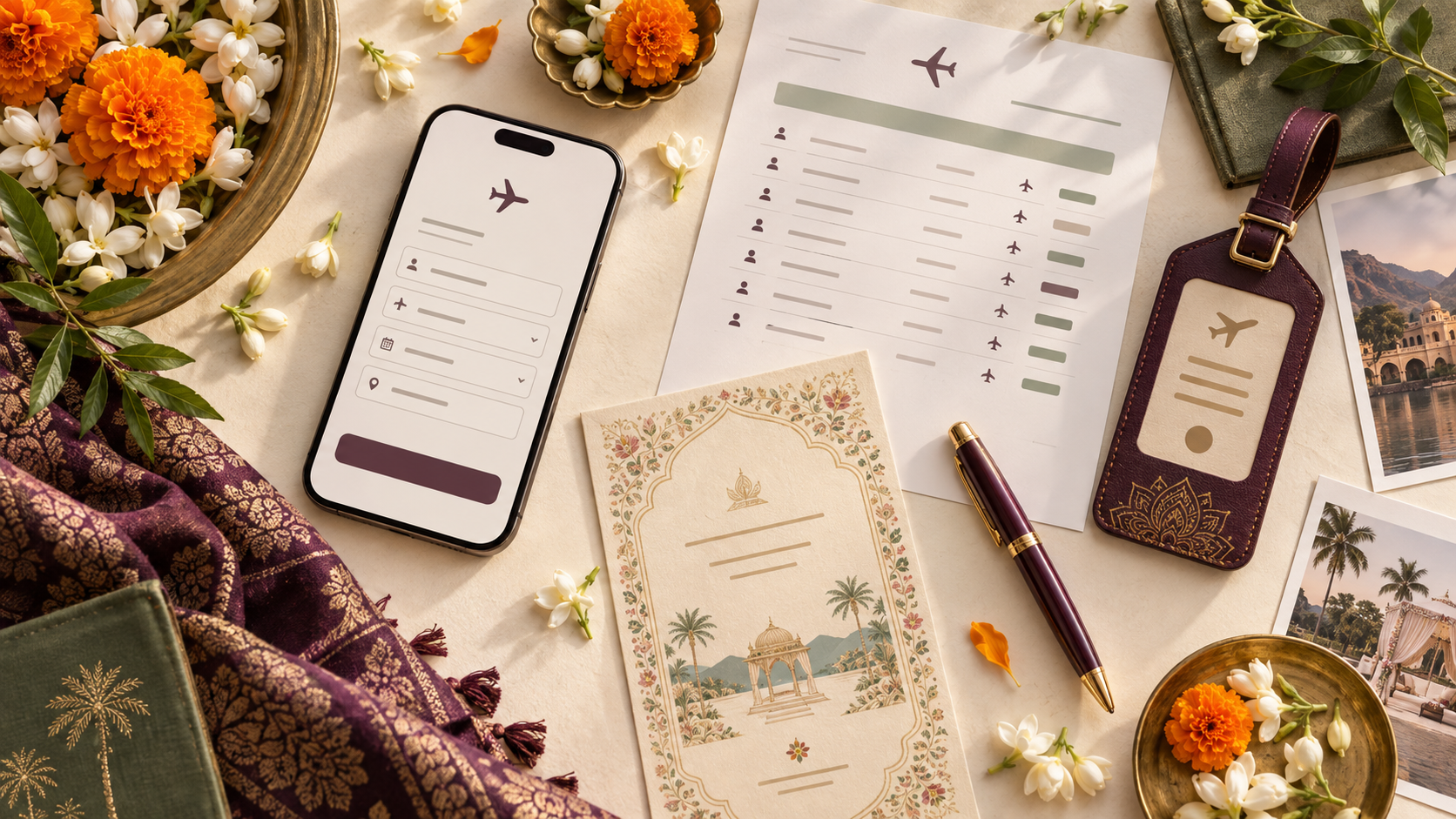
One guest writes “landing Friday evening.” Another sends a cropped ticket in the family group. A third changes flights but tells only the bride. By arrival day, the transport desk has three versions of the truth and a driver waiting at the wrong terminal.
Fix this with one form and one operational manifest. Collect one response per itinerary, require exact flight or train details, and stop accepting travel updates across scattered chats. Then use Mandap Chat for destination weddings to give guests the approved pickup, hotel and event answers without turning the couple into an arrivals helpline.
What is a destination wedding flight details form?
A destination wedding flight details form is a structured questionnaire used to collect each guest itinerary in a consistent format. It captures who is travelling, when and where they arrive, where they are staying, what assistance they need, and whether wedding transport is required. Its output should feed a live arrival manifest—not remain a pile of form responses.
The fast rule is simple: one response per distinct itinerary. Five relatives on the same flight going to the same hotel can submit together. A spouse arriving later, a guest using another terminal, or anyone needing different assistance gets a separate response.
What fields should the flight details form include?
Collect only information that changes a transport or hospitality decision. The essentials are traveller identity, contact number, exact itinerary, party size, luggage, destination hotel, assistance needs and departure plan. Avoid collecting passport scans, identity documents or unrelated personal data in a general wedding form.
Copy these fields into Google Forms, Typeform or your preferred wedding planning platform:
- Primary traveller's full name
- Mobile number with country code
- Names of accompanying travellers
- Total adults and children on this itinerary
- Arrival date in the destination's local time zone
- Travel mode: flight, train, bus, car or other
- Airline and flight number, or train and train number
- Origin city
- Scheduled arrival time
- Airport and terminal, or railway station
- Checked bags and oversized luggage
- Wheelchair, step-free access or child-seat requirement
- Confirmed hotel or accommodation
- Airport or station pickup required: yes, no or undecided
- Departure date, time, number and terminal or station
- Permission to share necessary logistics with the assigned transport team
Use conditional sections so a guest who selects “self-arrival” does not answer driver questions, while someone requesting a pickup must provide luggage and hotel details. Keep dietary preferences, room allocation and event RSVPs in their own workflows; combining everything makes updates harder to control.
What is the best copy-paste message for requesting flight details?
The best request explains why the data is needed, gives one deadline and sends guests to one form. It also tells them how to report a later change. Do not ask people to “send tickets here”; screenshots are difficult to search, easy to miss and often hide the arrival terminal.
Travel details for [Couple]'s destination wedding
We are arranging arrivals and hotel transport for [destination]. Please submit one form for each separate itinerary by [date]: [form link].
Keep your booking open while filling it so you can enter the exact flight/train number, arrival date, local arrival time, terminal/station, passenger count, luggage and hotel.
Travelling together on the same service to the same hotel? Submit one response for your group. Arriving separately? Submit separate responses.
If your itinerary changes after submission, use [edit link/change form] or message [travel coordinator] with your response name and the new details.
Send this privately or to a relevant travel group. For the wider communication sequence, use the destination wedding guest travel checklist so visa, baggage, accommodation and transport reminders arrive in the right order.
When should you collect guest travel details?
Open the travel form six to eight weeks before the wedding, when most guests have booked but there is still time to size the transport plan. Chase missing itineraries at four weeks and fourteen days, then create the first locked vehicle plan seven to ten days before arrivals begin.
| Timing | Action | Output | | --- | --- | --- | | 8-6 weeks before | Open form and explain pickup eligibility | First itinerary set | | 4 weeks before | Remind only non-responders | Fewer duplicate messages | | 14 days before | Request booking recheck and departure details | Confirmed arrival data | | 10-7 days before | Freeze initial grouping and vehicle count | Driver requirement | | 72 hours before | Reconfirm high-risk and changed journeys | Exception list | | Travel day | Monitor status and record actual arrival | Live pickup board | | After each pickup | Mark guest boarded and hotel reached | Closed journey |
Do not freeze edits completely. Instead, preserve the original response, timestamp every change, and alert the transport owner when a new arrival time affects an assigned vehicle.
How do you turn form responses into an airport pickup manifest?
Normalise every response into one row per itinerary, then group by airport, terminal, realistic arrival window, hotel and vehicle capacity. Every confirmed pickup needs an assigned vehicle, driver, coordinator, meeting point, guest contact, status and fallback action. A spreadsheet becomes operational only when every row has an owner.
Use these manifest columns:
| Column | Why it matters | | --- | --- | | Itinerary ID | Links the form response, vehicle and update history | | Lead guest + phone | Gives the coordinator one reachable contact | | Service number | Enables status checks against the correct journey | | Scheduled arrival + terminal | Prevents date, midnight and terminal errors | | Passenger and bag count | Determines safe vehicle capacity | | Hotel | Separates routes after pickup | | Assistance need | Flags accessible vehicle or meet-and-assist planning | | Vehicle + driver | Creates clear ownership | | Meeting point | Gives guest and driver the same location | | Status | Expected, delayed, landed, met, boarded, hotel reached | | Exception owner | Names the person who handles a failure |
Do not group solely by scheduled landing time. Allow for immigration, baggage reclaim, terminal transfers and mobility needs. Two flights landing fifteen minutes apart may produce guests an hour apart; two delayed flights may suddenly create one useful pickup group.
For vehicle-level execution, connect the manifest to a wedding shuttle schedule template instead of making drivers interpret the raw form sheet.
How should you handle changed or delayed flights?
Use one change channel and make every update produce a visible manifest alert. The guest should provide their name, original service, new service, new local arrival time and whether the passenger count changed. The transport lead then confirms whether the original pickup still works or sends a replacement instruction.
Use this decision table:
| Situation | Action | Guest message | | --- | --- | --- | | Minor delay; same vehicle window | Keep assignment and update ETA | “Your pickup remains confirmed at [meeting point].” | | Delay breaks shared transfer | Reassign vehicle before promising timing | “We are updating your pickup and will confirm by [time].” | | Terminal changes | Verify driver access and resend meeting point | “Meet at [specific location] in Terminal [X].” | | Missed connection | Move row to exception queue | “Send the new confirmed service once rebooked.” | | Guest chooses self-transfer | Cancel only after written confirmation | “Your wedding pickup is cancelled as requested.” | | Driver cannot locate guest | Call lead guest, check meeting point, escalate | “Stay at [landmark]; [coordinator] is calling you now.” |
Never tell a delayed guest that a replacement vehicle is confirmed until a driver and vehicle actually accept the assignment. If the hotel instruction also changes, send the final hotel check-in message in the same private thread.
What privacy rules should the form follow?
Collect the minimum information needed for the journey, restrict the response sheet to the planning and transport leads, and share only the relevant pickup rows with each driver. Do not post a full arrival manifest in a wedding WhatsApp group or give every vendor access to all guest phone numbers and itineraries.
Add a short notice beside the submit button:
We use these details to coordinate wedding travel, accommodation and guest support. Necessary itinerary and contact details may be shared with the assigned planner, transport provider, driver or hotel team. Access is limited to the wedding operation and retained only as long as needed for coordination and follow-up.
Ask the planner or event company to align this notice and retention period with its actual privacy obligations. Operational convenience is not a reason to keep guest travel data forever.
How can Mandap Chat reduce arrival-day questions?
Mandap Chat can answer routine questions from the approved plan: whether pickup is confirmed, where to meet, which hotel a guest should reach, when the first event begins and who handles a genuine exception. It should not invent a driver assignment or expose another guest's itinerary.
Before sharing the guest link, test these conversational questions:
- “Did you receive my flight details?”
- “Where do I meet the driver at Terminal 2?”
- “Can three suitcases fit in my assigned car?”
- “My flight is delayed; what should I update?”
- “Which hotel am I going to?”
- “Who do I call if I cannot find the driver?”
- “What time is the first event after check-in?”
For planners handling multiple families, Mandap Chat for wedding planners keeps approved answers available without forcing the same coordinator to repeat them across dozens of private chats.
FAQ
What should a destination wedding flight details form include?
Collect the traveller's name, mobile number, arrival date, transport mode, flight or train number, origin, scheduled arrival time, terminal or station, passenger count, luggage, accessibility or child-seat need, hotel, departure details, and permission to share operational data with the assigned transport team.
When should you collect wedding guest flight details?
Open the form six to eight weeks before the wedding, send reminders at four weeks and fourteen days, and lock the first transport plan seven to ten days before arrival. Keep a controlled exception process for genuine itinerary changes.
Should each family submit one form or should each guest submit separately?
Use one response per itinerary. Guests travelling together on the same service and going to the same hotel can share a response; different arrivals, terminals, hotels or assistance needs require separate entries.
How do you turn flight responses into an airport pickup plan?
Normalise dates and times, group travellers by airport, terminal, arrival window, hotel and vehicle capacity, then assign a vehicle, driver, coordinator, meeting point and fallback contact to every confirmed pickup row.
How can Mandap Chat help with destination wedding arrivals?
Mandap Chat can answer approved guest questions about pickup status, meeting points, driver details, hotel check-in and event timing, while routing missed connections, accessibility changes and transport failures to a named human coordinator.
Frequently asked questions
What should a destination wedding flight details form include?+
When should you collect wedding guest flight details?+
Should each family submit one form or should each guest submit separately?+
How do you turn flight responses into an airport pickup plan?+
How can Mandap Chat help with destination wedding arrivals?+
Continue the series
A practical contract checklist for Indian destination weddings, designed to turn hotel promises into written commitments before the deposit becomes non-refundable.
A destination wedding lost luggage plan gives guests a carry-on backup, a clear airline reporting process, a local essentials kit, and one wedding-team contact who can solve event problems without taking over the airline claim.
A destination wedding hotel check-in message gives each guest the confirmed hotel, arrival window, booking or room-allocation rule, payment responsibility, luggage plan, and escalation contact before they reach reception.
A destination wedding save-the-date should tell guests the city, full wedding window, travel commitment, and where updates will live—without pretending every venue, hotel, or event detail is already final.
Before booking an Indian destination wedding venue, test the property as a three-day guest operation: rooms, meals, event spaces, weather backup, transport, vendor access, sound limits, and one clear communication system.