
Wedding Vendor Payment Schedule Template for Indian Weddings
Use this wedding vendor payment schedule template to track advances, balances, GST invoices, approval owners, and final-week payment blockers.
A wedding vendor payment schedule should show what is due, when it is due, who can approve it, what proof is required, and whether a late payment can block setup. Use this Indian wedding template to keep vendor money calm before production week.
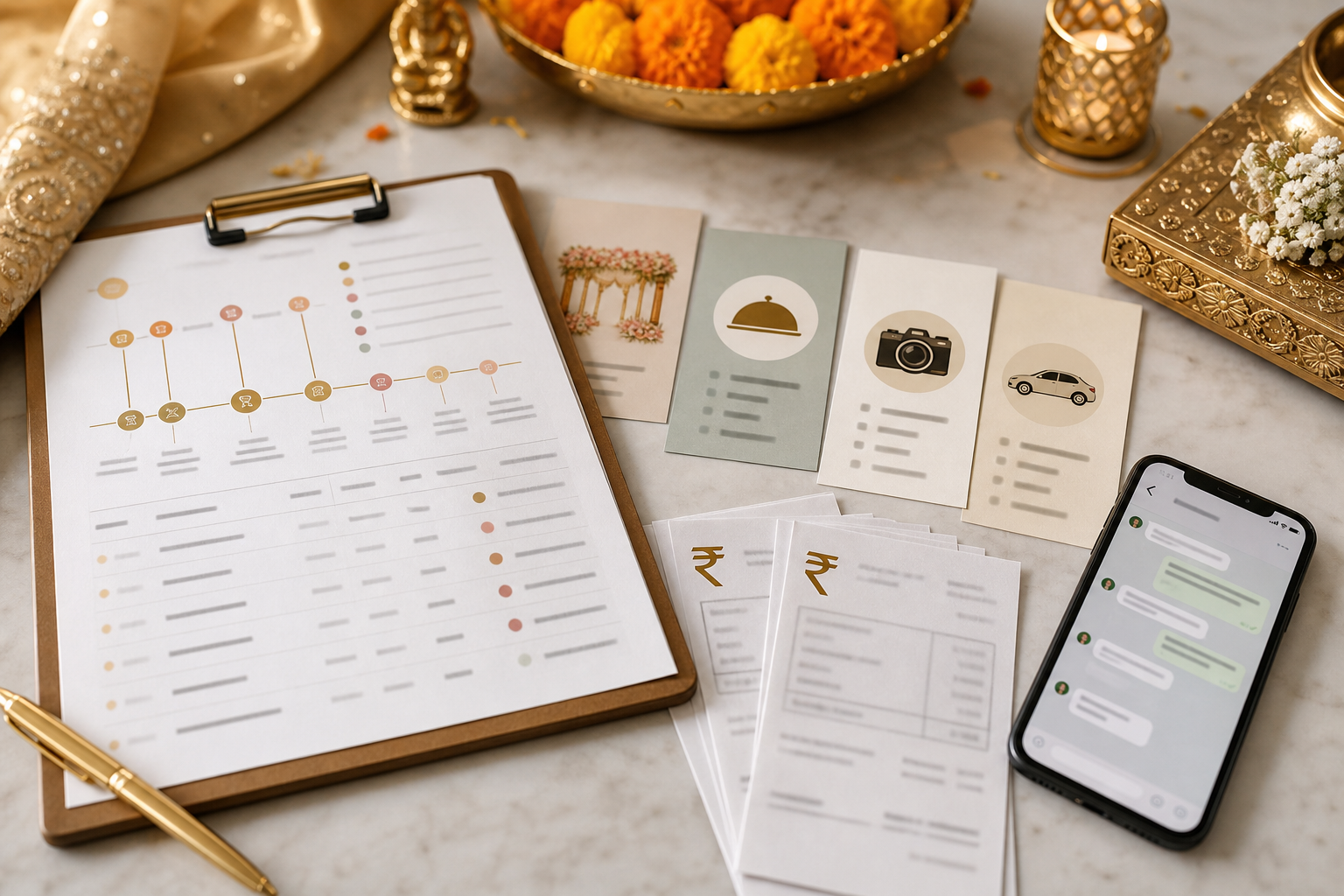
The scary payment problem is not "we forgot one vendor." It is the decorator waiting at the venue gate, the sound team asking for balance release before setup, the photographer's assistant calling the bride's brother, and nobody knowing whether the payment was approved, sent, or only promised in a WhatsApp message.
The outcome you want is boring: every vendor knows when they will be paid, the family knows who can approve money, and the planner knows which payment can block production. This wedding vendor payment schedule gives Indian wedding planners and families one clear command sheet before the final week begins.
Fast rule: if a payment can stop setup, delivery, travel, food service, rituals, photography, sound, transport, or hotel coordination, it belongs in the payment schedule. If it is only a post-event deliverable, keep it visible but do not let it distract the production team.
What is a wedding vendor payment schedule?
A wedding vendor payment schedule is a tracker that shows every vendor advance, milestone payment, balance due date, approval owner, payment method, invoice status, receipt proof, and event-day blocker. It turns "Dad will handle it" into a visible operating plan.
A wedding vendor payment schedule is the private finance tracker that tells the planner and family what is due, when it is due, who can approve it, and whether a delayed payment can block the wedding.
For Indian weddings, the payment schedule matters because there are usually many vendors across multiple functions: venue, decor, catering, photography, makeup, sound, lights, priest, transport, hospitality, artists, rentals, gifting, stationery, security, and hotel coordination. One missing balance can create a chain reaction.
Use the schedule as a production document, not as an accounting textbook. For couples paying Indian vendors from abroad, layer this with the NRI wedding vendor payment checklist so exchange routes, Indian account owners, and transfer proof do not sit in private chats. It should answer five questions quickly:
- Who needs to be paid?
- What milestone or event does this payment unlock?
- Who approves the payment?
- What proof confirms it is done?
- What happens if it is not done before production week?
What should the payment schedule include?
A useful wedding payment schedule should include the vendor, event, milestone, amount due, due date, approval owner, payment method, invoice status, receipt proof, and blocker risk. Anything less will force the planner to chase context during the most expensive week.
Use this template:
| Field | What to enter | Why it matters | | --- | --- | --- | | Vendor category | Decor, catering, photography, transport | Lets the planner filter quickly | | Vendor name | Company or individual name | Prevents confusion between brands and contacts | | Event/function | Haldi, mehendi, sangeet, wedding, reception | Multi-day weddings need event-wise clarity | | Milestone | Advance, mid-production, pre-event balance, post-event holdback | Shows why the payment exists | | Amount due | Exact amount in INR | Avoids "around 2 lakh" conversations | | Due date | Calendar date and time if urgent | Stops event-day surprises | | Approval owner | Parent, couple, finance owner, planner | Names the person who can release money | | Payment method | Bank transfer, UPI, card, cheque, cash | Helps collect the right proof | | Invoice status | Received, pending, corrected, not required | Keeps tax and receipt work visible | | Receipt proof | Screenshot, UTR/reference ID, vendor confirmation | Ends "was it sent?" arguments | | Setup blocker? | Yes, no, partial, contract-dependent | Tells production what can stop execution | | Escalation contact | Vendor owner or finance owner | Gives the planner a next move |
The most important column is "setup blocker." A late album payment is annoying. A late caterer balance can become a dinner-service problem. Treat them differently.
When should Indian wedding vendors be paid?
Most Indian wedding vendor balances should be scheduled before production week, with critical setup vendors cleared 7 to 14 days before the first event unless the contract says otherwise. Holdbacks should be written into the contract, not invented at the venue.
Use this practical timing:
| Timing | Payment task | Best owner | | --- | --- | --- | | Booking day | Pay advance and save signed quote or contract | Couple or family finance owner | | 60 to 45 days out | Check milestone payments for venue, decor, catering, photo/video | Planner plus finance owner | | 30 days out | Confirm every remaining due date and invoice requirement | Planner | | 14 days out | Clear critical setup balances or schedule exact release dates | Finance owner | | 7 days out | Mark blockers, pending receipts, and approval gaps | Planner operations lead | | 48 hours out | Freeze "paid / due / holdback" status in production sheet | Lead planner | | Post-event | Release written holdbacks after deliverables are confirmed | Finance owner |
Do not use event day as the normal payment day for critical vendors. Event day is for execution, not finance admin. If a balance must be released on event day, write the exact trigger: "release after decor setup sign-off by 4:00 PM" is better than "pay after setup."
How do advances, balances, and holdbacks work?
Advances lock the vendor, balances unlock execution, and holdbacks protect post-event deliverables. The mistake is treating all three like casual transfers instead of separate commitments.
Use this decision table:
| Payment type | What it should do | Common mistake | | --- | --- | --- | | Advance | Reserve date, team, venue slot, or material purchase | Paying without scope, date, or cancellation terms | | Milestone payment | Fund production work before the event | Forgetting what milestone the amount is tied to | | Pre-event balance | Clear the vendor to execute | Leaving it for the wedding morning | | Event-day release | Pay after visible setup or service check | No named approver on-site | | Post-event holdback | Protect albums, raw files, returnable items, damage checks | Holding money without contract language |
If the family wants to keep a holdback, agree it before signing. Last-minute holdbacks can poison vendor trust and create unnecessary conflict. The planner's job is not to negotiate under pressure. The planner's job is to make the pressure visible early.
Who should own vendor payments?
One finance owner should approve and release vendor payments. The planner can track dates, blockers, receipts, and reminders, but the planner should not become the family's bank account or the couple's emergency payment desk.
Use this ownership map:
| Role | Should own | Should not own | | --- | --- | --- | | Family finance owner | Payment approvals, release timing, proof collection | Guest FAQs, vendor setup calls | | Lead planner | Tracker, reminders, blocker alerts, escalation notes | Personal liability for payments | | Couple | Final approval for major exceptions | Routine vendor balance calls | | Vendor owner | Correct invoice, bank details, receipt confirmation | Chasing random relatives | | Planner assistant | Updating paid status and receipt links | Approving money independently |
The cleanest setup is one shared payment sheet, one finance owner, and one planner escalation rule. If a vendor calls anyone else, the answer is simple: "Please send this to the finance owner and planner group."
What payment proof should you collect?
Collect enough proof that the planner, family, and vendor can all agree on status without searching five phones. For bank transfers and UPI payments, save the transaction reference, screenshot, date, amount, payer name, and vendor acknowledgement.
For UPI, the National Payments Corporation of India describes UPI as a system that powers immediate money transfers through a virtual payment address or linked bank account (NPCI UPI overview). That speed is useful for weddings, but speed is not the same as documentation. A screenshot without vendor acknowledgement can still leave ambiguity.
For invoices and GST details, use the vendor's own invoice and keep corrections in writing. The GST portal explains invoice and registration concepts for taxpayers, and planners should treat tax information as a recordkeeping item, not as event-day guesswork (GST taxpayer resources).
Create one proof folder with:
- Vendor contract or signed quote.
- Invoice or payment request.
- Bank/UPI details supplied by the vendor.
- Payment screenshot or bank reference.
- Vendor acknowledgement.
- Final paid status in the schedule.
Do not rely on voice notes for money. If someone approves payment by voice note, convert the action into text: amount, vendor, due date, approval owner, and next step.
How do you prevent payment blockers during production week?
Prevent payment blockers by doing a seven-day finance check before the first event and a 48-hour freeze before production starts. The goal is to know which vendors are fully clear, which have written holdbacks, and which can stop work if money is late.
Use this seven-day check:
- Open the wedding vendor contact list.
- Match every vendor in the contact list to a payment row.
- Mark critical vendors: venue, decor, catering, sound, lights, photo/video, transport, priest, hotel, artist managers.
- Confirm balance status with each vendor owner.
- Add invoice or receipt proof links.
- Name the finance owner for every pending amount.
- Move guest-facing questions to Mandap Chat for wedding planners, not the finance thread.
- Add unresolved blockers to the wedding production week checklist.
The failure mode is predictable: the planner is answering shuttle questions, the family finance owner is at a ritual, and a vendor needs release approval before setup. Separating guest support from vendor finance is what keeps that from becoming a public crisis.
How should planners message vendors about payment status?
Payment messages should be specific, short, and tied to the contract. Do not send vague lines like "will clear soon." Send the amount, date, milestone, proof required, and contact person.
Copy this vendor message:
Hi [Name], payment confirmation for [Wedding / Event].
Vendor: [Company] Milestone: [Advance / Balance / Setup release / Holdback] Amount: Rs [amount] Due date: [date] Approval owner: [name] Proof needed: invoice + receipt confirmation
Please confirm your invoice, payment details, and whether this amount is required before setup.
For the family finance owner, use this shorter internal message:
Payment blocker check: [Vendor] has Rs [amount] due by [date]. It affects [setup/service/delivery]. Please approve or decline by [time] so the planner can update the production sheet.
This is where the wedding planner client update template helps. If payment approvals are already appearing in weekly updates, the final week is much calmer.
What is the 48-hour payment freeze?
The 48-hour payment freeze is the final payment status that production uses during the wedding. It shows which vendors are paid, which have approved pending releases, and which post-event holdbacks are intentional.
Freeze these fields:
- Vendor name and event.
- Amount paid.
- Balance due.
- Due date or release trigger.
- Approval owner.
- Receipt/proof link.
- Setup blocker status.
- Vendor acknowledgement.
- Escalation contact.
- Post-event holdback amount and deliverable.
After the freeze, do not let casual family conversations rewrite payment terms. Allow only real corrections: wrong amount, wrong bank detail, missing invoice, urgent vendor access issue, or a contract term that was missed.
Where does Mandap Chat fit?
Mandap Chat does not replace the planner's payment tracker. It protects the people running the tracker from guest noise.
During the final week, guests ask about venue pins, shuttle timing, dress code, food, room check-in, weather, after-party access, and kids policy. Those questions are valid, but they should not land in the same phone where vendor balances, setup approvals, and finance escalations are being handled.
Upload the guest-facing answers into Mandap Chat, then keep the private payment schedule with the planner and finance owner. The planner should be watching vendor risk, not typing "the mehendi starts at 4 PM" for the 80th time.
The 20-minute payment schedule setup
If production week has already started, build the 80/20 version now.
- List every vendor who is active in the next seven days.
- Add total amount, paid amount, and balance amount.
- Mark whether the balance blocks setup or delivery.
- Add one finance approval owner.
- Add invoice and receipt proof links.
- Confirm pending balances with vendors in writing.
- Move every guest question into one guest-support channel or Mandap Chat.
- Add the payment blocker list to the private run sheet.
- Recheck the list 48 hours before the first event.
The goal is not perfect accounting. The goal is a wedding week where no vendor, parent, planner, or couple has to ask, "Wait, did we pay them?"
FAQ
What is a wedding vendor payment schedule?
A wedding vendor payment schedule is a private tracker that shows every vendor advance, milestone payment, balance due date, approval owner, payment method, invoice status, receipt proof, and event-day blocker.
When should Indian wedding vendor balances be paid?
Schedule critical vendor balances 7 to 14 days before the first event unless the contract says otherwise. If money is held until setup or delivery, write the exact trigger and approval owner into the payment schedule.
Who should own wedding vendor payments?
One finance owner should approve and release payments. The planner should track due dates, blockers, proof, and escalation, but should not become the default payer or the couple's event-day finance desk.
What payment details should planners collect from vendors?
Collect vendor legal name, invoice number, GST details when applicable, bank or UPI details, payment milestone, due date, approval owner, paid amount, balance amount, receipt proof, and setup-blocker status.
How does Mandap Chat help with vendor payment chaos?
Mandap Chat keeps guest questions away from the planner's vendor and finance phone. That gives the planner more attention for balances, receipts, setup approvals, and urgent vendor escalation during production week.
Frequently asked questions
What is a wedding vendor payment schedule?+
When should Indian wedding vendor balances be paid?+
Who should own wedding vendor payments?+
What payment details should planners collect from vendors?+
How does Mandap Chat help with vendor payment chaos?+
Continue the series
A wedding planner escalation matrix assigns each type of problem a severity, response time, first owner, final decision owner, and communication route before the wedding begins.
Wedding planner quality control is a separate verification pass that checks whether approved details match across contracts, run sheets, vendor briefs, venue plans, and guest communication before execution begins.
An NRI wedding budget in India should be built in INR around guest count, city, event count, room nights, and production complexity—then protected with separate currency and contingency buffers.
Wedding plus-one wording should state exactly who is invited, where the guest adds their companion's name, and whether the rule applies to every function. Clear language feels kinder than a vague invitation followed by an awkward refusal.
Wedding vendor meals keep photographers, planners, drivers, decor, sound, and hospitality teams working through long Indian wedding functions. Count crew by event, confirm dietary needs, schedule service before the guest rush, and give one caterer captain the final list.