
NRI Wedding Family Approval Checklist: Who Decides What Before the Wedding
Use this NRI wedding family approval checklist to assign decision owners for budget, guest list, vendors, rituals, travel, hotel, and final-week changes.
An NRI wedding family approval checklist names who can approve money, vendors, guest-list changes, rituals, travel rules, hotel commitments, and final-week updates before every decision turns into a midnight WhatsApp debate.
Use this approval checklist alongside the 12-month NRI wedding planning timeline: the timeline says when a decision is due, while this page says who can make it without reopening the family debate.
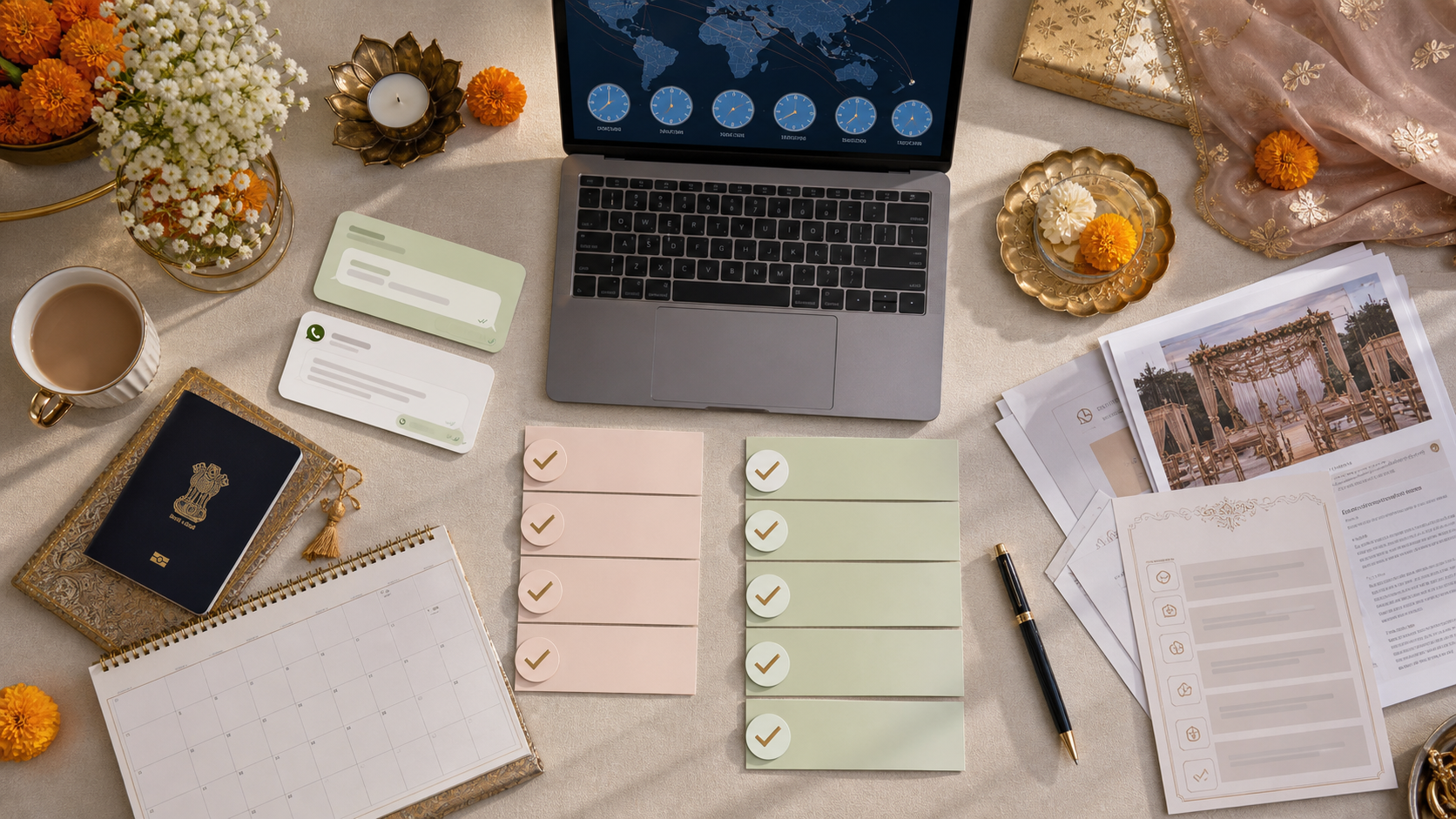
The most expensive NRI wedding delay is not a slow decorator or a late RSVP. It is a decision that everyone thought someone else had approved.
The bride says yes to the sangeet stage. The groom's father asks for a smaller quote. The planner pauses production. A cousin in India tells the vendor to wait. The couple wakes up in New Jersey to 47 messages and no actual decision.
The fast rule: before you ask vendors, guests, hotels, or relatives to act, decide who can approve what. An NRI wedding planning checklist is useful only when it includes approval owners, deadlines, and escalation rules.
What is an NRI wedding family approval checklist?
An NRI wedding family approval checklist is a private planning sheet that names the person who can approve each major wedding decision. It covers budget, vendors, guest list, rituals, hotel rooms, travel support, guest messages, payments, and final-week exceptions.
An NRI wedding family approval checklist is the decision map that stops a wedding planned across time zones from becoming a permanent family WhatsApp debate.
It is different from the public itinerary or guest FAQ. Guests do not need to see who approved the decor budget. Vendors do need to know whether one parent, both parents, the couple, or the planner can say yes.
Use this alongside the broader NRI wedding planning guide and the guest-facing planning from abroad checklist. Those pages explain the overall system. This page solves the hidden failure mode: approval confusion.
Which decisions need approval before planning moves?
NRI couples should pre-approve anything that can change money, timing, vendor scope, guest experience, or family expectations. If a missing answer can delay a contract, confuse guests, or trigger a parent call at 2 AM, it belongs in the approval checklist.
Use this decision table first:
| Decision area | Approval owner | Deadline | What happens if it is unclear | | --- | --- | --- | --- | | Total budget ceiling | Couple plus finance parents | Before venue shortlist | Every vendor quote gets re-debated | | Guest-list cap | Both family leads | Before invitations | Rooms, food, seating, and transport drift | | Venue and date | Couple plus hosting parents | Before vendor outreach | No vendor can quote accurately | | Vendor shortlist | Couple and planner | Before calls | Too many options stay alive | | Final vendor booking | Finance owner plus couple | Before advance payment | Deposits stall or get paid twice | | Ritual timing | Family ritual owner plus priest | Before run sheet | Photo, decor, food, and guest timing break | | Hotel coverage rule | Finance owner plus hospitality lead | Before room block note | Guests receive mixed payment answers | | Airport pickup rule | Hospitality lead | Before travel form | Every arrival becomes a private request | | Guest message wording | Couple or planner | Before broadcast | Guests screenshot old or unofficial details | | Final-week exceptions | One escalation owner | 14 days out | Everyone becomes an approver |
The goal is not to make planning more formal. The goal is to make the informal family system visible enough that decisions move.
Who should approve what in an NRI wedding?
Use one primary owner for each decision type. Shared input is fine; shared approval is where decisions go to die. For NRI weddings, the cleanest model is couple-owned priorities, parent-owned family commitments, planner-owned operations, and one India-side lead for urgent local issues.
Here is the practical split:
| Role | Should approve | Should not approve alone | | --- | --- | --- | | Couple | Priorities, guest experience, style direction, final trade-offs | Family money promises they are not funding | | Family finance owner | Budget ceiling, vendor advances, room coverage, payment releases | Guest-facing wording or event flow | | India-side lead | Local visits, sample checks, vendor handoffs, urgent on-ground calls | Major budget changes | | Planner | Production timing, vendor coordination, feasibility warnings | Family politics or money commitments | | Ritual owner | Ceremony sequence, priest coordination, family traditions | Decor, guest travel, or vendor payment terms | | Hospitality lead | Hotels, shuttles, welcome desk, airport pickup rules | Visa advice or private guest exceptions |
For many NRI weddings, one parent in India becomes the default decision maker because they are awake, nearby, and respected by vendors. That can work, but only if everyone knows their authority limit. "Can approve up to Rs 50,000 without a call" is useful. "Ask Mom" is not.
What should be frozen before vendors are booked?
Before booking major vendors, freeze the budget range, guest-count range, event list, venue/date, approval owner, and deposit rule. A vendor conversation without those facts turns into mood-board shopping instead of planning.
Use this pre-vendor checklist:
- Total working budget and stretch ceiling.
- Number of events and rough guest count per event.
- Venue city, date range, and non-negotiable ritual timing.
- Vendor categories that must be premium versus practical.
- One approval owner for each vendor category.
- Maximum advance amount that can be paid without another family call.
- Contract-signing rule: who signs, who pays, who stores the quote.
- India-side person who can attend tastings, sample reviews, or walkthroughs.
If the family has not answered these, pause. A two-day approval conversation now is cheaper than changing caterer scope, decor layouts, or photography coverage later.
This is also where a planner's intake should connect with your wedding planner questionnaire. The questionnaire collects facts; the approval checklist decides who can act on them. If the decision involves money moving from abroad, add it to the NRI wedding vendor payment checklist before the vendor starts chasing the nearest awake relative.
What family decisions should be made before guest communication?
Before messaging guests, approve the hotel rule, event access, RSVP deadline, travel support, dress code, food policy, gift guidance, and emergency contact path. Guest confusion usually comes from family members giving different answers, not from guests being difficult.
Freeze these guest-facing decisions:
| Guest question | Decision to approve internally | | --- | --- | | "Am I invited to every event?" | Event-wise invitation rules | | "Where should I stay?" | Official hotel and backup hotel | | "Who pays for the room?" | Hosted rooms versus guest-paid rooms | | "Is airport pickup arranged?" | Pickup eligibility and arrival windows | | "What should I wear?" | Event-wise dress code and cultural notes | | "Can I bring my child?" | Kids policy by event | | "What food is available?" | Vegetarian, Jain, vegan, allergy, and alcohol rules | | "Who do I call if something goes wrong?" | Emergency contact versus routine question path |
Once those decisions are approved, turn them into the NRI wedding guest communication timeline, itinerary, RSVP form, and Mandap Chat knowledge base.
Do not send a guest logistics pack while the family is still debating hotel coverage or pickup rules. Guests can handle almost any rule when it is clear. They get frustrated when one uncle says "the family is covering rooms" and the official hotel note says "pay directly."
How do you handle time-zone approvals without slowing everything down?
Time-zone approvals work when decisions are batched, deadlines are visible, and urgent exceptions have a smaller approval path. Do not let every color, quote, and rooming question become a full-family video call.
Use the NRI wedding planning meeting agenda as the weekly operating layer for this checklist: send the decisions before the call, approve the most expensive blockers first, and read every owner and deadline back before the call ends.
Use this rhythm:
- Weekly decision call for big items: venue, budget, vendors, guest cap, rituals.
- 24-hour approval window for vendor quote revisions.
- 12-hour approval window for guest-facing wording.
- Immediate approval path only for event-week issues that affect safety, access, timing, or vendor setup.
- Written decision log after every call.
The decision log can be simple:
| Date | Decision | Owner | Final answer | Where it is used | | --- | --- | --- | --- | --- | | 8 July | Hotel payment rule | Finance owner | Guests pay directly except elders and wedding party | Invitation, hotel note, Mandap Chat | | 8 July | Haldi dress code | Couple | Yellow/white, flats, clothes may stain | Website, WhatsApp reminder | | 8 July | Airport pickup cutoff | Hospitality lead | Official pickups only 10 AM to 10 PM | Travel form, arrival messages |
This is the boring admin that saves the wedding. Without it, people remember different versions of the same call.
What should the family approval checklist look like?
The checklist should be short enough that people use it and specific enough that nobody can hide behind vague agreement. Build it as one sheet with decision, owner, deadline, budget impact, guest impact, status, and source-of-truth link.
Use these columns:
| Column | Example | | --- | --- | | Decision | "Reception alcohol service" | | Category | Food and beverage | | Owner | Groom's parents | | Contributors | Couple, planner, venue manager | | Needed by | 20 July | | Budget impact | Bar quote and corkage | | Guest impact | Reception FAQ and menu note | | Current status | Pending family approval | | Final answer | "Beer, wine, and two cocktails; no hard bar" | | Source link | Client update, guest FAQ, Mandap Chat document |
Keep the final answer in plain language. If a guest or vendor could misunderstand it, rewrite it.
How should planners use this checklist with clients?
Planners should use the approval checklist as the bridge between intake, weekly updates, vendor briefs, and guest communication. It tells the planner who needs to decide, not just what needs to happen.
Add a short approval section to every wedding planner client update:
Decisions needed this week:

1. Hotel room coverage rule
Owner: Bride's parents
Needed by: Friday
Why it matters: The hotel note and guest FAQ cannot go out until this is final.

2. Sangeet dinner service style
Owner: Couple
Needed by: Sunday
Why it matters: Caterer quote and floor plan depend on this.
The planner should not become the judge of family politics. The planner should make the missing approval visible early enough that the family can resolve it.
Where does Mandap Chat fit after approvals?
Mandap Chat should receive the approved guest-facing answers, not the messy internal debate. Upload the final schedule, hotel rules, pickup rules, dress codes, food notes, gift guidance, first-time guest explanations, and emergency contacts only after the family agrees. If the same decision keeps resurfacing in chat, add NRI wedding WhatsApp group rules so the family knows what counts as final.
That separation matters:
| Internal decision | Guest-facing Mandap Chat answer | | --- | --- | | "Family covers elders and wedding party only" | "Most guests should book and pay directly through the hotel block. If your room is hosted, the family will tell you separately." | | "Pickup only for 10 AM to 10 PM arrivals" | "Official airport pickup is available for arrivals between 10 AM and 10 PM after you submit the travel form." | | "Haldi on lawn, turmeric stains likely" | "Wear yellow or white, choose flats, and avoid delicate clothes because haldi may stain." | | "No kids at after-party" | "Children are welcome at the reception, but the late-night after-party is adults-only." |
Mandap Chat for NRI couples is useful because guests ask across time zones: "Is my hotel covered?", "Can I wear black?", "Do I have pickup?", "Which events am I invited to?" The answer should come from approved decisions, not whichever relative is awake.
What is the 20-minute setup?
If planning is already moving and the family approval system is messy, build the 80/20 version now.
- List the next 20 decisions that affect money, guests, vendors, rituals, or timing.
- Assign one owner to each decision.
- Add a needed-by date.
- Mark whether the decision affects guests.
- Mark whether the decision affects a vendor payment or contract.
- Write the current best answer in one sentence.
- Review the list on one family call.
- Move approved guest-facing answers into the wedding website, WhatsApp templates, and Mandap Chat.
- Move private vendor or money decisions into the planner's tracker.
- Revisit the checklist weekly until production week.
The point is not to make an NRI wedding feel corporate. The point is to stop the same decision from being made six times in four WhatsApp groups.
FAQ
What is an NRI wedding family approval checklist?
An NRI wedding family approval checklist is a private planning sheet that names who can approve budget changes, vendors, guest-list additions, rituals, travel commitments, hotel rooms, guest messages, and final-week exceptions for an Indian wedding planned across countries.
Who should approve decisions in an NRI wedding?
Use one primary approval owner per decision type. The couple should own priorities and guest experience, parents should own family commitments and budgets, the planner should own operational timing, and one India-side lead should handle urgent local calls.
When should NRI couples create the family approval checklist?
Create it before booking major vendors, ideally 10 to 12 months before the wedding. If the wedding is closer, build it before invitations, hotel notes, room blocks, airport pickup messages, or guest logistics packs go out.
What decisions need family approval before an Indian wedding?
Approve the budget ceiling, guest-list cap, event list, venue, vendor selection, food rules, ritual timing, hotel coverage, travel support, dress code, payment releases, and who can approve last-minute changes.
How does Mandap Chat help after decisions are approved?
Mandap Chat turns approved decisions into consistent guest answers. Once the family confirms the schedule, hotel rule, dress code, travel policy, food notes, and emergency contacts, guests can ask routine questions without pulling the couple back into every thread.
Frequently asked questions
What is an NRI wedding family approval checklist?+
Who should approve decisions in an NRI wedding?+
When should NRI couples create the family approval checklist?+
What decisions need family approval before an Indian wedding?+
How does Mandap Chat help after decisions are approved?+
Continue the series
A wedding planner escalation matrix assigns each type of problem a severity, response time, first owner, final decision owner, and communication route before the wedding begins.
Wedding planner quality control is a separate verification pass that checks whether approved details match across contracts, run sheets, vendor briefs, venue plans, and guest communication before execution begins.
An NRI wedding budget in India should be built in INR around guest count, city, event count, room nights, and production complexity—then protected with separate currency and contingency buffers.
Wedding plus-one wording should state exactly who is invited, where the guest adds their companion's name, and whether the rule applies to every function. Clear language feels kinder than a vague invitation followed by an awkward refusal.
Wedding vendor meals keep photographers, planners, drivers, decor, sound, and hospitality teams working through long Indian wedding functions. Count crew by event, confirm dietary needs, schedule service before the guest rush, and give one caterer captain the final list.