
Baraat Planning Checklist: Route, Timing and Guest Coordination
Plan a baraat without delaying the ceremony. Use this checklist for route approval, timing, dhol, horse, guest messages, safety, and venue handoff.
A baraat plan coordinates the groom's procession from assembly to venue handoff. It fixes the route, start and finish times, procession pace, transport, vendor positions, safety rules, guest instructions, weather fallback, and the person authorized to shorten the route if the ceremony timeline slips.
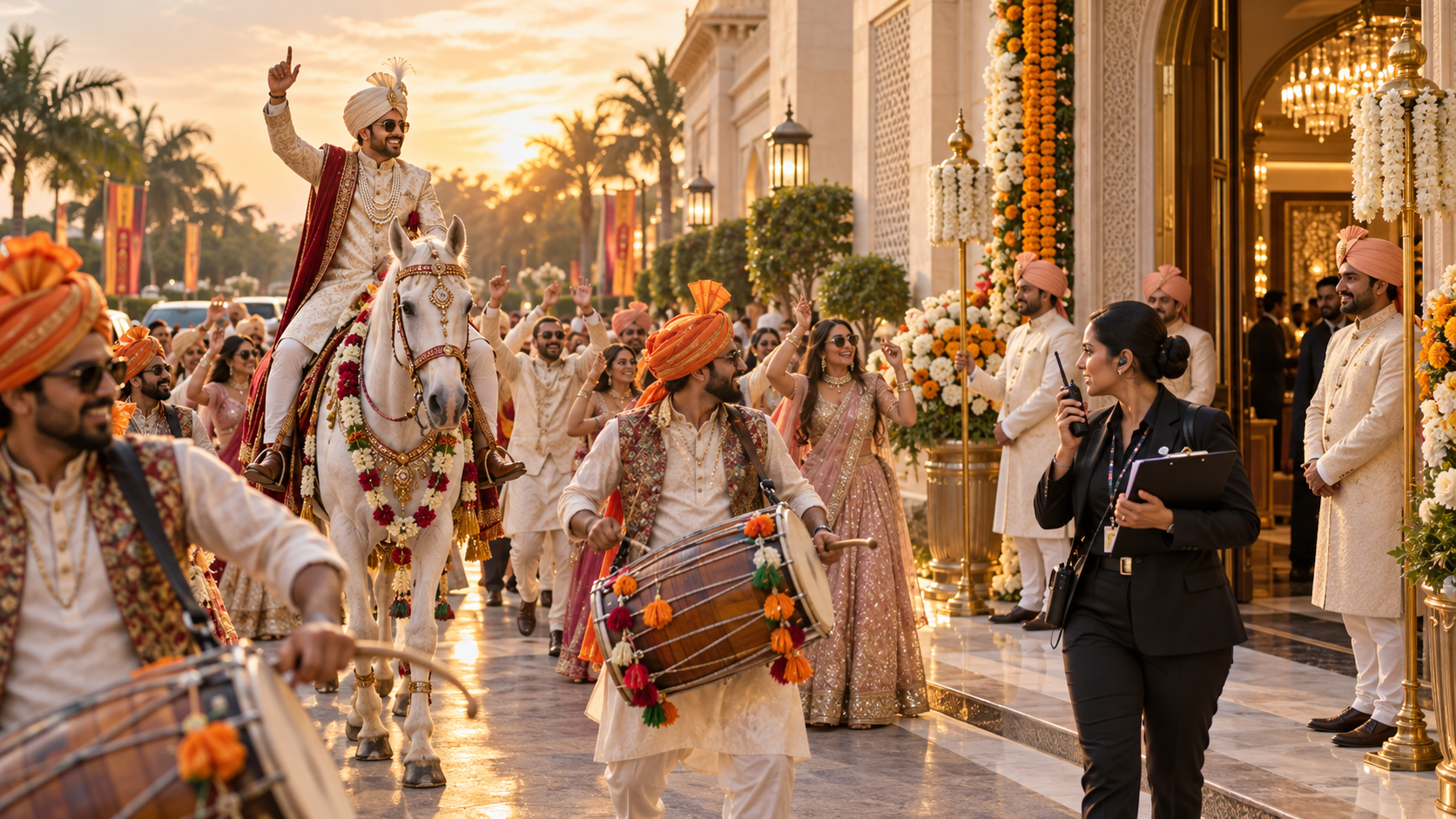
A baraat that starts 35 minutes late does not end 35 minutes late. The delay expands: the groom's welcome moves, the ceremony team waits, photographers lose their shot window, hungry guests call the family, and the priest is asked to compress a timeline nobody protected.
The fix is not “start early.” It is a controlled procession with a deadline, route, pace, captain, and shorten-route decision already agreed.
Fast rule: work backward from the groom's venue handoff, not forward from the invitation time. Lock the assembly, movement, arrival, welcome, and ceremony milestones in the wedding-day run sheet, then publish the guest version through Mandap Chat for wedding planners.
What is a baraat?
A baraat is the groom's wedding procession to the ceremony venue, traditionally accompanied by family, friends, music, dancing, and often a horse or vehicle. From a planning perspective, it is a moving event with a fixed arrival deadline, several vendors, changing crowd speed, traffic and venue constraints, and a formal handoff at the entrance.
The cultural details vary by family, region, religion, and venue. Confirm the couple's actual sequence rather than copying a generic schedule. The operational plan should support the tradition, not dictate it.
How do you plan a baraat without delaying the wedding?
Work backward from the latest acceptable venue handoff. Reserve time for guest assembly, groom preparation and mounting, procession movement, planned pauses, arrival photos, and the family welcome. Give one captain authority to control the pace and shorten the route at pre-agreed checkpoints.
Use this order:
- Confirm the cultural sequence and non-negotiable ceremony time.
- Walk the exact route with the venue, planner, band or DJ, and procession-transport vendor.
- Fix the assembly point, movement time, arrival point, and indoor or rain fallback.
- Calculate the route backward from the venue handoff.
- Assign one baraat captain and one venue-side arrival lead.
- Put every vendor on the same minute-by-minute sheet.
- Send guests only the information they need to join safely and on time.
- Agree in advance what gets shortened if the procession falls behind.
“Baraat at 5:00 PM” is not a plan. It could mean report, groom mounting, music start, procession movement, or venue arrival. Label every time by the action it controls.
What should the baraat timeline include?
The timeline should separate guest reporting, groom readiness, procession movement, route checkpoints, arrival, and venue handoff. Each milestone needs an owner and a latest acceptable time. This prevents a soft gathering time from being mistaken for the moment the procession must move.
| Milestone | Example time | Owner | Latest acceptable time | | --- | ---: | --- | ---: | | Band, horse or vehicle ready | 4:15 PM | Vendor lead | 4:25 PM | | Guests report at assembly point | 4:30 PM | Guest coordinator | 4:45 PM | | Groom ready and safety check complete | 4:40 PM | Groom-side lead | 4:50 PM | | Procession begins moving | 5:00 PM | Baraat captain | 5:10 PM | | Mid-route checkpoint | 5:20 PM | Captain | 5:25 PM | | Arrival music ends | 5:40 PM | Band/DJ lead | 5:45 PM | | Groom reaches welcome point | 5:45 PM | Venue-side lead | 5:50 PM | | Welcome or milni begins | 5:50 PM | Family ritual lead | 5:55 PM |
These are example times, not a universal duration. A 200-metre hotel driveway behaves differently from a public-road route with 250 dancers. Test the route at a similar hour, including the transition through security and the final walk to the welcome point.
How long should a baraat be?
Reserve roughly 60 to 90 minutes from guest assembly to venue handoff for a typical venue-based procession, while keeping the active dancing route closer to 30 to 45 minutes when ceremony timing is tight. The right duration depends on route length, crowd size, welcome rituals, transport, weather, and local restrictions.
Build the duration from components:
| Component | Planning allowance | | --- | ---: | | Guest gathering and lineup | 15–25 minutes | | Groom mounting or vehicle setup | 10–15 minutes | | Active procession | 30–45 minutes | | Arrival photos and final approach | 5–10 minutes | | Venue handoff or welcome setup | 10–20 minutes |
Do not fill every available minute with dancing. Keep recovery time before the ceremony-facing deadline. If the welcome must begin at 5:50 PM, a plan that predicts arrival at 5:49 PM is already late.
What belongs on the baraat route plan?
The route plan must show the assembly point, groom mounting position, exact procession path, sound limits, traffic crossings, emergency access, shorten-route turn, arrival gate, dismount point, and bad-weather alternative. It should be understood by vendors without relying on a family member to interpret it.
Walk the route and confirm:
- Whether the route is on private property or needs local permission.
- Where cars, shuttles, and non-participating guests wait.
- Whether the surface is safe for a horse, vehicle, elders, and dancing guests.
- Where the band, DJ cart, lighting, photographer, and planner stand.
- How power cables, batteries, and equipment remain clear of feet and wheels.
- Where the procession pauses without blocking emergency or hotel access.
- The final sound cutoff and exact arrival gate.
- A short loop that can replace the full route.
- The indoor or covered option for rain, heat, or poor air quality.
Coordinate this with the wedding guest transportation plan. Guests who join the procession should not discover afterward that their shuttle, handbags, or elderly relatives are at another gate.
Who should be in charge of the baraat?
One baraat captain should control the start, pace, route, vendor cues, and shorten-route decision. A venue-side lead should control the arrival gate and welcome readiness. Other helpers can own guest gathering, groom support, transport, and vendor coordination, but all status flows through the captain.
Use a small command structure:
- Baraat captain: final operational authority from assembly to handoff.
- Venue-side lead: confirms the entrance, welcome party, ritual team, and ceremony readiness.
- Groom support lead: manages personal items, mounting, water, and immediate family.
- Guest coordinator: gathers dancers and directs anyone not joining the route.
- Vendor lead: confirms band or DJ, horse or vehicle, lighting, and backup equipment.
- Transport lead: positions shuttles, cars, drivers, and the post-baraat transfer.
Put these roles in the wedding-day contact list. The groom and parents may make ceremonial decisions, but they should not be receiving routine calls about parking or a missing extension cable.
How should the horse, car, band, and DJ be coordinated?
Give every procession vendor the same call time, route map, sound cutoff, arrival cue, payment status, and named contact. Confirm animal-welfare and venue rules directly with the vendors and property. No performer or vehicle should arrive with a different interpretation of where the procession starts or ends.
The final vendor confirmation should cover:
- Arrival and setup time.
- Exact loading and parking access.
- Route surface, slope, distance, and turnaround space.
- Groom mounting or vehicle-entry method.
- Music start, pause, and hard-stop cues.
- Power source and weather protection.
- Drinking water and safe breaks for people and animals.
- Backup for equipment or vehicle failure.
- Dismount position and exit path after handoff.
- Balance payment owner and completion proof.
For any animal involved, use an experienced professional, follow applicable local rules and venue restrictions, and stop if conditions become unsafe. Aesthetic plans do not outrank welfare.
What should guests be told before the baraat?
Guests need the report time, assembly point, expected walking or dancing duration, footwear guidance, weather note, transport arrangement, and venue-entry plan. They also need to know where elders, children, or anyone skipping the procession can wait comfortably.
Send this the day before:
BARAAT — SATURDAY

Guest report: 4:30 PM
Procession moves: 5:00 PM sharp
Meet: Hotel west lawn, beside the fountain
Route: About 35 minutes of walking and dancing
Wear: Comfortable footwear recommended; 31°C forecast
Not joining the procession? Shuttle leaves the lobby at 5:05 PM.
Live updates and questions: [Mandap Chat link]
Urgent help: [guest coordinator]
Send a short reminder 60 to 90 minutes before reporting. If the route changes, state exactly which previous message is obsolete. The wedding reminder message guide has additional timing and wording patterns.
What is the late-baraat backup plan?
The backup plan should define decision times, not vague intentions. At each checkpoint, the captain chooses the full route, short loop, direct arrival, or vehicle transfer based on the protected venue-handoff time. Vendors and family leads must approve these options before guests assemble.
| Status | Decision | | --- | --- | | Ready on time | Run the full approved route | | Start is 10–15 minutes late | Remove an optional pause and control song extensions | | Mid-route checkpoint is missed | Take the short loop to the arrival gate | | Ceremony deadline is at risk | End procession music and move directly to handoff | | Unsafe weather or route condition | Use the covered route or vehicle-transfer plan | | Horse, vehicle, or sound system fails | Activate the agreed vendor fallback; do not hold all guests indefinitely |
Never ask the band to “make up time” by moving a dense dancing crowd faster than is safe. Save time by shortening distance or removing optional stops.
What should be checked 24 hours before the baraat?
The final check should confirm that the route, timings, vendors, people, transport, guest message, and fallback all agree. Complete it with the captain and venue-side lead, then freeze the guest-facing details unless a real change occurs.
- Ceremony-facing handoff deadline is confirmed.
- Full route and short route have been physically walked.
- Assembly, mounting, arrival, and dismount points are marked.
- Venue, security, traffic, sound, and access conditions are confirmed.
- Band or DJ, horse or vehicle, lighting, and photography call times match.
- Guest shuttles, parking, and post-procession transfers are positioned.
- Water, first aid, weather cover, and accessible alternatives are ready.
- Captain and venue-side lead can contact every vendor owner.
- Old schedules have been withdrawn from shared folders and groups.
- Guest reminder contains one current link and one help contact.
- Full-route, short-route, and weather decisions are pre-approved.
- The couple and parents are not the operational help desk.
How can Mandap Chat reduce baraat confusion?
Mandap Chat can answer approved guest questions about where to meet, when the procession moves, how long it lasts, what to wear, where transport leaves, and what changed because of weather. The planner updates one source while urgent decisions remain with the human operations team.
Load the guest-facing version of:
- Report and movement times.
- Assembly landmark and tested map pin.
- Walking duration and footwear advice.
- Shuttle, parking, and non-participant instructions.
- Heat, rain, or indoor-route update.
- Arrival gate and venue entry instructions.
- Guest coordinator contact for urgent help.
Then test real questions: “Is 5:00 the meeting time or start time?”, “Can my grandmother go directly to the venue?”, “Where do I leave my bag?”, “Is the baraat outside?”, and “Which gate do we enter after it ends?”
A good baraat feels spontaneous to guests because the control sits behind the scenes. Protect the handoff deadline, give one captain authority, and design a shorter route before you need it. Then let Mandap Chat handle the repetitive guest questions without turning the family group into a control room.
FAQs
How long should a baraat be?
Most baraat plans should reserve 60 to 90 minutes from guest assembly to the groom's venue handoff, but the actual dancing route may be only 30 to 45 minutes. Work backward from the ceremony deadline and include gathering, mounting, pauses, milni or welcome, and the walk from the arrival point.
Who is responsible for managing the baraat?
Name one baraat captain with authority over the start, pace, route, vendors, and shorten-route decision. A second venue-side lead should manage the arrival gate and handoff. The groom, couple, and parents should not be the routine operations contacts.
What should guests be told before the baraat?
Tell guests the assembly point, report time, movement time, footwear advice, transport plan, weather note, and where non-participants can wait. Give them one live update link and one help contact rather than several family phone numbers.
What is the backup plan if the baraat is late?
Set decision checkpoints before the event. The captain can reduce a long route to a shorter loop, remove a planned stop, move directly to the arrival gate, or use vehicles for part of the transfer. Protect the ceremony deadline instead of trying to recover time after arrival.
How can Mandap Chat help manage a baraat?
Mandap Chat can answer approved guest questions about the assembly point, timing, transport, attire, weather changes, and venue entry. It keeps routine questions in one place while urgent operational decisions remain with the planner and baraat captain.