
Wedding Seating Chart Template for Indian Weddings: Tables, Family Sides, and VIP Rules
A practical wedding seating chart template for Indian weddings: how to assign tables, manage family sides, elders, kids, vendors, accessibility needs, and late RSVP changes.
The best wedding seating chart template for an Indian wedding starts from guest groups, not table decor. Map family side, relationship, event access, RSVP status, elders, kids, accessibility needs, VIPs, food notes, and conflict rules before assigning table numbers.
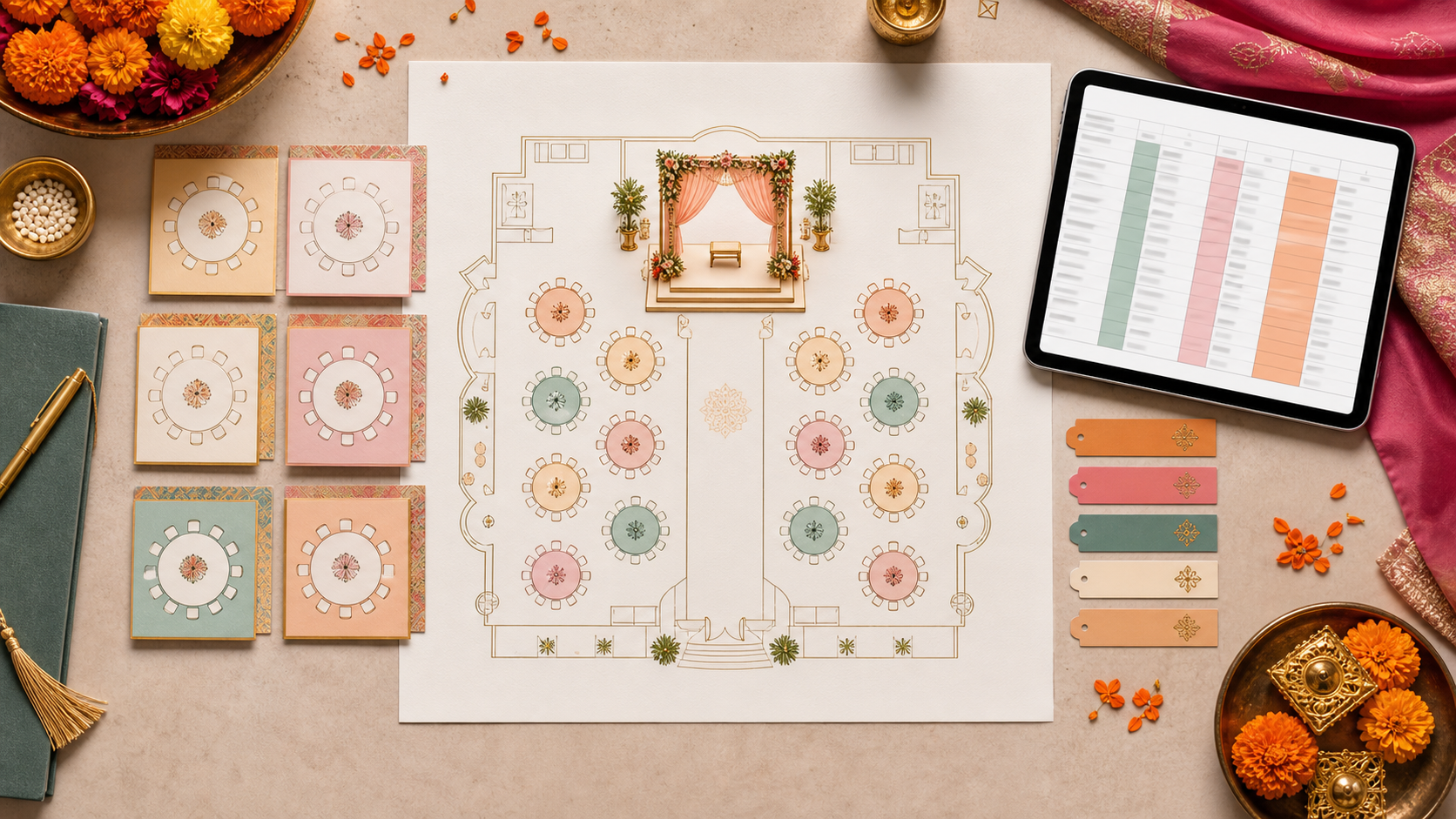
A wedding seating chart becomes painful when it is treated like calligraphy. The board looks beautiful, but the real questions are ugly: which bua refuses to sit near which maasi, where do the elders sit, who needs wheelchair access, who gets a high chair, which NRI guests know nobody, and which family is going to add four people after the chart is printed?
The outcome you want is not a perfect diagram. It is a seating system that lets the planner, venue, caterer, family captains, and guests all act without asking the couple again.
The fast rule: build the seating chart from the guest list first, then make it pretty. For Indian weddings, the useful template is a table plan connected to family side, RSVP status, meal notes, accessibility needs, kids, VIPs, and late-change ownership.
What should a wedding seating chart template include?
A wedding seating chart template should include enough detail to place people without creating new problems: guest name, family side, relationship group, event, RSVP status, table number, seat number if needed, VIP note, kids note, meal note, accessibility need, conflict rule, and follow-up owner.
Use this table as the working version before you design the printed sign:
| Column | Example | Why it matters | | --- | --- | --- | | Guest full name | Neha Shah | Prevents duplicate nicknames | | Family side | Bride, groom, both | Balances visible family zones | | Relationship group | Mama family, school friends, office | Keeps people comfortable | | Event | Sangeet, wedding, reception | Seating differs by function | | RSVP status | Confirmed, maybe, late add | Shows risk before printing | | Table number | T12 | Lets venue and guests find the table | | Seat number | Optional | Needed only for formal/plated meals | | VIP or elder note | Front row, aisle, near stage | Protects family expectations | | Kids or high-chair note | High chair, stroller space | Helps venue and caterer | | Accessibility note | Wheelchair space, low-walk route | Prevents day-of embarrassment | | Meal note | Jain, vegan, allergy | Helps catering service | | Conflict rule | Do not seat with X family | Keeps politics out of the room | | Change owner | Planner, bride brother, groom father | Stops five people editing the chart |
If this looks close to your wedding guest list template, good. Seating is not a separate creative exercise. It is a filtered view of the guest list.
What is a wedding seating chart?
A wedding seating chart is the plan that assigns guests to tables, rows, or seats for a wedding function. In a practical planning workflow, it connects the guest list to the venue floor plan, family priorities, food service, accessibility needs, and guest-facing table sign.
For Indian weddings, the seating chart usually changes by event. A haldi may need open seating, a sangeet may need family and friend zones, the ceremony may need reserved rows, and the reception may need table assignments.
The mistake is trying to solve all of that in one pretty Canva file. Start with a spreadsheet. Then make the public seating sign only after the working chart survives family review.
Do Indian weddings need assigned seats or assigned tables?
Most Indian weddings need assigned tables, not assigned seats. Assigned tables give the family enough control over elders, VIPs, friends, work guests, kids, and food notes without making the event brittle. Assigned seats are useful only for formal dinners, plated meals, protocol-heavy VIPs, or very small receptions.
Use this decision table:
| Event type | Best seating style | Why | | --- | --- | --- | | Mehendi or haldi | Open seating with elder reserve | Guests move around often | | Sangeet | Assigned zones or tables | Families, performers, and friends need grouping | | Wedding ceremony | Reserved rows for family and elders | Ritual visibility matters | | Reception buffet | Assigned tables | Enough structure without seat-level stress | | Plated reception | Assigned seats | Caterer needs exact meal service | | VIP or political guest event | Assigned seats | Protocol and security matter |
If the caterer is serving a buffet, avoid over-engineering exact seats. Give guests a table, not a chair. The more rigid the plan, the more visible every late change becomes.
How do you make an Indian wedding seating chart?
Make an Indian wedding seating chart by starting with the final guest list, grouping guests by relationship and family side, reserving high-priority tables, placing elders and accessibility needs first, then assigning friends, work guests, and flexible groups after the family map is stable.
Use this workflow:
- Export the confirmed guest list with event attendance.
- Remove guests who are not invited to that specific function.
- Mark immediate family, elders, VIPs, kids, and accessibility needs.
- Add table sizes from the venue floor plan.
- Reserve front or central tables for close family.
- Place elders near exits, restrooms, or low-walk routes when needed.
- Keep families with known tension apart before adding friends.
- Group friends by actual comfort, not just "college" or "office."
- Put work guests together unless they know the family well.
- Reconcile meal notes with the caterer.
- Send one private review copy to each family side.
- Freeze the public sign only after late changes are logged.
For multi-day weddings, do not duplicate the same chart blindly. Guests who sit together at the reception may need to be split for a ceremony, photo call, or family lunch.
Which tables should be assigned first?
Assign the riskiest tables first: immediate family, elders, VIPs, accessibility needs, kids, and guests with conflict rules. Flexible friend groups and work guests should come later because they can absorb changes without turning into family drama.
Use this priority order:
| Priority | Seat this group first | What to check | | --- | --- | --- | | 1 | Couple's immediate family | Stage view, ritual access, family photos | | 2 | Elders and mobility-limited guests | Walking distance, aisle width, restroom access | | 3 | VIP guests | Visibility, protocol, family owner | | 4 | Kids and parents | High chairs, stroller space, exit access | | 5 | Dietary-sensitive guests | Caterer service notes | | 6 | Extended family clusters | Side balance and known tensions | | 7 | Friends | Comfort and energy | | 8 | Work and formal guests | Professional grouping | | 9 | Late additions | Overflow table or flexible zone |
The seating chart should protect comfort before aesthetics. A perfectly balanced floor plan that makes elders walk across the ballroom is a bad plan.
How should you handle elders, kids, and accessibility?
Handle elders, kids, and accessibility before you assign decorative table names. These guests need practical placement: short walking routes, clear aisles, lower-noise areas, companion seats, stroller or wheelchair room, and a nearby family owner who can help if something changes.
For accessibility, ask the venue for the actual accessible route, restroom location, lift access, ramp access, and any fixed seating limits. The U.S. Access Board's ADA guidance for assembly areas, for example, specifies minimum wheelchair space widths and companion-seat planning for formal venues (Access Board). Even outside the U.S., the planning principle is the same: leave real space, not just good intentions. Use the accessible Indian wedding checklist to audit the complete journey beyond the table plan.
Add these fields to the seating sheet:
- Low-walk route needed.
- Wheelchair or walker space.
- Companion seat.
- Near restroom.
- Away from speakers.
- High chair or booster.
- Stroller parking.
- Family helper assigned.
Do not write sensitive medical details on the public chart. The public sign only needs the table. The planner sheet can hold the operational note.
How do you stop late RSVP changes from breaking the chart?
Stop late RSVP changes from breaking the seating chart by freezing the working version in stages and keeping a separate late-change sheet. Do not let every family member edit the master chart after table numbers are assigned.
Use this timeline:
| Timing | Seating action | | --- | --- | | 30 days out | Confirm table sizes and venue floor plan | | 21 days out | Build rough family and guest zones | | 14 days out | Assign working tables from confirmed RSVPs | | 10 days out | Send private family review copy | | 7 days out | Reconcile catering, kids, and accessibility notes | | 48 hours out | Freeze public sign and send late-change sheet | | Event day | Hospitality desk handles table lookups |
This works best when the wedding RSVP workflow and guest list are already clean. If RSVP answers are vague, the seating chart becomes guesswork.
Keep one overflow strategy: a flexible table, a family captain who can approve changes, and a printed lookup sheet at the welcome desk. Do not solve late additions by silently moving elders, VIPs, or anyone with accessibility needs.
What should the public seating sign show?
The public seating sign should show only what guests need: guest name and table number, grouped alphabetically or by table. It should not expose family side, RSVP status, conflict notes, dietary notes, payment notes, or private planner comments.
For a 300-plus guest Indian wedding, alphabetical lookup is usually faster than table-by-table browsing. Guests walk in asking "where am I?" not "who else is at Table 18?"
Use this public format:
| Guest display | Table | | --- | --- | | Aakash Mehra | 12 | | Aanya Kapoor | 4 | | Aarav and Nisha Shah | 17 |
If the venue has a welcome desk, give the hospitality team a private copy with phone numbers, family side, and owner notes. Guests should not have to message the bride's cousin to find their table.
How does Mandap Chat help with seating questions?
Mandap Chat helps by answering guest-facing seating and venue questions without exposing the private seating sheet. Upload the public rules: how to find tables, which events have assigned seating, kids policy, accessibility support, venue zones, and who to contact for a seating issue.
Good test questions:
- "Do I have an assigned table?"
- "Where is Table 12?"
- "Can I sit with my parents?"
- "Is there a high chair for my child?"
- "My grandmother cannot walk far. Who can help?"
- "Which side is the bride's family seated on?"
- "I was added late. Where should I go?"
The answer should be practical, not dramatic. Example: "Reception tables are assigned. Please check the seating board at the welcome desk. If your name is missing, ask the hospitality desk for Rhea or show this message."
Upload the same guest-facing instructions into Mandap Chat for wedding planners so the planner is not answering routine table questions while coordinating vendors.
What should the final seating chart checklist include?
Before printing or publishing the chart, check the boring details. Boring is what saves the wedding day.
- Guest list and seating chart use the same names.
- Every guest is assigned to the correct event.
- Family side and relationship group are filled privately.
- Immediate family and elders have approved placement.
- Accessibility and low-walk needs are visible to the planner.
- Kids, high chairs, and stroller notes are confirmed.
- VIP tables have one family owner.
- Known conflict rules are checked before printing.
- Meal notes are reconciled with the caterer.
- Table sizes match the venue floor plan.
- Public seating sign hides private notes.
- One late-change owner is named.
- Welcome desk has the final lookup sheet.
- Mandap Chat has the same public seating rules.
The wedding seating chart is not just a sign at the entrance. It is the last mile of guest operations. Build it from the guest list, protect the sensitive details, and give guests a simple way to ask where to go.
If your planner is already using a wedding day run sheet, connect seating to that document too. The reception entry, family photos, food service, VIP movement, and accessibility support all depend on the same table plan.
Frequently asked questions
What should a wedding seating chart template include?+
How do you make an Indian wedding seating chart?+
When should the wedding seating chart be finalized?+
Do Indian weddings need assigned seats or just assigned tables?+
How does Mandap Chat help with seating questions?+
Continue the series
A wedding planner escalation matrix assigns each type of problem a severity, response time, first owner, final decision owner, and communication route before the wedding begins.
Wedding planner quality control is a separate verification pass that checks whether approved details match across contracts, run sheets, vendor briefs, venue plans, and guest communication before execution begins.
An NRI wedding budget in India should be built in INR around guest count, city, event count, room nights, and production complexity—then protected with separate currency and contingency buffers.
Wedding plus-one wording should state exactly who is invited, where the guest adds their companion's name, and whether the rule applies to every function. Clear language feels kinder than a vague invitation followed by an awkward refusal.
Wedding vendor meals keep photographers, planners, drivers, decor, sound, and hospitality teams working through long Indian wedding functions. Count crew by event, confirm dietary needs, schedule service before the guest rush, and give one caterer captain the final list.