
Wedding Guest List Template for Indian Weddings: The 12-Column System
A practical wedding guest list template for Indian weddings: what columns to track, how to segment guests, when to freeze changes, and how to turn the list into guest answers.
The best wedding guest list template for an Indian wedding is not just names and headcount. It is a live operations sheet that connects each guest to family side, RSVP status, events, travel, hotel, food, kids, plus-ones, and the question-answer system guests will use.
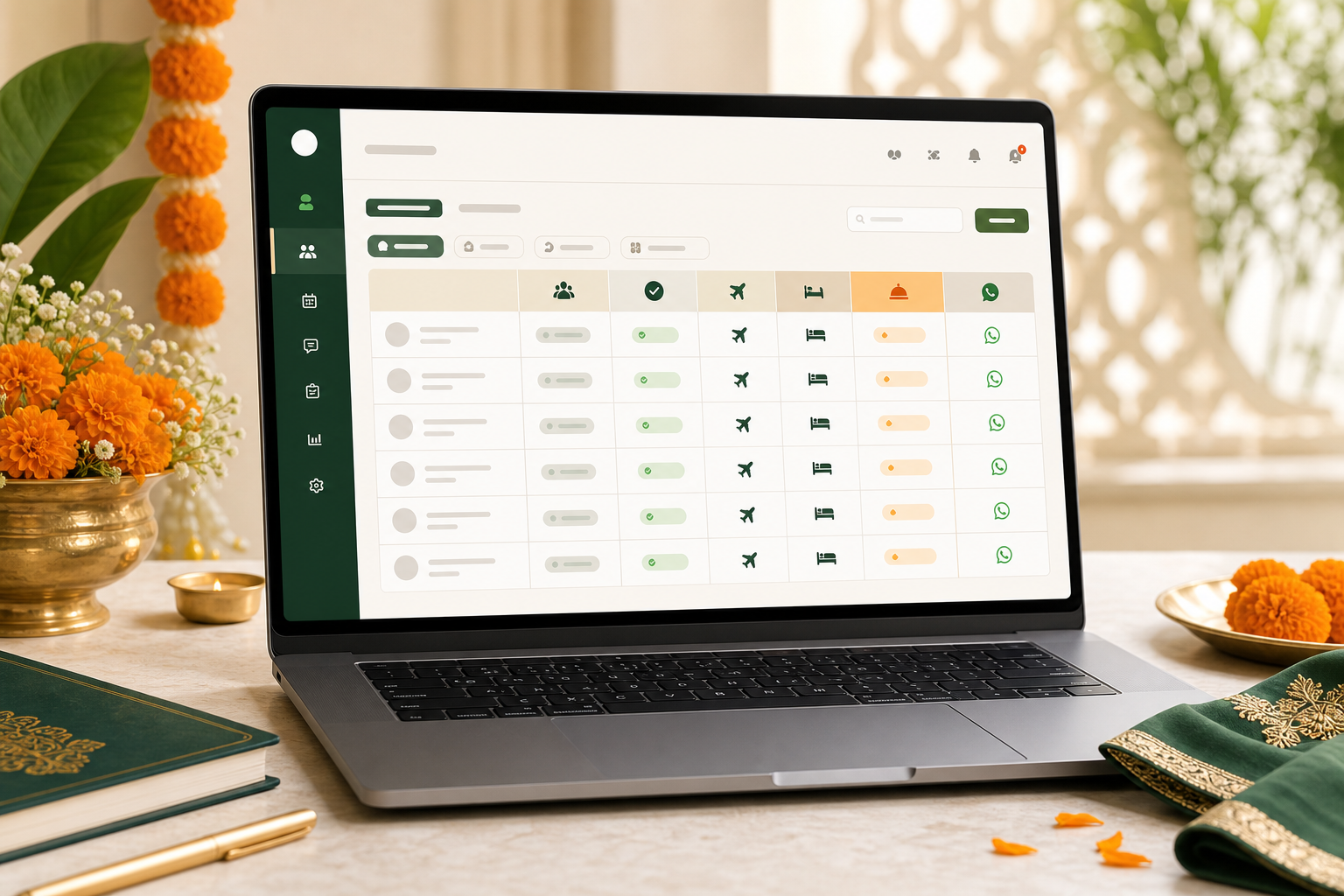
The wedding guest list is where Indian wedding planning quietly goes off the rails. Everyone thinks it is a name sheet until the first real question arrives: "Are their kids invited?", "Are they coming for all three days?", "Do they need a room?", "Which side are they from?", "Did we already send the visa letter?", "Who is following up with them?"
The fast rule: build the guest list as an operations database, not a polite invitation tracker. If one row can tell the planner who the guest is, what they are invited to, what they need, and what message they should receive next, the wedding gets calmer fast.
For most Indian weddings, the useful version is a 12-column core sheet with optional hotel, transport, and dietary tabs. Once the sheet is clean, connect it to Mandap Chat so guests can get consistent answers without turning the couple's family WhatsApp into a help desk.
Once phone numbers, event access, kids notes, and follow-up owners are clean, send a structured wedding RSVP reminder message instead of chasing people one by one. The reminder only works if the sheet already knows who is being chased and which answer will update the final count.
Before the invitation suite goes out, turn the same guest-facing rules into a wedding details card. The card should point guests to the RSVP link, schedule, venue, dress code, hotel, transport, and Mandap Chat answer path so the guest list does not become a manual help desk.
What should a wedding guest list template include?
A wedding guest list template should include the guest's identity, family relationship, invitation scope, RSVP status, event attendance, food needs, stay needs, travel needs, and follow-up owner. For Indian weddings, the most important upgrade is event-level tracking: mehendi, haldi, sangeet, wedding, reception, brunch, and any private family rituals.
Use this 12-column template as the minimum:
| Column | Example | Why it matters | | --- | --- | --- | | Guest full name | Rohan Mehta | Prevents duplicate nicknames | | Family side | Bride, groom, both | Helps seating and follow-up | | Relationship group | Mama family, college friends, office | Makes messaging personal | | Phone with country code | +91..., +1... | Needed for WhatsApp and travel updates | | City or country | Delhi, Dubai, New Jersey | Helps travel and visa planning | | Invited events | Sangeet, wedding, reception | Avoids accidental over-inviting | | RSVP status | Yes, no, maybe, no response | Shows follow-up priority | | Expected headcount | 1, 2, family of 4 | Drives catering math | | Kids or plus-one rule | Kids yes, plus-one no | Stops awkward late questions | | Meal note | Jain, vegan, no onion-garlic | Keeps catering accurate | | Hotel or travel need | Room needed, airport pickup | Connects to logistics | | Follow-up owner | Bride father, planner, cousin | Makes reminders accountable |
A guest list is the master database. RSVP is only one field inside it. That distinction matters because a guest can be "yes" for the reception, "no" for the haldi, "needs hotel," and "has not confirmed airport pickup" at the same time. The meal-note column should be fed by a wedding meal preference RSVP template, not by memory from scattered family calls.
How do you organize an Indian wedding guest list?
Organize an Indian wedding guest list by family side first, then by relationship group, event invitation, city, and priority. Alphabetical order is useful only after the real planning fields are clean. The list should help families decide whom to call, whom to seat together, and which guests need extra help.
Use these segments:
| Segment | Best use | | --- | --- | | Immediate family | Ritual timing, room proximity, VIP movement | | Extended family | Follow-up calling trees and seating zones | | Friends | Event-specific invites and room sharing | | Work guests | Reception lists and formal reminders | | Outstation guests | Travel, hotel, pickup, welcome bags | | International guests | Visa letters, itinerary, airport timing | | Elders | Accessibility, room floors, transport priority | | Vendors and performers | Meals, green rooms, security access |
The mistake is creating separate sheets for every team. One planner has a guest list. One cousin has a hotel list. One uncle has the "real" VIP list. The caterer has a final number that does not match any of them. By the week of the wedding, nobody knows which file is true.
Keep one master list, then create filtered views for hotels, catering, transport, and family follow-up.
What is the easiest Indian wedding guest-list workflow?
The easiest workflow is invite, tag, collect RSVP, verify logistics, then lock changes. Do not wait for the full RSVP deadline before adding logistics fields. If you ask about rooms, kids, food, and airport pickup too late, the answers arrive as scattered messages.
Use this workflow:
- Build one master sheet before invitations go out.
- Assign each guest a family side and follow-up owner.
- Mark which events each guest is invited to.
- Send invitations with a clear RSVP and question path.
- Track RSVP by event, not just by guest.
- Add hotel, travel, food, kids, and accessibility notes.
- Send reminder messages by segment.
- Lock catering, hotel, and transport views separately.
- Keep a late-change log instead of editing old numbers silently.
- Upload the final guest-facing rules to Mandap Chat.
If you already use the Indian wedding RSVP guide, treat that form as the data intake layer. The guest list is where those answers become action.
When should you freeze the guest list?
Freeze the guest list in stages. Catering and seating should lock 10 to 14 days before the first event. Hotel and transport should lock earlier when possible. Final WhatsApp reminders can continue after that, but late additions should go into a change log instead of quietly changing the master count.
Use this timeline:
| Timing | Guest-list action | | --- | --- | | 90 days out | Build master list and family owners | | 60 days out | Confirm event invitation groups | | 45 days out | Send RSVP and collect hotel/travel needs | | 30 days out | Start family follow-up calls | | 21 days out | Reconcile hotel, rooming, and pickup needs | | 14 days out | Lock catering and seating working counts | | 10 days out | Send final guest itinerary by segment | | 48 hours out | Send only the late-change sheet to vendors |
The 48-hour sheet should show additions, cancellations, room changes, pickup changes, and meal changes. It should not be a fresh guest list. That is how vendors miss details.
How should you track plus-ones and kids?
Track plus-ones and kids as rules, not vibes. A single "headcount" column hides the real decision. The guest-list row should show invited adults, confirmed adults, invited children, confirmed children, plus-one allowed, and plus-one name if known.
Use simple labels:
No plus-oneNamed plus-one onlyPlus-one allowedKids welcomeKids only for family eventsAdults-only evening eventAsk family before confirming
Write the rule before reminders go out. A late plus-one conversation feels personal when the rule is invisible. It feels operational when everyone can point to the same guest policy.
If you expect guests to ask this repeatedly, add the rule to Mandap Chat with event-specific language: "Children are welcome at the mehendi and wedding ceremony. The cocktail is adults-only because of venue capacity." That answer is clearer than ten cousins improvising ten different replies.
What guest-list fields prevent WhatsApp chaos?
The fields that prevent WhatsApp chaos are phone number, country code, guest group, event access, RSVP status, follow-up owner, and last message sent. Without those, families send duplicate reminders, miss international guests, and accidentally message people about events they are not invited to.
Add these communication columns:
| Column | Use | | --- | --- | | WhatsApp-ready phone | Saves time when importing contacts | | Preferred language | Hindi, English, Gujarati, Tamil, Telugu | | Last message sent | Invite, reminder, itinerary, hotel note | | Next follow-up date | Prevents daily nagging | | Question status | Asked, answered, escalated | | Mandap Chat link sent | Confirms guest has the self-serve answer path |
WhatsApp's own help page notes that broadcast recipients need to have saved your number for broadcast delivery to work reliably, so do not treat broadcast lists as a guaranteed reach channel for every guest (WhatsApp Help Center). Google Contacts supports importing contacts from CSV or vCard files, which is useful if your sheet is clean and phone fields are standardized (Google Contacts Help).
The practical takeaway: keep guest phone numbers in international format, segment messages by group, and keep Mandap Chat as the consistent answer layer for questions that come after the reminder.
How do you connect the guest list to hotel rooms and travel?
Connect the guest list to hotel rooms and travel by using IDs, not copy-paste. Each guest or family group should have one guest ID that appears in the rooming list, pickup list, welcome-bag list, and itinerary list. This makes changes traceable.
For rooming, use the wedding guest accommodation template. For destination hotel blocks, use the room block playbook. The guest list decides who needs help; the rooming list decides where they stay.
Minimum connection fields:
- Guest ID or family group ID
- Hotel needed: yes, no, self-booked, unknown
- Room group size
- Arrival date and time
- Departure date and time
- Airport or station pickup needed
- Shuttle group
- Welcome-bag count
- Accessibility or elder support note
Do not make the hotel sheet the source of truth. It is a filtered view of the master list. If a guest cancels in the RSVP sheet but still appears in the hotel sheet, your process is broken.
What should guests receive from the guest list?
Guests should receive only the information that applies to them: the events they are invited to, the RSVP link, the hotel or travel instruction, the dress code, and the Mandap Chat link for questions. They should not see the planning spreadsheet or broad family notes.
Copy this message:
Hi [Name], we are excited to celebrate with you.
You are invited for: [events].
Please confirm your attendance here: [RSVP link].
Hotel and travel notes: [short instruction].
For schedule, dress code, venue, food, hotel, and transport questions, ask here: [Mandap Chat link].
If anything urgent changes, message [owner name].
For multi-day weddings, send the guest itinerary template after the guest list and rooming list agree. If the itinerary is sent before guest segments are clean, people receive details for events they are not meant to attend.
How does Mandap Chat help with the wedding guest list?
Mandap Chat turns guest-list rules into instant answers. It does not need private family notes or your full raw spreadsheet. It needs the guest-facing rules: event access, RSVP deadlines, hotel instructions, transport schedules, dress codes, kids policy, plus-one policy, meal notes, and escalation contacts.
Good questions to test before launch:
- "Which events am I invited to?"
- "Can I bring my child to the cocktail?"
- "Can I bring a plus-one?"
- "Where should I RSVP?"
- "I am arriving from Dubai. Do I need a visa letter?"
- "Which hotel should I book?"
- "Is Jain food available?"
- "Who do I call if my flight is delayed?"
If the concierge cannot answer these, the guest list is missing operational rules. Fix the source sheet before sending the link.
The final wedding guest list checklist
Before the list is called final, check this:
- Every guest has one clean row or one family-group row.
- Family side, relationship group, city, and follow-up owner are filled.
- Event-level invitations are marked separately.
- RSVP status is tracked by event where needed.
- Plus-one and kids rules are written, not assumed.
- Phone numbers include country codes.
- Hotel, travel, meal, and accessibility needs have separate columns.
- Outstation and international guests are filtered into their own views.
- Catering, seating, hotel, and transport views all come from the master list.
- Late changes are tracked in a change log.
- Guests receive only their relevant instructions.
- Mandap Chat has the same guest-facing rules the family is using.
The wedding guest list is not admin work. It is the control panel for the wedding. Build it once, keep it clean, and every later decision becomes easier.
Once RSVPs are stable, turn the same master list into a wedding seating chart template so family side, elders, kids, accessibility notes, and meal rules flow into the table plan without rebuilding the data.
Frequently asked questions
What should a wedding guest list template include?+
How do you organize an Indian wedding guest list?+
When should you freeze the wedding guest list?+
What is the difference between a guest list and an RSVP list?+
How does Mandap Chat use the wedding guest list?+
Continue the series
A wedding help desk gives guests one place to ask routine questions and gives the family one way to stop answering the same logistics all day. For Indian weddings, the best setup combines a staffed desk, a pinned WhatsApp message, and Mandap Chat as the live answer layer.
Wedding planner email templates work best when each message has one job: collect an approval, confirm a fact, answer a guest question, or escalate a blocker. For Indian weddings, planners should keep email as the written record and use WhatsApp or Mandap Chat to distribute approved answers.
NRI wedding WhatsApp group rules should define who can post, which group owns each topic, what gets pinned, when decisions expire, and where guests should ask routine questions.
A wedding day contact list is the command sheet that tells planners, families, venue teams, and hospitality desks who to call when something changes. Use this Indian wedding template to keep routine guest questions, vendor issues, family decisions, and real emergencies from landing on the couple.
Wedding planner software should not be one overloaded app. For Indian weddings, the strongest stack is a simple client workspace, a vendor CRM, a budget and payment tracker, a run sheet, a guest communication layer, and one AI concierge for repeat guest questions.