
Wedding Website FAQ: 35 Questions Indian Wedding Guests Ask
Copy these 35 wedding website FAQ questions and answers for Indian weddings, covering schedules, venues, dress codes, travel, food, children, gifts, and updates.
A useful Indian wedding website FAQ answers the practical questions guests hesitate to ask: which function they are invited to, what to wear, how transport works, whether children are welcome, and where last-minute changes will appear.
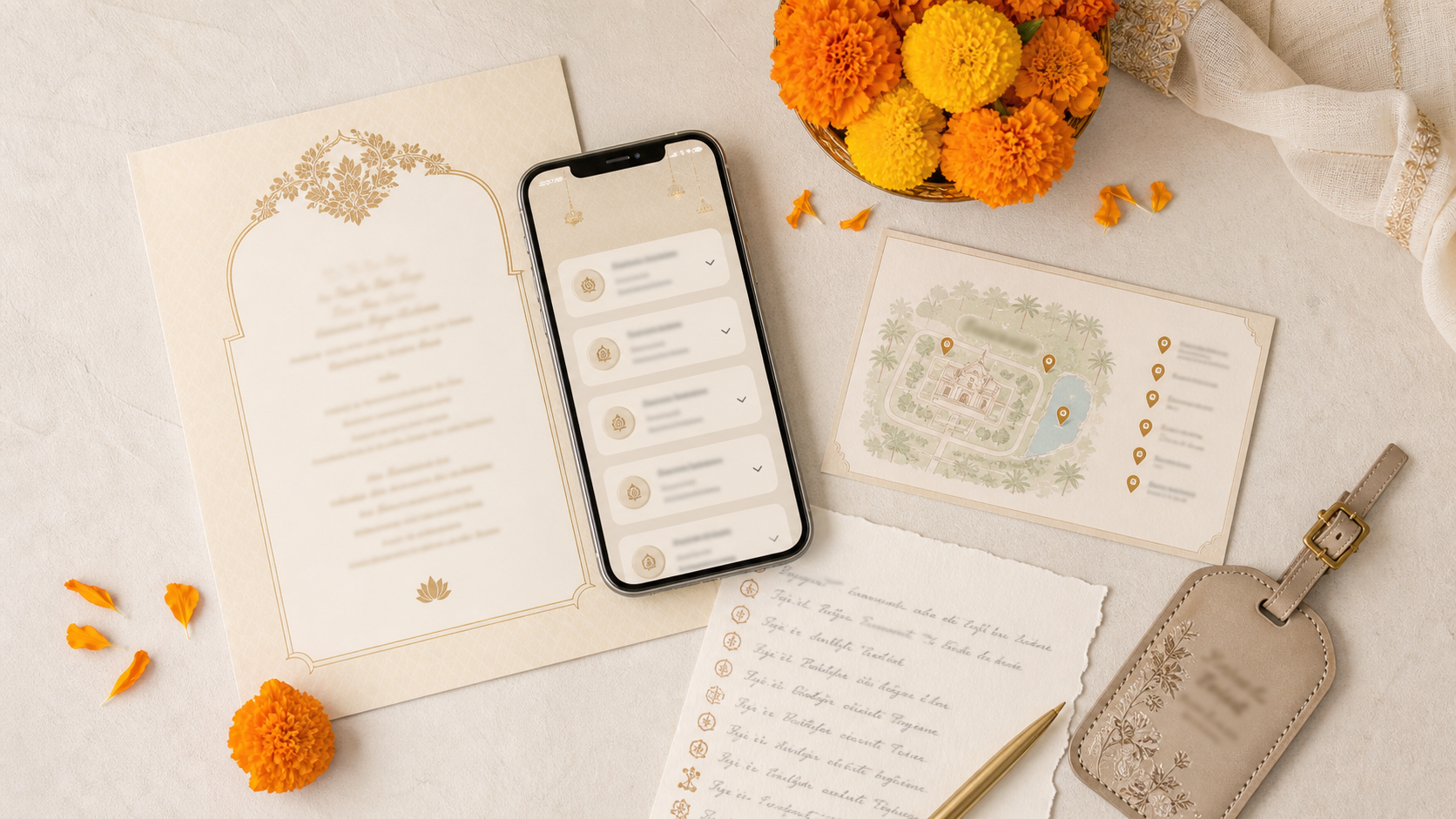
The worst wedding FAQ is the one guests cannot find until after they have called the couple, both sets of parents, and the planner.
An Indian wedding creates more questions than a single-page invitation can answer: multiple functions, different venues, outfit changes, hotel blocks, airport pickups, shuttles, food preferences, children, rituals, and guest-specific invitations. A clear wedding website FAQ turns those loose details into one reliable answer source.
Fast rule: publish answers to the 10 questions guests are already asking, then add the sections below that match your wedding. Delete anything irrelevant. A short, accurate FAQ beats 70 generic answers copied from another couple.
What is a wedding website FAQ?
A wedding website FAQ is a guest-facing list of approved answers about attendance, schedules, venues, travel, clothing, food, gifts, and wedding-day logistics. It reduces repeated messages by giving guests one current place to check before contacting the family or planner.
For an Indian wedding, the FAQ should distinguish each function. “The ceremony starts at 7” is not useful when the haldi, sangeet, wedding, and reception all have different arrival times and venues. Every answer should say who it applies to, which event it concerns, and where guests should check for changes.
What should you include in an Indian wedding website FAQ?
Include the information a guest needs to decide, pack, travel, arrive, participate, and get home without chasing the hosts. The minimum useful FAQ covers invitations, timing, venue access, travel, accommodation, dress codes, food, children, accessibility, gifts, photography, and updates.
Use this decision table before copying the questions:
| Guest situation | Must-answer topics | Useful extra detail | | --- | --- | --- | | Mostly local, one venue | Arrival time, parking, dress code, food | Driver waiting area, entry gate | | Multi-event Indian wedding | Event-by-event schedule, invitations, attire | Ritual explanations, footwear notes | | Destination wedding | Flights, hotel, transfers, shuttles | Check-in, baggage, free-time ideas | | NRI and international guests | Visa, airport, time zone, currency | SIM cards, weather, cultural context | | Families with children | Which events include children, meals, seating | Childcare, quiet room, high chairs | | Older or disabled guests | Step-free access, transport, seating | Wheelchair help, nearby restrooms |
If your celebration involves flights and hotels, pair the FAQ with the destination wedding guest travel checklist. The checklist collects guest actions; the FAQ explains the rules.
Which invitation and attendance questions should you answer?
Answer attendance questions without vague wording. Guests need to know exactly who is invited, which functions appear on their invitation, whether they may bring a partner or child, and when the RSVP becomes final. Private, guest-specific details should not sit on a public page.
-
Which wedding events am I invited to?
Please follow the functions listed on your personal invitation or RSVP page. If an event is not shown there, contact [name] before making plans. -
Can I bring a plus-one?
Your invitation names everyone included. If it says “and guest,” please add their details when you RSVP; otherwise, ask before adding someone. -
Are children invited?
Children are [welcome at all events / invited only to named events / not included unless named]. Please include each child in the RSVP so we can arrange seating and meals. -
When is the RSVP deadline?
Please respond by [date]. After that date, hotel rooms, meals, transport, and event access may already be finalized. -
Can I change my RSVP later?
Update it through [link or contact] before [date]. For a genuine last-minute change, message [contact] instead of replying in a family group.
For the collection flow itself, use the Indian wedding RSVP form questions so names, attendance, travel, rooms, and meal needs arrive in one usable format.
Which schedule and venue questions should you answer?
Publish an event-by-event schedule with the guest arrival time, not only the ceremonial start. Add the exact venue name, entrance or hall, map pin, parking instructions, and a clear rule for schedule changes. Guests should never have to compare two invitation PDFs to find the current answer.
-
What time should I arrive?
Please arrive at [time], which is [number] minutes before [event] begins. The full event schedule is at [link]. -
Are Indian wedding timings exact?
Guest arrival times are the times to follow. If a procession or ritual shifts, we will update [official page] and send an urgent message when needed. -
Where is each function?
List every event beside its full venue, hall or lawn, address, and map pin. Do not reuse one hotel pin when functions use different entrances. -
Is parking available?
Parking is available at [location] from [time]. Valet service is [available/not available]. Drivers should wait at [area]. -
What happens if the weather changes?
The backup location for [outdoor event] is [location]. Check [official link] before leaving; confirmed changes will also be sent by WhatsApp.
The Indian wedding guest itinerary template helps you publish these details in a format guests can scan on their phones.
Which travel, hotel, and transport questions should you answer?
Travel answers should name eligibility, deadlines, pickup points, and owners. “Transport is arranged” creates more questions than it solves. State whether airport pickup is included, how guests submit flight details, which hotel is assigned, and when every shuttle leaves.
-
Which airport or station should I use?
The most convenient arrival point is [name and code], approximately [time] from the hotel. [Alternative] is [time] away. -
Is airport or railway pickup provided?
Pickup is available for [eligible guests/dates]. Submit confirmed arrival details by [deadline] through [link]. -
Which hotel am I staying at?
Your hotel assignment appears in [private message or guest portal]. Do not publish room numbers or private allocations on a public FAQ. -
Who pays for accommodation?
The hosts cover [nights/room type/eligible guests]. Extras, extensions, minibar charges, and upgrades are paid directly by the guest. -
What are hotel check-in and checkout times?
Standard check-in is [time] and checkout is [time]. Early access depends on availability; luggage storage is [available/not available]. -
Are shuttles provided between venues?
Yes. The [event] shuttle leaves [pickup point] at [times]. It will not automatically wait for late guests, so arrive [number] minutes early. -
Can I arrange my own transport?
Yes. Use this map pin: [link]. Allow [buffer] for traffic and tell [contact] if you will not use a reserved shuttle seat.
Which dress code questions should you answer?
Write dress codes as practical guidance, not mood-board poetry. Name the level of formality, useful colours or fabrics, footwear needs, weather, and whether an outfit may get stained. Guests should understand the brief without buying an entirely new wardrobe.
-
What should I wear to each function?
Haldi: [guidance]. Mehendi: [guidance]. Sangeet: [guidance]. Wedding: [guidance]. Reception: [guidance]. -
Do I need Indian clothes?
Indian or fusion clothing is [encouraged/optional] for [events]. Comfortable formal clothing that follows the stated dress code is welcome. -
Are any colours reserved or discouraged?
Please avoid [colours] at [event]. The couple or close family will wear [colour] if guests need to distinguish it. -
What footwear should I bring?
[Event] is on [grass/sand/stone], so choose flats, wedges, or block heels. Bring easy-to-remove footwear if required for a religious venue. -
Will the haldi or mehendi stain clothing?
It can. Wear something comfortable that you will not mind staining, and avoid delicate shoes or bags near the ceremony area.
If wording this section feels awkward, copy and adapt the examples in the Indian wedding dress code wording guide.
Which food and accessibility questions should you answer?
Tell guests what can be accommodated, how to report it, and by when. Do not promise a medically safe meal unless the caterer has confirmed the process. Accessibility answers should cover the actual route through the venue, not merely say “accessible.”
-
Will vegetarian, Jain, vegan, or allergy-aware food be available?
[Options] will be available. Submit dietary needs through [RSVP link] by [date]; for severe allergies, contact [named person] so the caterer can explain its process. -
Is alcohol served?
Alcohol is [served/not served] at [events]. Guests must follow venue rules and arrange a safe journey home. -
Is the venue wheelchair accessible?
The [entrance/lift/restroom/event area] is step-free. Contact [person] by [date] if you need a wheelchair, reserved seat, or vehicle access near the entrance. -
Is there a quiet room or seating for older guests?
A quieter seating area is at [location], and reserved chairs are available near [event area]. Ask the help desk on arrival. -
Is childcare available?
Childcare is [available/not provided] during [times]. Parents must [booking requirement, age rule, or supervision rule].
Which gift, photography, and cultural questions should you answer?
Use warm but direct language for gifts, photos, and rituals. International or first-time guests appreciate a short explanation of what will happen and what participation is optional. Name any phone-free moments before the ceremony begins.
-
Do you have a gift registry?
Your presence is enough. If you would like to give a gift, [registry/link/shagun guidance] is available here: [link]. Use these Indian wedding cash gift wording examples to keep the request optional and the payment details private. For overseas guests, use this NRI wedding gift registry setup guide to label country, currency, delivery, and envelope options clearly. -
Where should I leave gifts or shagun envelopes?
Please use the staffed gift desk at [location]. Do not hand valuables to an unnamed venue worker. -
Can guests take photos and videos?
Personal photos are welcome except during [moments]. Please remain seated and avoid blocking the professional team. -
Can I post wedding photos online?
Please [wait until the couple posts / use hashtag / avoid posting identifiable children / share freely] according to the couple's preference. -
What happens during the ceremony?
Add a short sequence of the major rituals, approximate duration, and whether guests need to stand, remove shoes, cover their head, or participate.
How should guests receive last-minute updates?
Choose one official information source and one urgent distribution channel. Update the website or concierge first, then use WhatsApp or SMS to alert affected guests. This prevents an old forwarded message from competing with the current schedule.
-
Where will schedule changes be posted?
The current schedule always lives at [link]. Urgent same-day changes will also come from [official number or broadcast list]. -
Who should I contact with a question?
Check [FAQ or concierge link] first. For an issue it cannot solve, contact [guest help desk]. Please avoid calling the couple on wedding day. -
Who should I contact in an emergency?
For immediate danger, call local emergency services. For an urgent wedding logistics issue, call [named coordinator and number].
WhatsApp works best as the alert, not the archive. Use the wedding WhatsApp message templates for the FAQ launch, RSVP chase, travel reminder, and same-day change.
How do you keep a wedding website FAQ accurate?
Give one person ownership, connect every answer to an approved source, and timestamp the final review. A FAQ becomes dangerous when it looks official but contains last month's shuttle time. During wedding week, no family member should announce a change before the source of truth is updated.
Run this checklist:
- [ ] Remove placeholder answers and unconfirmed promises.
- [ ] Distinguish every event, venue, hotel, and guest group.
- [ ] Test all map, RSVP, hotel, and registry links on a phone.
- [ ] Keep private invitations, room assignments, and phone numbers off public pages.
- [ ] Ask one local guest, one older relative, and one out-of-town guest to test it.
- [ ] Make the latest-update date visible.
- [ ] Name a human escalation contact for exceptions.
- [ ] Recheck all answers two weeks before the first event.
- [ ] Update the source before broadcasting a last-minute change.
For a large or multilingual wedding, a static FAQ can still force guests to scan a long page. Mandap Chat for wedding planners lets guests ask the same approved information in their own words, while the planner keeps exceptions and urgent problems for humans. Upload the schedule, venue pins, hotel notes, transport rules, dress codes, food information, and contacts; then test it with the 35 questions above.
FAQ
What should I put in a wedding website FAQ?
Include answers about invitations, event times, venue pins, transport, accommodation, dress codes, food, children, accessibility, gifts, photos, and last-minute updates. Keep each answer specific to your wedding and name a human contact only for exceptions or emergencies.
When should an Indian wedding website go live?
Publish the first useful version when save-the-dates or invitations are sent. Add confirmed travel and hotel details 8 to 12 weeks before the wedding, then recheck every answer two weeks before the first event.
Should every guest see the same wedding FAQ?
No. General logistics can be public, but event access, hotel allocations, pickup details, and family contacts may differ by guest. Use private links, guest groups, or personalized answers for information that should not be visible to everyone.
Can WhatsApp replace a wedding website FAQ?
WhatsApp is useful for reminders and urgent changes, but it is a poor permanent FAQ because messages get buried and forwarded without context. Keep one current answer source and use WhatsApp to send guests back to it.
How often should a wedding website FAQ be updated?
Review it whenever a guest-facing decision changes and run a full audit two weeks before the wedding. During wedding week, update the source immediately before broadcasting a changed time, venue, shuttle, or weather plan.
Frequently asked questions
What should I put in a wedding website FAQ?+
When should an Indian wedding website go live?+
Should every guest see the same wedding FAQ?+
Can WhatsApp replace a wedding website FAQ?+
How often should a wedding website FAQ be updated?+
Continue the series
A wedding planner escalation matrix assigns each type of problem a severity, response time, first owner, final decision owner, and communication route before the wedding begins.
Wedding planner quality control is a separate verification pass that checks whether approved details match across contracts, run sheets, vendor briefs, venue plans, and guest communication before execution begins.
An NRI wedding budget in India should be built in INR around guest count, city, event count, room nights, and production complexity—then protected with separate currency and contingency buffers.
Wedding plus-one wording should state exactly who is invited, where the guest adds their companion's name, and whether the rule applies to every function. Clear language feels kinder than a vague invitation followed by an awkward refusal.
Wedding vendor meals keep photographers, planners, drivers, decor, sound, and hospitality teams working through long Indian wedding functions. Count crew by event, confirm dietary needs, schedule service before the guest rush, and give one caterer captain the final list.