
Wedding Planning Platforms: How to Choose One for Guest Communication
Compare wedding planning platforms for Indian wedding guest communication using a practical checklist for schedules, travel, FAQs, languages, and updates.
The best wedding planning platform for guest communication gives every guest one reliable place to ask about schedules, venues, hotels, transport, dress codes, and food—and lets the planning team update an answer once instead of repeating it across WhatsApp groups.
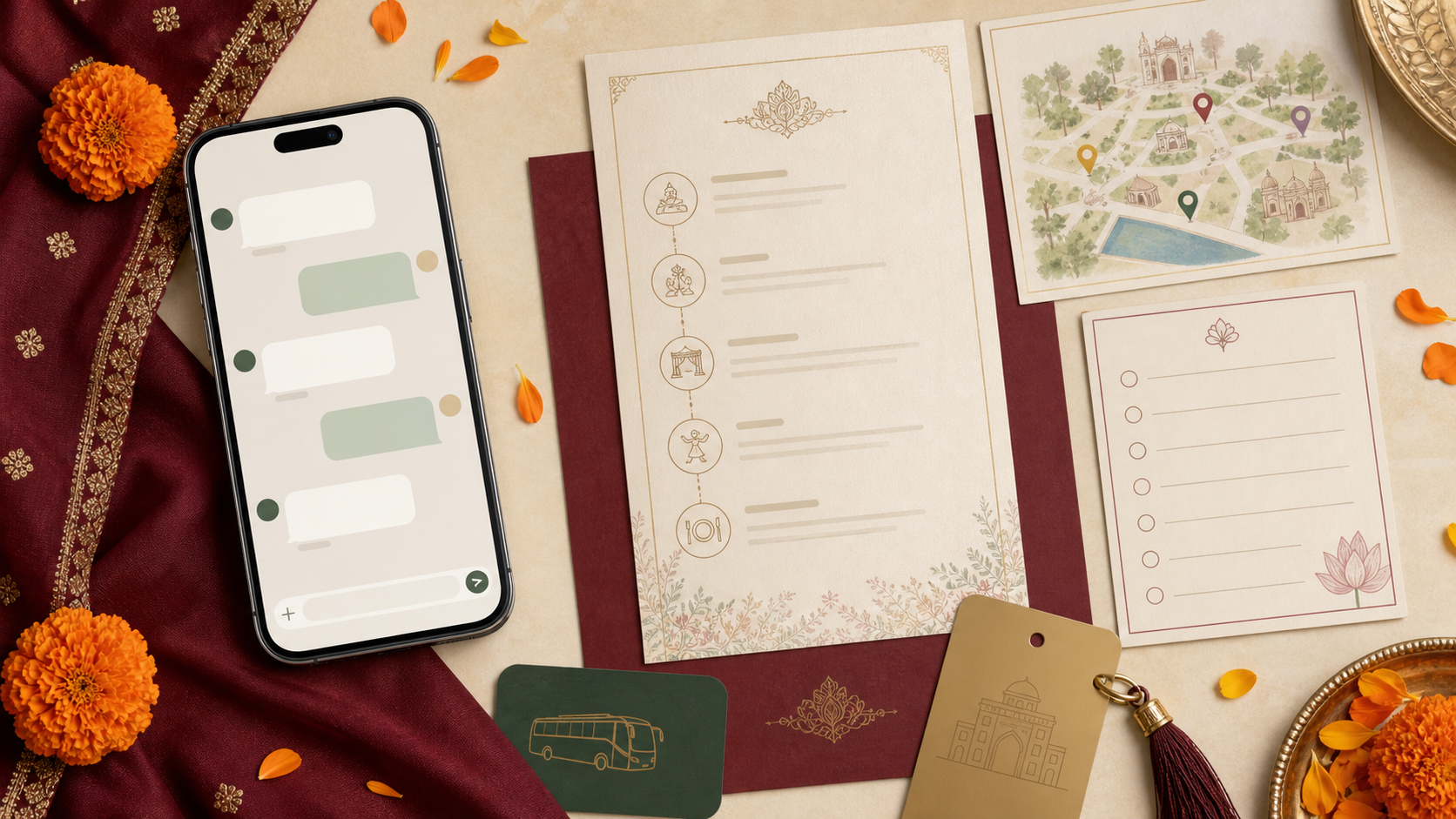
The expensive mistake is choosing a wedding planning platform that looks organised to the couple but still sends every guest question to the couple, parents, siblings, or planner.
For an Indian wedding, guest communication is not one invitation and one venue pin. It is several functions, changing timings, hotel check-ins, airport arrivals, shuttle routes, dress codes, food questions, family customs, and guests operating across languages and time zones. The desired outcome is simple: one approved answer reaches everyone, while private planning work stays private.
Fast decision rule: choose the platform that can answer 15 real guest questions accurately, publish a changed detail in under two minutes, and work from one link without an app download. Ignore the rest of the feature list until it passes those three tests.
What is a wedding planning platform?
A wedding planning platform is software that organizes one or more wedding jobs, such as tasks, budgets, vendors, RSVPs, schedules, travel details, and guest questions. It may be an all-in-one suite or a focused tool connected to a simple planning stack.
The term covers several very different products:
- Internal project tools for tasks, approvals, and timelines.
- Vendor and budget systems for contracts and payments.
- Wedding websites for publishing schedules, stories, and RSVP forms.
- Guest communication tools for questions, reminders, and changing logistics.
- AI wedding concierges that answer from approved wedding information.
Do not assume one product must do every job. A planner's internal workspace contains private negotiations, payment notes, risks, and unfinished decisions. Guests need only the approved layer: what is happening, where, when, what to wear, how to get there, and whom to contact when something is genuinely urgent.
Which type of platform fits your wedding?
Choose the platform type from the communication problem, not the wedding's budget or aesthetic. A 150-person destination wedding can create more guest support work than a 500-person local reception if travel, hotels, and time zones are involved.
| Wedding situation | Best starting point | Main reason | | --- | --- | --- | | One venue, one event, mostly local guests | Wedding website plus RSVP form | Information is simple and stable | | Multi-event Indian wedding | Website or guest hub plus conversational FAQ | Guests need event-specific answers | | Destination wedding | Guest hub with hotel, travel, and transport updates | Logistics change and questions repeat | | NRI couple with international guests | Mobile web platform with time-zone and language support | Guests need accessible, contextual answers | | Planner managing several weddings | Internal planning system plus separate guest layer | Client data and guest data must stay separated | | Details changing during wedding week | Guest concierge plus WhatsApp broadcast | One source of truth plus fast distribution |
If you need the wider operational setup too, use the wedding planner software stack for Indian weddings. The rest of this guide evaluates the guest-facing layer only.
What should a guest communication platform include?
A useful guest communication platform should cover the questions that otherwise become calls and WhatsApp messages. For Indian weddings, that means multi-event schedules, venue and travel context, hotel and shuttle details, attire, food, family customs, accessibility, and a clear escalation route.
Use this capability checklist:
- One mobile link: guests can open it from an invitation, QR code, or WhatsApp message.
- Event-aware answers: the mehendi venue is not confused with the wedding venue.
- Easy updates: the planner changes an approved fact once and can see where it appears.
- Natural-language questions: guests do not need to guess the correct menu or page.
- Multilingual access: relatives can ask in the language they are comfortable using.
- Travel context: hotel, airport, parking, pickup, and shuttle information stays connected.
- Uncertainty handling: the platform says when information is unavailable instead of guessing.
- Human escalation: urgent or personal issues reach the correct person.
- Privacy controls: private guest or family data is not exposed in public answers.
- No-install access: guests can use it in a browser unless an app is genuinely necessary.
This is also why a generic task manager is rarely enough. It may organise the planner perfectly while giving a guest no sensible way to ask, “Does the 4:30 shuttle go to the sangeet venue or the hotel?”
How do you compare wedding planning platforms?
Compare platforms with a scored test using your real wedding information. A polished demo with sample data proves very little; the platform must work with your number of functions, venue names, family terminology, travel rules, and incomplete decisions.
Score each option from 0 to 2:
| Test | 0 points | 1 point | 2 points | | --- | --- | --- | --- | | Answer accuracy | Invents or mixes details | Usually right, needs navigation | Correct and cites the approved detail | | Update speed | Requires support or redesign | Manual edits in several places | One edit updates the guest answer | | Guest access | App and account required | Browser works after login | One link opens immediately | | Multiple events | Treats wedding as one event | Events exist but context is weak | Answers are function-specific | | Language handling | One language only | Translated static pages | Guests can ask naturally across languages | | Escalation | No clear route | Generic contact form | Routes the issue to the right owner | | Privacy | Broad public exposure | Basic permissions | Guest-facing and private data are separated | | Analytics | No visibility | Page views only | Shows unanswered or repeated questions |
Decision threshold: reject any platform that scores zero on accuracy, updates, privacy, or escalation. Among the survivors, pick the simplest product scoring at least 12 out of 16. Complexity is a cost: every extra login, dashboard, and duplicate field becomes production-week work.
What 15 questions should you use in the demo?
Test a platform with the awkward, specific questions guests actually ask. This exposes whether it understands the wedding or merely searches for matching words.
- What time should I reach the haldi?
- Is tonight's sangeet indoors or outdoors?
- Which venue pin should I send my driver?
- When does the shuttle leave my hotel?
- My flight lands late; is airport pickup still available?
- Can I check in before the standard hotel time?
- What should men wear to the mehendi?
- Is there Jain food at every function?
- Can I bring my child to the reception?
- Is the venue wheelchair accessible?
- Where should I leave a gift or shagun envelope?
- Has tomorrow's baraat time changed?
- Who do I call if the shuttle does not arrive?
- Which events am I invited to attend?
- I do not see my question answered—what happens next?
Write the expected answer beside each question before the demo. If the platform provides a confident but wrong answer, treat that as worse than no answer. A reliable system must distinguish “approved,” “not confirmed,” and “ask this person.”
Can WhatsApp be your main guest communication platform?
WhatsApp is excellent for reach, reminders, and urgent broadcasts, but it is weak as the only source of truth. Messages get buried, newcomers miss earlier details, separate groups receive different versions, and the same question is answered repeatedly in private chats.
Use WhatsApp for distribution:
- Send the guest platform link after invitations go out.
- Broadcast reminders 24 hours before each function.
- Announce genuinely urgent changes.
- Pin the current help link and escalation contact.
Keep the approved schedule, venue, hotel, transport, dress code, and food information in the guest platform. This “source plus distribution” model is cleaner than asking guests to search a group chat. The wedding WhatsApp message templates provide copy-ready launch, reminder, and update messages.
How should information move from planners to guests?
Use a simple approval chain: a named owner confirms the fact, the communication owner updates the guest platform, and WhatsApp distributes only changes that matter immediately. This prevents draft decisions from becoming promises.
For every guest-facing detail, record:
- The approved answer.
- The owner who approved it.
- The date and time it was last checked.
- Which events or guest groups it applies to.
- Whether it needs a broadcast after changing.
- The person who handles exceptions.
A final itinerary is useful, but guests still ask questions in their own words. Pair the structured Indian wedding guest itinerary template with a conversational layer so guests can retrieve the relevant detail without scanning every function.
Before testing any platform, build the approved answer set with these 35 wedding website FAQ questions for Indian weddings. It gives the couple and planner a practical baseline for invitations, schedules, travel, attire, food, accessibility, gifts, and last-minute updates.
When is an AI wedding concierge better than a static website?
An AI wedding concierge is better when guests have many context-specific questions, details change, or the wedding includes several venues, hotels, languages, and travel routes. A static website is better for visual storytelling, galleries, public schedules, and a clean RSVP form.
The strongest setup is often both: a lightweight website for the couple's story and RSVP, and a concierge for logistics. The concierge should answer only from approved wedding information, admit when an answer is missing, and hand exceptional cases to a human.
Mandap Chat for wedding planners is built for that guest-support role. Upload the approved schedule, venue, hotel, transport, attire, food, and FAQ details; then give guests one link where they can ask instead of searching documents or messaging the planner. For travel-heavy celebrations, see the dedicated destination wedding concierge setup.
What is the fastest way to make a final decision?
Shortlist no more than three platforms, upload the same minimum information to each, run the 15-question test, make one schedule change, and ask a relative who was not involved in setup to use each option on their phone.
Use this final checklist:
- [ ] Guests can open one link without installing an app.
- [ ] All 15 test questions return correct or safely uncertain answers.
- [ ] A changed time is reflected in under two minutes.
- [ ] Each event, venue, hotel, and shuttle is clearly distinguished.
- [ ] Guests can ask in the languages your families use.
- [ ] Private planning notes remain private.
- [ ] Unanswered questions reach a named human owner.
- [ ] The platform works for an older relative on mobile data.
- [ ] The planning team can maintain it during production week.
- [ ] The total cost is lower than the support work it removes.
Do not buy the platform with the longest feature page. Buy the one that makes the correct answer easiest to publish, easiest to find, and hardest to misunderstand.
FAQ
What is a wedding planning platform?
A wedding planning platform is software that organizes one or more planning jobs, such as tasks, budgets, vendors, RSVPs, schedules, travel details, and guest questions. For Indian weddings, it should handle multiple functions and make approved information easy to update and find.
What is the best wedding planning platform for guest communication?
The best platform gives guests one mobile-friendly link, answers from approved wedding information, supports changing schedule and travel details, works across languages, and clearly escalates unanswered questions to a human. Compare those capabilities before generic feature counts.
Can WhatsApp be the main wedding planning platform?
WhatsApp is effective for reminders and urgent broadcasts, but it is weak as the only source of truth because messages get buried and different groups receive different versions. Keep approved details in a structured platform, then use WhatsApp to distribute the link and urgent updates.
Do guests need to download an app?
Usually they should not. A browser-based link or QR code reduces friction for older relatives, international guests, and anyone with limited phone storage. Require an app only when its benefit clearly outweighs the extra login and download step.
How should wedding planners test a guest communication platform?
Run a 15-question test using real guest wording about event times, venues, shuttles, hotel check-in, dress codes, food, children, gifts, and last-minute changes. Reject the platform if it invents answers, hides uncertainty, or makes updates difficult.
Frequently asked questions
What is a wedding planning platform?+
What is the best wedding planning platform for guest communication?+
Can WhatsApp be the main wedding planning platform?+
Do guests need to download an app?+
How should wedding planners test a guest communication platform?+
Continue the series
A wedding planner escalation matrix assigns each type of problem a severity, response time, first owner, final decision owner, and communication route before the wedding begins.
Wedding planner quality control is a separate verification pass that checks whether approved details match across contracts, run sheets, vendor briefs, venue plans, and guest communication before execution begins.
An NRI wedding budget in India should be built in INR around guest count, city, event count, room nights, and production complexity—then protected with separate currency and contingency buffers.
Wedding plus-one wording should state exactly who is invited, where the guest adds their companion's name, and whether the rule applies to every function. Clear language feels kinder than a vague invitation followed by an awkward refusal.
Wedding vendor meals keep photographers, planners, drivers, decor, sound, and hospitality teams working through long Indian wedding functions. Count crew by event, confirm dietary needs, schedule service before the guest rush, and give one caterer captain the final list.