
NRI Wedding Planning Timeline: A 12-Month India Checklist
Use this 12-month NRI wedding planning timeline to coordinate venues, vendors, India trips, family approvals, guest travel, payments, and final-week communication.
A month-by-month NRI wedding planning timeline for couples organizing an Indian wedding from abroad, with decision deadlines, India trips, guest communication, and final-week handoffs.
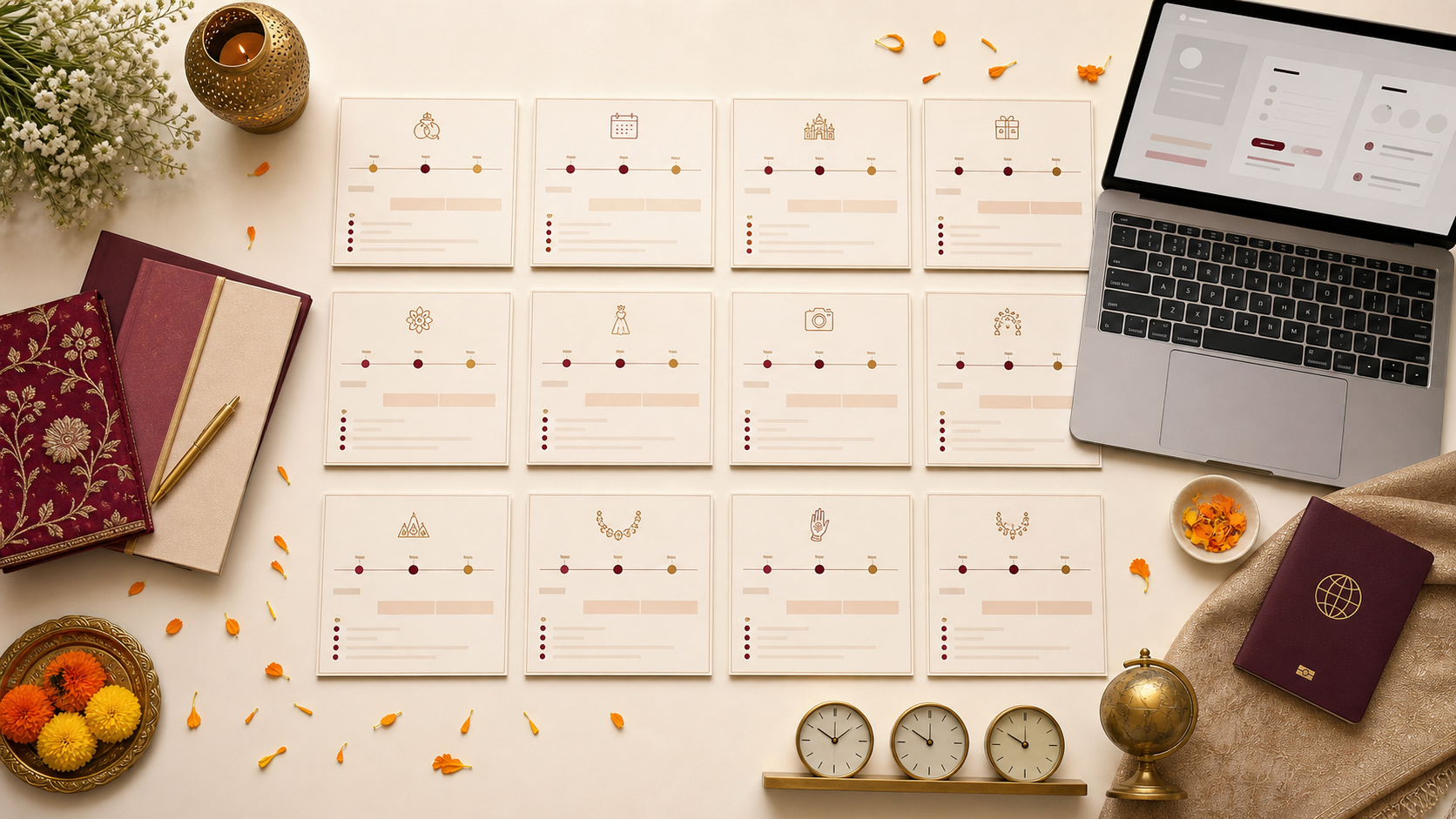
Planning an Indian wedding from abroad gets painful when every task feels equally urgent. The venue wants a deposit, parents want to add guests, outfits need an India trip, and relatives are already asking for hotel details that do not exist.
The fastest fix is to work backwards from the first event and give every decision a deadline, owner, and dependency. Use the 12-month timeline below as the operating plan; if you have 15 months, stretch the first three phases instead of adding more tasks.
What is an NRI wedding planning timeline?
An NRI wedding planning timeline is a month-by-month schedule for coordinating an Indian wedding while the couple lives abroad. It connects venue and vendor deadlines with India trips, family approvals, cross-border payments, guest travel, outfits, and communication across time zones.
An NRI wedding planning timeline is the single calendar that shows what must be decided, who owns it, and what becomes harder or more expensive if it slips.
Use this fast decision rule:
| Time remaining | Protect first | Do not waste time on yet | | --- | --- | --- | | 12-10 months | Date, city, guest range, budget, planner, venue | Favours, detailed decor, welcome bags | | 9-7 months | Major vendors, first India trip, rooms, save-the-dates | Final seating, exact menus | | 6-4 months | Invitations, RSVPs, outfits, guest travel, event details | Final headcount, table assignments | | 3-2 months | Production, payments, transport, fittings, final walkthrough | New inspiration and optional upgrades | | Final month | Confirmations, guest answers, handoffs, emergency plans | Renegotiating the wedding concept |
For strategy, costs, and team structure, start with the broader NRI wedding planning guide. This page is the execution calendar you can copy into your planner.
What should you decide 12 months before the wedding?
Twelve months out, decide the constraints that every later choice depends on: wedding city, workable dates, guest-count range, budget ceiling, planning model, and approval owners. Then book the venue before designing invitations or collecting decor references.
Your first-month checklist:
- Choose the city and two or three acceptable date combinations.
- Set a guest range, not a fantasy exact count: for example, 300 to 350.
- Set the total budget in INR and a separate contingency.
- Decide whether you need a full-service planner, partial planner, or coordinator.
- Name one India-side operations lead.
- Create one shared decision log and one budget tracker.
- Shortlist venues that fit capacity, rituals, accessibility, rooms, and transport.
- Hold the venue only after reviewing payment, cancellation, noise, catering, and curfew terms.
Do not let six relatives become equal approvers. Use an NRI wedding family approval checklist to define who can approve vendors, budget changes, guest additions, rituals, and guest-facing messages.
What should happen 10 to 9 months before the wedding?
Book the scarce vendors and announce the date to people who must travel internationally. Your goal is not to finish the aesthetic; it is to secure the people, places, and room inventory that cannot be replaced cheaply later.
Prioritize:
- Planner, if not already hired.
- Photographer and filmmaker.
- Caterer, where the venue does not control catering.
- Decor or production partner for complex multi-event weddings.
- Makeup artist and key entertainment.
- Main hotel block and a practical backup option.
- Save-the-date for overseas guests.
Send international guests the date, city, nearest airport, broad event window, and a clear note that booking instructions will follow. Do not send guessed flight, shuttle, or hotel promises just to make the message look complete.
If your families need a recurring call, use the 45-minute NRI wedding planning meeting agenda. Five documented decisions per week beats a two-hour call that produces none.
What should the first India planning trip include?
Schedule the first India trip roughly 7 to 9 months before the wedding. Treat it like a production sprint: pre-book every appointment, group tasks by area, and reserve open time for decisions that require a second visit.
A useful 7-day trip looks like this:
| Day | Focus | Required output | | --- | --- | --- | | 1 | Venue and hotel walkthrough | Layout constraints, room plan, open questions | | 2 | Food tasting | Shortlisted menu and dietary gaps | | 3 | Decor and production | Direction, scope, revised quote deadline | | 4 | Outfits and jewellery | Orders placed, fitting dates, pickup owner | | 5 | Photo, video, makeup | Teams confirmed and contract gaps closed | | 6 | Ritual and family meeting | Event order, family responsibilities, special needs | | 7 | Buffer and decision closeout | Written approvals and next deadlines |
Ask vendors to send proposals before you fly. An India trip should be used for tasting, trying, walking the site, and deciding—not watching vendors build their first quotation.
What should happen 6 to 5 months before the wedding?
Turn the booked wedding into a guest-ready plan. Finalize the event list, invitation scope, RSVP questions, accommodation rules, and the first version of travel guidance before the formal invitation goes out.
Build a guest list that tracks more than names:
- Country and city.
- Phone number with country code.
- Events invited to.
- RSVP status by event.
- Room and airport-transfer needs.
- Dietary, accessibility, child, and plus-one needs.
- Follow-up owner.
Send the formal invitation when guests can act on it. A beautiful invite without confirmed dates, city, RSVP route, and accommodation guidance simply creates more messages.
This is also the right time to create the guest answer system. Mandap Chat for NRI couples gives guests one place to ask about schedules, venues, dress codes, hotels, transport, and rituals across time zones instead of messaging the couple and parents separately.
What should happen 4 to 3 months before the wedding?
Four to three months out, convert creative ideas into approved production details and convert RSVPs into logistics. Lock event flows, decor scopes, room demand, transport assumptions, outfits, invitations, and payment milestones.
Use this checkpoint:
- Event-by-event run sheets have owners and rough timings.
- Decor references have become itemized deliverables.
- Guest rooms are assigned by priority and arrival pattern.
- Airport pickups use flight details, not verbal promises.
- Vendor contracts, invoices, bank details, and balances sit in one tracker.
- Couple and family outfits have fitting and collection owners.
- Guest-facing answers are approved before being published.
For payments from abroad, use the NRI wedding vendor payment checklist. Record the INR amount, foreign-currency estimate, route, due date, approver, payer, invoice, and transfer proof for every milestone.
What should happen 8 to 6 weeks before the wedding?
Use the second India trip for verification, not reinvention. Complete final fittings, a venue walkthrough, production review, menu confirmation, family ritual check, and any in-person approvals that cannot safely wait.
Walk the venue as a guest would:
- Arrival and parking or drop-off.
- Check-in and welcome desk.
- Route to each event space.
- Lift, stairs, accessible paths, and toilets.
- Meal service and dietary-request handling.
- Elderly guest seating and rest areas.
- Rain, heat, power, and transport backup.
- Departure and late-night shuttle plan.
Then freeze the production direction. Changes after this point should fix a real risk, not satisfy a new Pinterest screenshot.
What should happen in the final 30 days?
The final month is for confirming people, information, and handoffs. Freeze major creative choices, close RSVP gaps, publish final guest details, reconcile vendor balances, and make every operational task survivable without the couple.
Four weeks out
- Chase unresolved RSVPs through named family owners.
- Reconfirm room inventory and transport demand.
- Publish confirmed schedule, venue, dress code, hotel, and help details.
- Review vendor balances and due dates.
- Assign welcome desk, hospitality, gifts, and emergency owners.
Two weeks out
- Finish the NRI wedding packing checklist for India, including cross-packed outfits, document copies, customs checks, and local purchases.
- Freeze catering and production headcounts under the contracted rules.
- Reconfirm every vendor's arrival time and on-site lead.
- Share the current run sheet only with people who need it.
- Test guest links, phone numbers, map pins, and concierge answers.
- Prepare a change log for late flight, room, and attendance updates.
Final week
- Move routine questions away from the couple.
- Hold one final operations call with the planner and family leads.
- Confirm money, keys, gifts, transport, and emergency contacts.
- Protect sleep, meals, medicines, and buffer time.
- Accept that non-critical imperfections are now cheaper than last-minute fixes.
When should the couple arrive in India?
Arrive 10 to 14 days before the first event when possible. This gives you time for jet-lag recovery, final fittings, family rituals, vendor checks, and genuine surprises without making every delayed suitcase or alteration an emergency.
Arriving three or four days before a multi-day Indian wedding is a fragile plan. If work prevents an earlier arrival, give the planner and India-side lead written authority, finish fittings on the earlier trip, and avoid tasks that require the couple's physical presence.
How do you keep the timeline from slipping across time zones?
Run one weekly decision meeting, one shared tracker, and one approved source of guest information. Each task needs one owner and date; each decision needs a written outcome. WhatsApp can carry alerts, but it should not be the archive.
Use these rules:
- Put dates in both the couple's time zone and India Standard Time.
- Record the final decision, not the entire debate.
- Give routine approvals to the lowest sensible level.
- Escalate only decisions with budget, contract, safety, or guest impact.
- Update guest information once, then let the same answer flow to the website, planner, family leads, and concierge.
- Review the next six weeks every Sunday; distant deadlines hide until they become expensive.
The timeline works when it removes choices from the final month. Book scarce resources early, batch physical decisions into two India trips, release guest information in stages, and hand off operations before you fly. That is how an NRI wedding feels like a wedding—not a year-long international support ticket.
Frequently asked questions
How early should an NRI couple start planning an Indian wedding?
Start 12 to 15 months before the first event. Use the first three months to fix the city, budget, guest-count range, planner, venue, and major vendors. A shorter timeline can work, but it needs faster approvals, flexible dates, and a strong India-side operations lead.
How many India trips are needed to plan an NRI wedding?
Plan two focused India trips when possible: one 7 to 9 months before the wedding for venue visits, tastings, outfits, and major vendor meetings, then one 6 to 10 weeks before the wedding for fittings, venue walkthroughs, and final production decisions.
What should NRI couples book first for an Indian wedding?
Book the venue first, then the planner, photographer or filmmaker, caterer, and accommodation inventory if guests are travelling. These choices determine the date, capacity, logistics, and budget available for everything else.
When should NRI wedding invitations and guest travel details be sent?
Send save-the-dates 9 to 12 months ahead for international guests. Send the formal invitation and RSVP flow 4 to 6 months ahead, then release confirmed hotel, airport-transfer, dress-code, and event details in stages rather than waiting for one perfect final message.
When should an NRI couple arrive in India before the wedding?
Aim to arrive 10 to 14 days before the first event. That gives enough time for final fittings, family rituals, vendor checks, jet-lag recovery, and genuine emergencies without turning every small delay into a wedding-week crisis.
Frequently asked questions
How early should an NRI couple start planning an Indian wedding?+
How many India trips are needed to plan an NRI wedding?+
What should NRI couples book first for an Indian wedding?+
When should NRI wedding invitations and guest travel details be sent?+
When should an NRI couple arrive in India before the wedding?+
Continue the series
A wedding planner escalation matrix assigns each type of problem a severity, response time, first owner, final decision owner, and communication route before the wedding begins.
Wedding planner quality control is a separate verification pass that checks whether approved details match across contracts, run sheets, vendor briefs, venue plans, and guest communication before execution begins.
An NRI wedding budget in India should be built in INR around guest count, city, event count, room nights, and production complexity—then protected with separate currency and contingency buffers.
Wedding plus-one wording should state exactly who is invited, where the guest adds their companion's name, and whether the rule applies to every function. Clear language feels kinder than a vague invitation followed by an awkward refusal.
Wedding vendor meals keep photographers, planners, drivers, decor, sound, and hospitality teams working through long Indian wedding functions. Count crew by event, confirm dietary needs, schedule service before the guest rush, and give one caterer captain the final list.