
NRI Wedding Vendor Payment Checklist for Indian Weddings
A practical NRI wedding vendor payment checklist for paying Indian wedding vendors from abroad: routes, owners, proof, due dates, and final-week blockers.
An NRI wedding vendor payment checklist should show who pays each Indian vendor, which payment route will be used, what invoice or proof is needed, when money must reach India, and which late payments can block setup.
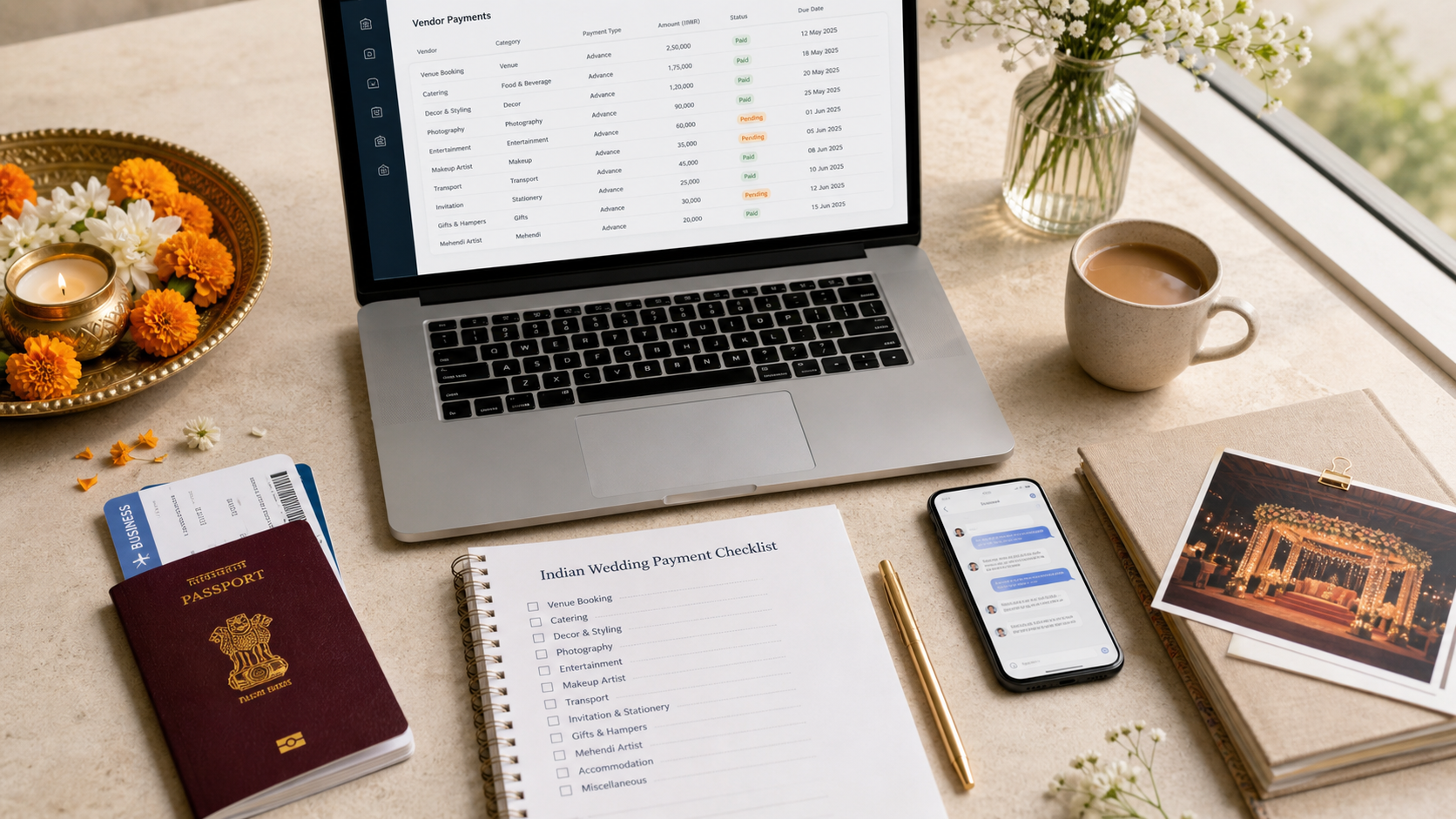
The payment problem in an NRI wedding is rarely one dramatic mistake. It is smaller and more annoying: the decorator wants INR today, the couple is in California, the father has an Indian account but not the invoice, the planner has the due date but not approval, and the vendor only sent bank details in a WhatsApp photo from three months ago.
The outcome you want is boring: every Indian wedding vendor has a payment route, approval owner, due date, invoice trail, and proof folder before production week starts.
Fast rule: if a payment can delay venue access, decor setup, catering, sound, lights, photography, makeup, transport, hotel rooms, or priest coordination, treat it as a production blocker. Put it in the NRI wedding vendor payment checklist, not in someone's private chat.
How should NRI couples pay Indian wedding vendors from abroad?
NRI couples should separate payment planning from actual money movement. Decide the route for each vendor first: Indian bank transfer from an NRE or NRO account, overseas remittance to the vendor's Indian account, a family finance owner's Indian account, card payment where the vendor supports it, or UPI for smaller local payments.
An NRI wedding vendor payment checklist is the private tracker that connects each Indian vendor's INR due date with the overseas payer, payment route, approval owner, invoice proof, and setup risk.
Do not make the planner guess who can pay. Do not make the vendor chase three relatives. And do not assume that "we can just transfer later" is enough for a venue, caterer, or decor team that needs cleared funds before setup.
Use this article with the broader NRI wedding planning guide, the general wedding vendor payment schedule, and Mandap Chat for NRI couples. The general schedule tells you what to track. This NRI version solves the cross-border mess: currency, time zones, Indian accounts, transfer proof, and family approval.
Which payment route should an NRI wedding use?
Choose the payment route based on amount size, vendor seriousness, documentation need, and who actually controls the money. For major vendors, use a traceable banking route. For small wedding-week expenses, use a local family owner's UPI or bank account only when the amount and proof needs are simple.
| Payment route | Best for | Watch out for | | --- | --- | --- | | NRE account to vendor bank | NRI income held abroad and brought into India for wedding payments | Confirm account rules with your bank and keep transfer references | | NRO account to vendor bank | India-sourced funds, rent, dividends, or money already in India | Tax and repatriation rules can matter; ask your bank or adviser | | Overseas remittance provider | Couple paying from the US, UK, UAE, Singapore, Canada, or Australia | Fees, FX rate, processing time, purpose code, and vendor bank details | | Indian family finance owner | Parent or sibling in India releasing payments quickly | Needs written approval limits and proof discipline | | UPI | Smaller local balances, makeup, mehendi, transport, errands | Not every NRI has usable UPI; limits and bank linking vary | | Card payment | Venues or platforms that support cards | Convenience fees and foreign-card issues | | Cash | Last-resort tips or small event-week errands | Weak proof, security risk, and family confusion |
For Indian bank-account basics, the Reserve Bank of India explains that NRE and NRO accounts have different permissible credits, debits, and repatriation treatment in its non-resident account FAQ. That is enough for planning language, but not enough for personal tax or FEMA advice. Large or unusual transfers should be checked with the bank or adviser handling the account.
For UPI, the National Payments Corporation of India describes UPI as an instant payment system developed by NPCI and regulated by RBI on its UPI product page. UPI is useful when it works, but the wedding tracker still needs the amount, date, reference, payer, and vendor acknowledgement.
What should the NRI payment checklist include?
The checklist should include enough detail that the couple, parent, planner, and vendor can all agree on the same status without searching WhatsApp. The minimum fields are vendor, event, amount, route, owner, proof, due date, and blocker status.
Use these columns:
| Column | Example | | --- | --- | | Vendor category | Venue, decor, catering, photo/video, makeup, transport | | Vendor legal name | The name on invoice or bank account | | Event | Mehendi, sangeet, wedding, reception, all events | | Amount due in INR | INR 3,50,000 | | Foreign-currency estimate | USD estimate for the overseas payer | | Payment route | NRE transfer, overseas remittance, family bank, UPI | | Due date | 14 days before first event | | Finance owner | Bride, groom, parent, sibling, family accountant | | Approval status | Approved, pending, needs quote correction | | Invoice status | Received, pending, GST correction, not applicable | | Transfer proof | UTR/reference ID, screenshot, bank advice | | Vendor acknowledgement | Written confirmation from vendor owner | | Setup blocker? | Yes, no, partial, contract-dependent | | Backup contact | Person to call if transfer is delayed |
For GST invoices, the GST Council's taxpayer material explains that invoices identify parties, describe supply, show value, and include prescribed details for tax invoices where applicable (GST tax invoice guide). For weddings, the practical point is simple: collect the vendor's invoice before sending the final balance, not after the event when everyone has moved on.
When should NRI couples send vendor payments?
Send payments earlier than a local couple would, because cross-border transfers have more failure points. A payment that feels instant to the couple may still need bank review, exchange-rate confirmation, corrected account details, or vendor-side acknowledgement.
Use this timing:
| Timing | Payment task | Owner | | --- | --- | --- | | Contract signing | Pay advance, save signed quote, record cancellation terms | Couple plus finance owner | | 60 days out | Confirm all milestone amounts and foreign-currency estimate | Planner plus finance owner | | 30 days out | Collect missing invoices, GST details, and bank details | Planner | | 14 days out | Clear critical setup payments or schedule exact release dates | Finance owner | | 7 days out | Mark blockers, pending proof, and vendor acknowledgement gaps | Planner operations lead | | 48 hours out | Freeze payment status for production | Lead planner | | Post-event | Release written holdbacks after agreed deliverables | Finance owner |
Do not leave major vendor balances for the wedding morning unless the contract explicitly says the payment is triggered by setup sign-off. Even then, write the trigger clearly: "release INR 1,00,000 after stage setup approval by planner at 4 PM" is a plan. "Pay after decor" is a fight waiting to happen.
Who should own payments when the couple is abroad?
One finance owner should own payment release, and one planner should own payment visibility. They are not the same job. The finance owner controls money. The planner tracks due dates, proof, blockers, and escalation.
| Role | Should own | Should not own | | --- | --- | --- | | NRI couple | Budget priorities, big approvals, overseas transfer source | Every routine payment chase | | Family finance owner in India | Local payment release, Indian bank coordination, proof upload | Guest questions or vendor scope negotiation | | Planner | Tracker, reminders, blocker alerts, vendor confirmation | Acting as the family's bank | | Vendor owner | Correct invoice, correct bank details, written acknowledgement | Chasing random relatives | | Family accountant/adviser | Tax, FEMA, account-specific questions | Wedding production decisions |
This is where the NRI wedding family approval checklist matters. If everyone knows who can approve money, vendors stop calling the couple during work hours abroad and the planner stops becoming the human router for private finance decisions.
What payment proof should you save?
Save the proof that ends arguments. For every payment, keep the invoice or request, bank details supplied by the vendor, approval message, transfer reference, screenshot or bank advice, exchange-rate note if relevant, and vendor acknowledgement.
Create one folder per vendor:
- Signed quote or contract.
- Invoice or payment request.
- Bank details as text, not only an image.
- Approval message from finance owner.
- Transfer proof with reference ID.
- Vendor acknowledgement.
- Balance and holdback note.
Avoid voice-note approvals for money. If a parent approves by voice note, convert it into text in the tracker: vendor, amount, due date, payment route, approver, and next action.
How do you prevent duplicate or missed payments?
Prevent duplicates by using one tracker and one release owner. Prevent missed payments by marking blocker status against each vendor and reviewing the sheet at 30 days, 14 days, 7 days, and 48 hours before production.
The common NRI failure pattern is predictable:
- Couple sends a transfer from abroad.
- Parent pays the same vendor locally because the vendor called.
- Planner does not know either payment happened.
- Vendor confirms receipt to one person, not the group.
- Final balance still appears unpaid in the production sheet.
The fix is not more trust. It is better plumbing. Every payment update goes into the same tracker within 24 hours, and the vendor acknowledgement is saved against the row.
What should the finance owner message vendors?
Vendor messages should be specific, short, and tied to a payment row. Never send "will pay soon" when a vendor needs cleared funds before setup.
Copy this:
Hi [Name], payment confirmation for [Couple / Event].
Vendor: [Company] Event: [Sangeet / Wedding / Reception] Milestone: [Advance / Balance / Setup release / Holdback] Amount: INR [amount] Payment route: [NRE transfer / family bank / UPI / remittance] Due date: [date] Approval owner: [name]
Please confirm the invoice, bank details, and whether this amount is required before setup.
Internal family message:
Payment blocker check: [Vendor] has INR [amount] due by [date]. It affects [setup/service/delivery]. [Name] owns approval. Please confirm by [time] so the planner can update the production sheet.
Where does Mandap Chat fit?
Mandap Chat should not store private bank details, approve vendor payments, or tell anyone which account route to use. Its job is to protect the payment team from guest noise.
In the final month, guests ask about hotel check-in, airport pickup, ceremony times, dress code, food, kids policy, shuttle timing, and ritual meaning. Those are valid questions, but they should not hit the same people handling vendor balances and cross-border transfer proof.
Upload the guest-facing logistics into Mandap Chat, then keep the private vendor payment checklist with the planner and finance owner. For NRI weddings, that split is the difference between a family that can sleep across time zones and a family that becomes a 24-hour helpdesk.
If guest communication is also messy, pair this with the NRI wedding guest communication timeline. Payment chaos and guest-message chaos usually show up together in the same final week.
The 20-minute NRI vendor payment setup
If the wedding is close, build the 80/20 version now. Do not wait for a perfect spreadsheet.
- List every vendor active in the next 30 days.
- Add amount due in INR and paid amount.
- Pick the payment route for each vendor.
- Name one finance owner per payment.
- Mark whether late payment blocks setup or delivery.
- Collect missing invoices and bank details.
- Save transfer proof and vendor acknowledgement.
- Move guest questions into Mandap Chat or one guest-support channel.
- Review blockers 7 days out and freeze status 48 hours out.
The goal is not to become an accountant. The goal is to make sure no vendor, parent, planner, or couple has to ask, "Wait, who was supposed to pay them?"
FAQ
How should NRI couples pay Indian wedding vendors from abroad?
The cleanest setup is to pay major vendors through bank transfer, NRE or NRO account, or a regulated remittance provider, then keep each invoice, transfer reference, exchange-rate note, and vendor acknowledgement in one payment tracker. Use UPI only when the payer has a valid Indian bank-linked setup and the amount is suitable.
What should an NRI wedding vendor payment checklist include?
Include vendor name, legal name, event, amount due in INR, foreign-currency estimate, payment route, due date, finance owner, invoice status, GST details where applicable, transfer proof, vendor acknowledgement, setup blocker status, and backup contact.
When should NRI couples send vendor payments for an India wedding?
Send major vendor advances as soon as contracts are signed, confirm milestone balances 30 days out, clear critical setup payments 14 to 7 days before the first event, and freeze payment status 48 hours before production starts.
Can Mandap Chat answer vendor payment questions?
Mandap Chat should not handle private vendor finance or banking instructions. It helps indirectly by answering guest questions about schedule, venues, dress code, hotels, shuttles, and rituals so the planner and finance owner can focus on vendor payments.
What is the biggest NRI wedding payment mistake?
The biggest mistake is leaving payments split across parents, the couple, a planner, and overseas relatives without one tracker. That creates duplicate transfers, missed balances, stale bank details, and event-week vendor escalation.
NRI wedding payments become calm when they are visible. Pick the route, name the owner, save the proof, and keep guests out of the finance thread. Mandap Chat handles the guest questions; your planner and finance owner handle the money trail.
Frequently asked questions
How should NRI couples pay Indian wedding vendors from abroad?+
What should an NRI wedding vendor payment checklist include?+
When should NRI couples send vendor payments for an India wedding?+
Can Mandap Chat answer vendor payment questions?+
What is the biggest NRI wedding payment mistake?+
Continue the series
Wedding welcome sign wording should do more than say welcome. For Indian weddings, the best signs name the couple, identify the function, confirm guests are in the right place, and point them to the itinerary, seating, dress code, transport, or Mandap Chat link when they need help.
A wedding food count sheet turns RSVP data into event-wise catering numbers: total plates, Jain meals, vegan or halal needs, kids meals, staff meals, buffers, and named exceptions that the caterer can execute without guessing.
A wedding planner checklist for Indian weddings should move in phases: client intake, budget and vendor lock, guest communication, final-month production, wedding-week execution, and post-event wrap. The checklist works only when every task has an owner, deadline, source of truth, and guest-facing answer.
An NRI wedding family approval checklist names who can approve money, vendors, guest-list changes, rituals, travel rules, hotel commitments, and final-week updates before every decision turns into a midnight WhatsApp debate.
A wedding website welcome message should welcome guests, name the couple and wedding dates, explain what guests can do next, and route routine questions to the right place. For Indian weddings, the best version points guests to the itinerary, RSVP, travel, dress code, hotel, and Mandap Chat link within the first screen.