
Wedding Planner Event Debrief Template for Indian Weddings
Use this wedding event debrief template to review vendors, timelines, guest issues, budgets, and team performance after an Indian wedding.
A wedding event debrief turns one wedding's delays, guest questions, vendor misses, and team wins into a better operating system for the next one. Run it within 72 hours, use evidence instead of blame, and assign every improvement an owner and deadline.
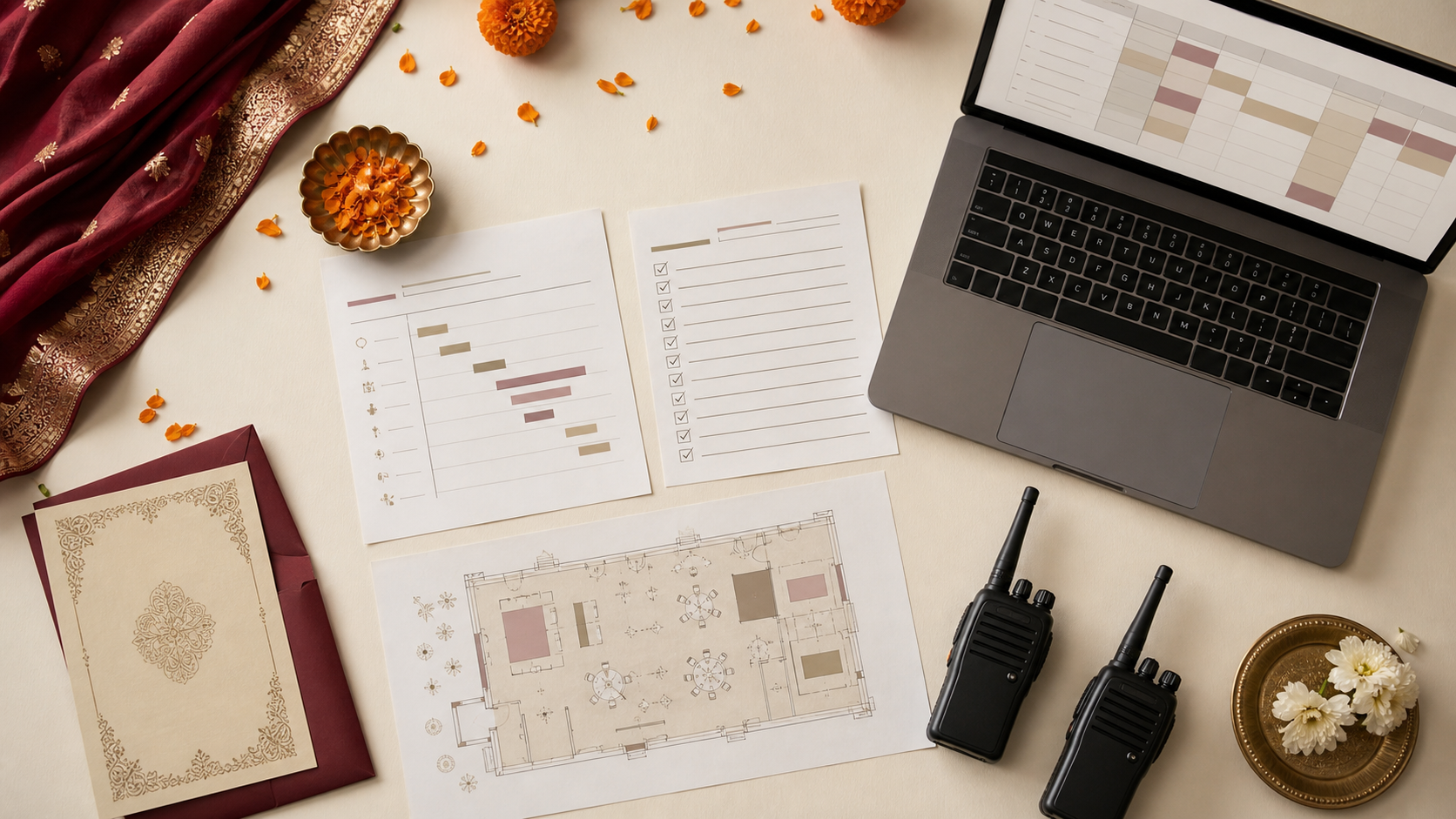
The wedding ended, but the useful work is not over. If the baraat ran 35 minutes late, three airport pickups were missed, guests could not find the after-party, and the planner somehow saved all four problems, there is a week of operational knowledge sitting in people's heads.
Leave it there and the same problems return at the next wedding. Capture it properly and one difficult weekend becomes a better timeline, vendor brief, guest FAQ, and team playbook.
Use this wedding event debrief template within 72 hours of the final function. In one hour, your team can separate symptoms from causes, keep the practices that worked, and assign fixes before memory turns into vague opinion.
The fast rule: do not discuss a problem without recording the evidence, root cause, next action, owner, and deadline. That prevents a debrief from becoming either a celebration or a blame session.
What is a wedding event debrief?
A wedding event debrief is a structured post-event review that compares the approved plan with what actually happened. The team records successes, failures, causes, guest impact, and specific improvements for the next wedding.
A wedding event debrief is a time-boxed review that converts event-day evidence into owned changes to the planner's process. It is different from a client offboarding call, which focuses on deliverables, payments, feedback, and closing the relationship.
Use the wedding planner client offboarding checklist for the client-facing close. Keep the operational debrief candid and internal so the team can examine handoffs, staffing, vendor dependencies, and mistakes without making the couple relive production details.
When should planners run the post-wedding review?
Run a 10-minute hot debrief within 24 hours, then a full team review within 72 hours. The first captures facts while they are fresh; the second creates actions after everyone has slept and collected timelines, messages, invoices, and incident notes.
| Review | Timing | Purpose | Length | | --- | --- | --- | --- | | Hot debrief | Within 24 hours | Capture urgent facts, unresolved risks, and notable wins | 10-15 minutes | | Team debrief | Within 72 hours | Find root causes and agree process changes | 45-60 minutes | | Closeout check | Within 7-10 days | Verify invoices, client feedback, and action owners | 15-20 minutes |
Do not wait two weeks for everyone's calendar to clear. By then, exact delays become guesses and people remember outcomes more clearly than causes.
Who should attend a wedding planner debrief?
Include the people who owned execution: lead planner, function captains, production, hospitality, transport, and guest communication. Keep the core group small enough to speak honestly, then invite a venue or vendor lead only for the section they can clarify.
The couple usually should not attend the internal debrief. Send them a clean closeout update, ask for feedback, and resolve outstanding deliverables separately. The internal review needs details such as unclear radio calls, staffing gaps, incorrect file versions, vendor lateness, and family-side approval delays.
Assign four meeting roles:
- Facilitator: keeps the conversation factual and on time.
- Recorder: completes the template and action register.
- Evidence owner: brings the final run sheet, message log, guest data, and invoices.
- Decision owner: approves changes to the planning workflow.
What should the team collect before the meeting?
Collect the planned schedule, actual timing notes, vendor contacts, incident log, guest questions, transport exceptions, rooming changes, payment records, and team observations. Evidence lets the group discuss the system instead of debating whose memory is right.
Use this pre-debrief checklist:
- Final approved wedding day run sheet.
- Actual start and finish times for every function.
- Vendor arrival and setup-complete times.
- Latest wedding vendor contact list.
- Transport delays, missed pickups, and vehicle changes.
- Hotel check-in, rooming, and welcome-desk exceptions.
- Guest questions from WhatsApp, calls, the help desk, and Mandap Chat.
- Event-wise guest counts and food-count differences.
- Incident, first-aid, weather, accessibility, and security notes.
- Approved scope changes, overtime, and unplanned expenses.
- Compliments and complaints from the couple, family, guests, and vendors.
Ask every team lead to submit three bullets before the meeting: one thing to keep, one thing to stop, and one thing to change.
What is the best wedding event debrief template?
The best template is short enough to finish and specific enough to change behaviour. Review each operating area using planned outcome, actual outcome, evidence, root cause, improvement, owner, and due date.
Copy this structure into your project tool:
Wedding event details
- Couple and wedding dates:
- Venues and functions:
- Lead planner:
- Core team:
- Final guest count by function:
- Debrief date and facilitator:
Executive summary
- Three wins to repeat:
- Three failures to prevent:
- Largest guest-experience issue:
- Largest operational risk:
- One change required before the next event:
Operating-area review
| Area | Planned | Actual | Root cause | Next change | Owner / due date | | --- | --- | --- | --- | --- | --- | | Timeline | Sangeet doors at 7:00 PM | Doors opened 7:25 PM | Soundcheck started late after stage handoff | Add setup-complete gate 90 minutes before doors | Production lead / Friday | | Transport | Airport pickups grouped by terminal | Two guests used old flight details | Arrival sheet was not re-frozen | Timestamp final sheet and archive old versions | Hospitality lead / next kickoff | | Guest communication | After-party pin in itinerary | Guests asked in three groups | Pin was absent from reminder message | Add venue pin to every day-of reminder | Guest comms / template update | | Vendor coordination | One on-site contact per vendor | Decor backup lead was unknown | Contact list used sales contact | Require site lead and backup at T-7 days | Planner ops / Monday |
Action register
| Priority | Action | Owner | Deadline | Proof complete | | --- | --- | --- | --- | --- | | High | Add actual-time column to master run sheet | Lead planner | Before next production week | Updated template link | | High | Add late-night venue pin to guest FAQ | Guest comms owner | Before next guest upload | Approved FAQ entry | | Medium | Add backup driver number to transport sheet | Transport captain | Next vendor confirmation | Updated contact row |
If an action has no owner or deadline, it is only a wish.
How do you find the root cause without blaming people?
Describe the observed gap, measure its impact, then ask why the system allowed it. Stop when you reach a process the planner can change—not a personality judgment such as "the vendor was careless" or "the family was difficult."
Use this five-question sequence:
- What was supposed to happen?
- What actually happened, and at what time?
- What was the guest, budget, safety, or timeline impact?
- Which missing information, approval, owner, trigger, or handoff allowed it?
- What small process change would make recurrence less likely?
Example: "The baraat was late" is not a root cause. The useful chain may be: the bus left late because two VIPs were missing; nobody could decide whether to leave; the transport sheet named a coordinator but not a departure authority. The fix is to add a named departure decision owner and a maximum hold time.
Which wedding-day areas need separate review?
Review timeline, vendors, guest experience, hospitality, transport, food, production, communication, payments, team operations, and safety separately. A wedding can feel successful overall while one weak system creates expensive hidden work.
For an Indian wedding, ask:
- Timeline: Which functions, rituals, entries, or meal services moved by more than 15 minutes?
- Vendors: Who arrived on time, completed setup, communicated clearly, and handled changes?
- Hospitality: Where did check-in, rooming, welcome desks, or VIP exceptions fail?
- Transport: Were flight changes, pickup points, driver contacts, and departure authority clear?
- Food: Did actual covers, service timing, dietary requests, and staff meals match the plan?
- Guest communication: Which question was repeated most, and where should the answer have lived?
- Team: Were shifts, radios, breaks, handoffs, and escalation contacts adequate?
- Money: Which overtime, add-on, damage, or emergency expense lacked prior approval?
- Safety: Did any medical, crowd, weather, alcohol, fire, or accessibility issue need a stronger protocol?
Keep safety records factual and private. Escalate legal, insurance, medical, or contractual matters through the appropriate professional rather than treating the debrief as a substitute investigation.
How should planners score vendors after the wedding?
Score vendors on observable delivery, not likability. Use the same five criteria for every vendor: punctuality, scope completion, communication, change handling, and guest or team impact.
| Score | Meaning | Next step | | --- | --- | --- | | 5 | Delivered fully and improved execution | Preferred list | | 4 | Strong delivery with a minor correctable gap | Rebook with note | | 3 | Acceptable but required planner intervention | Conditional rebook | | 2 | Material miss affected cost, timing, or guests | Corrective review before rebooking | | 1 | Serious scope, conduct, or safety failure | Do not rebook; document formally |
Record evidence beside the score. A low score should point to a missed contract requirement, timestamp, incomplete setup, unanswered escalation, or measurable impact—not gossip.
How can guest questions improve the next wedding?
Repeated guest questions reveal missing or hard-to-find information. Group them by schedule, venues, dress code, transport, hotels, food, children, accessibility, and contacts; then update the next wedding's guest FAQ before invitations or reminders go out.
If 28 guests asked where the mehendi was, the lesson is not "guests do not read." Check whether the room name appeared in the itinerary, reminder, hotel signage, and searchable FAQ. One unclear answer can create dozens of interruptions during production.
Mandap Chat gives planners a dedicated guest-answer layer. Add the approved itinerary, venue pins, transport instructions, dress codes, food notes, and hotel rules to Mandap Chat for wedding planners, then use the debrief's question patterns to strengthen the next upload. Guests get a consistent answer while the planner's vendor channel stays operational.
What should happen after the debrief?
Update the actual templates within seven days, share each action with its owner, and verify the change before the next wedding reaches production week. A debrief is complete only when the operating system changes.
Finish with this checklist:
- Archive the approved and actual run sheets together.
- Update templates rather than storing lessons in meeting notes.
- Add or remove vendors from the conditional/preferred list with evidence.
- Add missing questions to the master guest FAQ.
- Update transport, rooming, payment, and contact-list fields.
- Share confidential incident follow-ups only with the people who need them.
- Review open actions at the next project kickoff.
- Delete duplicate or obsolete file versions that could be reused accidentally.
The goal is not a perfect retrospective. It is a measurably easier next wedding: fewer repeated questions, clearer handoffs, earlier decisions, and less planner attention spent rescuing preventable problems.
FAQ
What is a wedding event debrief?
A wedding event debrief is a structured review held after the wedding to record what worked, what failed, why it happened, and what the planning team will change. It should cover timelines, vendors, guest experience, communication, budget, safety, and team operations.
When should a wedding planner hold the debrief?
Hold a short hot debrief within 24 hours while details are fresh, then a 45- to 60-minute team review within 72 hours. Close the final action list after invoices, guest feedback, and vendor notes are available.
Who should attend a wedding debrief?
The lead planner, event captains, hospitality lead, transport lead, production lead, and guest communication owner should attend. Invite vendors only for relevant sections; keep the internal operations review separate from client offboarding.
What should a wedding debrief template include?
Include planned versus actual timings, vendor performance, guest questions, transport and rooming issues, budget changes, safety incidents, team handoffs, root causes, and an action register with one owner and deadline for every improvement.
How does Mandap Chat improve a planner's next wedding?
Mandap Chat shows which guest questions were repeated or missing from the approved information. Planners can turn those patterns into a stronger FAQ for the next wedding, reducing repetitive WhatsApp messages and protecting the production team's attention.
Frequently asked questions
What is a wedding event debrief?+
When should a wedding planner hold the debrief?+
Who should attend a wedding debrief?+
What should a wedding debrief template include?+
How does Mandap Chat improve a planner's next wedding?+
Continue the series
A wedding planner escalation matrix assigns each type of problem a severity, response time, first owner, final decision owner, and communication route before the wedding begins.
Wedding planner quality control is a separate verification pass that checks whether approved details match across contracts, run sheets, vendor briefs, venue plans, and guest communication before execution begins.
An NRI wedding budget in India should be built in INR around guest count, city, event count, room nights, and production complexity—then protected with separate currency and contingency buffers.
Wedding plus-one wording should state exactly who is invited, where the guest adds their companion's name, and whether the rule applies to every function. Clear language feels kinder than a vague invitation followed by an awkward refusal.
Wedding vendor meals keep photographers, planners, drivers, decor, sound, and hospitality teams working through long Indian wedding functions. Count crew by event, confirm dietary needs, schedule service before the guest rush, and give one caterer captain the final list.