
Accessible Indian Wedding Checklist for Elderly and Disabled Guests
Plan an accessible Indian wedding with a practical venue, transport, seating, food, communication, and emergency checklist for every guest.
An accessible Indian wedding removes avoidable barriers before guests arrive. The plan covers step-free routes, suitable toilets, seating, transport, dietary information, quiet spaces, communication formats, and a named assistance contact across every function.
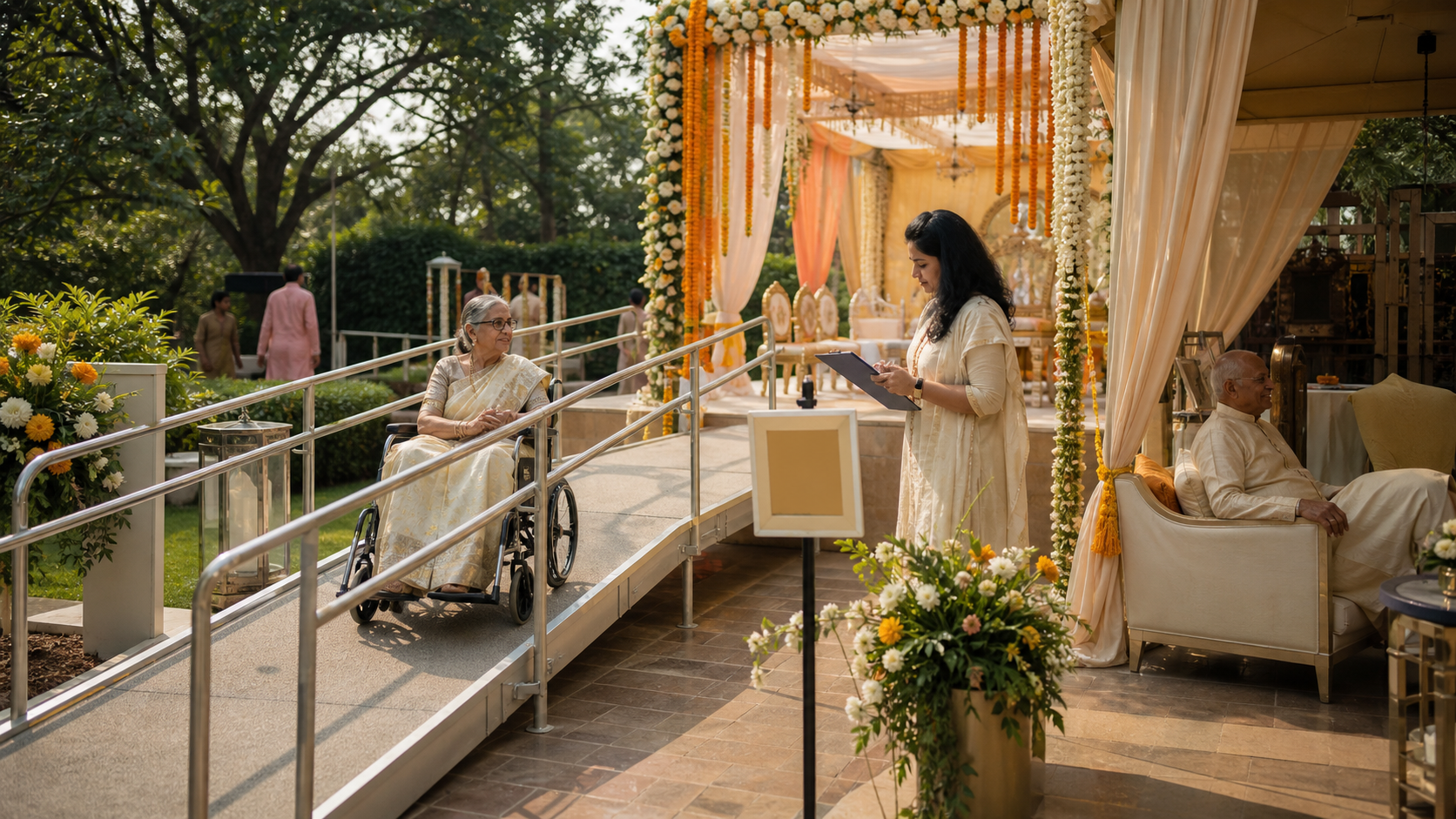
A beautiful mandap is irrelevant if a grandmother cannot reach it, a wheelchair user discovers three steps at the entrance, or a guest with hearing loss misses every schedule change. These failures are rarely caused by a lack of care. They happen because “accessible” was treated as a venue feature instead of a complete guest journey.
The fast rule is: trace every guest's route from home or hotel to their seat, meal, toilet, and return vehicle. A broken link anywhere makes the whole journey inaccessible. Use this checklist for each function, then place the approved answers in Mandap Chat so guests can ask privately without explaining their needs in a family group.
What is an accessible Indian wedding?
An accessible Indian wedding is one where guests with mobility, sensory, cognitive, dietary, or other support needs can participate safely and with dignity. Accessibility covers invitations, travel, entrances, movement, seating, toilets, ceremonies, meals, communication, and departure—not simply the presence of a ramp.
Wedding accessibility is the removal of physical, communication, and operational barriers that prevent an invited person from participating. The correct adjustment depends on the guest and the venue. Ask; do not guess.
Indian weddings need an event-by-event plan because the haldi, mehendi, ceremony, reception, and meals may use different lawns, floors, hotels, or venues. A route that works at the sangeet tells you nothing about the temple entrance the next morning.
What should you ask guests about accessibility?
Ask one optional, private question during RSVP: “Is there anything we can arrange to help you attend comfortably?” Offer examples without forcing a guest into a label, and provide a named person they can contact directly. Record only the operational information the planning team needs.
A practical follow-up can cover:
- Step-free access or shorter walking routes.
- Wheelchair-accessible or door-to-door transport.
- A companion or caregiver seat.
- Supportive seating, an aisle position, or space for a mobility aid.
- Captioning, sign-language interpretation, written instructions, or a hearing loop.
- A quiet room or lower-stimulation waiting area.
- Allergy, dietary, refrigeration, or meal-timing information.
- Early entry, additional boarding time, or another requested adjustment.
Avoid “Are you disabled?” and do not ask for a diagnosis. The useful question is what arrangement removes the barrier. Keep responses out of general guest spreadsheets and WhatsApp groups; share them only with the transport, venue, catering, or guest-care owner who must act.
The Government of India's Accessible India Campaign frames accessibility across the built environment, transport, and information and communication. That same whole-journey model is the right way to audit a multi-event wedding.
How do you audit a wedding venue for accessibility?
Visit the venue with the actual event layout and follow the guest route in person. Start at the road or parking bay, not the ballroom door. Confirm continuous step-free access to every essential area, measure tight spaces where needed, photograph barriers, and assign each fix to a named owner and deadline.
Use this decision table for every function:
| Checkpoint | Verify in person | If it fails | | --- | --- | --- | | Arrival | Level drop-off, firm surface, lighting, shelter | Reserve a closer bay or create a staffed alternate drop-off | | Entrance | Step-free route, usable doors, no loose cables | Install a suitable temporary ramp or move the guest entrance | | Ceremony | Firm path, wheelchair space, clear sightline | Add matting, reserved spaces, and companion seating | | Dining | Reachable tables, aisle width, buffet alternative | Provide table service and rearrange furniture | | Toilet | Reachable, unlocked, usable, clearly signed | Hire a suitable accessible unit or change venue/area | | Stage/photo area | Safe route without forced lifting | Create a level photo point or alternative backdrop | | Exit | Lit, staffed route and evacuation plan | Add trained staff and a venue-approved emergency procedure |
Never accept “we have hosted wheelchair users before” as proof. Ask staff to show the full route while the wedding layout is installed. Decorative platforms, flower arches, cables, carpets, buffet queues, and extra chairs can erase access that existed in an empty venue.
For destination events, add these checks to the destination wedding venue checklist before signing or finalizing layouts.
Is a temporary ramp enough for wheelchair access?
No. A ramp is only one part of a continuous accessible route. It must lead somewhere usable, have a safe surface and gradient, remain unobstructed, and connect arrival, event, dining, toilet, and departure areas. A portable ramp placed over entrance steps does not solve grass, narrow doors, raised stages, or inaccessible toilets.
Do not improvise with loose boards on the wedding day. Ask the venue or a qualified supplier to specify and install the solution, and have the guest or their companion review the plan when possible. Never manually lift a person or wheelchair without their explicit direction; it is undignified and can be unsafe.
Also inspect:
- Thick rugs, gravel, sand, wet grass, thresholds, and cable covers.
- Door weight and whether someone will be stationed there.
- Lift dimensions, operating hours, backup power, and access keys.
- Distance and slope between functions on a resort property.
- Whether rain changes the accessible route.
- Whether the backup venue is as accessible as the original.
Build the weather alternative alongside your rain-on-wedding-day plan, not after the lawn becomes unusable.
How should transport work for elderly and disabled wedding guests?
Transport should match the passenger's stated needs and connect door to door. Confirm vehicle access, space for mobility equipment, boarding assistance, pickup landmark, travel companion, journey time, and return plan. Give the driver and guest-care lead the required operational details before departure.
Use a separate accessible-transport row inside your wedding guest transportation plan. Include:
- Guest and companion names.
- Pickup room, lobby, home, or arrival point.
- Vehicle type confirmed by the guest.
- Mobility equipment dimensions or storage needs, if relevant.
- Boarding and transfer instructions supplied by the guest.
- Venue's step-free drop-off point.
- Driver and guest-care contacts.
- Return time and backup vehicle.
Do not assign the last seat in a high-floor bus to an elder and call it solved. Do not separate a mobility device from its user without agreement. For airport arrivals, confirm whether equipment and luggage fit together and allow more time than a standard guest pickup.
What seating makes a wedding more inclusive?
Reserve seating based on the guest's preference: a stable chair with arms, wheelchair space without removing the person from their chair, a companion seat, an aisle position, a clear sightline, proximity to a toilet, or distance from loud speakers. Keep routes and exits clear throughout the event.
Good accessible seating is integrated with family and friends, not isolated behind a pillar or beside service equipment. Hold reserved places until the guest arrives, mark them discreetly, and brief ushers so nobody has to argue for the arrangement.
For long ceremonies, provide:
- Chairs near rituals that are otherwise standing-room only.
- A shaded, cooled, or heated rest area depending on weather.
- Drinking water that does not require navigating a crowded buffet.
- A quiet room with a clear path back to the event.
- Flexible participation, including permission to enter late or leave early.
Add the final placements to the wedding seating chart template, but protect private support notes from general viewers.
How do you make wedding information accessible?
Send essential information in short, structured text as well as designed graphics. State exact locations, step-free entrances, timings, clothing or footwear considerations, transport, assistance contacts, and change alerts. Test links and avoid making a decorative PDF or image the only source of instructions.
Useful communication practices include:
- High-contrast text at a readable size.
- Alt text for important images.
- Captions for video announcements.
- Plain-language summaries of long itineraries.
- Written versions of announcements made only on a microphone.
- Venue signs with large text, arrows, and recognizable landmarks.
- One current digital source when timings change.
The Web Content Accessibility Guidelines explain how digital information can be made more perceivable and understandable; see the W3C's WCAG overview. For the guest journey itself, use the wedding itinerary template and add only the access details relevant to that guest.
Who owns accessibility on the wedding day?
One guest-care lead should own the plan, with named backups for transport and each venue. The lead needs authority to clear blocked routes, hold reserved seats, coordinate vendors, and solve ordinary issues without calling the couple. Guests should receive this person's contact before the first function.
The role is coordination, not personal care unless that has been explicitly agreed. Brief ushers and vendors on respectful assistance: ask before helping, speak to the guest rather than only their companion, and follow the guest's instructions.
Create a compact operating sheet containing:
| Owner | Responsibility | | --- | --- | | Guest-care lead | Confirms individual arrangements and handles questions | | Venue lead | Keeps routes, lifts, toilets, seating, and quiet room usable | | Transport lead | Confirms vehicles, drop-offs, companions, and returns | | Catering lead | Handles approved allergy and meal arrangements | | AV lead | Manages captions, microphones, written announcements, and lighting | | Emergency lead | Follows the venue's emergency and evacuation procedure |
Do a handover at every venue. “The family knows” is not an operating plan.
What is the final accessible wedding checklist?
The final checklist confirms that every requested adjustment has an owner, has been tested, and has been explained to the guest. Complete it 48 hours before the first function and repeat the route check after décor, AV cables, dining tables, and weather protection are installed.
- Guest support requests were collected privately and confirmed.
- Every function has a continuous step-free arrival-to-departure route.
- Drop-off, parking, lift, toilet, seating, dining, and exit were checked.
- Temporary ramps, matting, lighting, and backup power are installed and tested.
- Suitable transport and return vehicles are assigned.
- Mobility aids stay with their users unless they request otherwise.
- Reserved seats and companion spaces are integrated into the event.
- Dietary and allergy arrangements are confirmed directly with catering.
- Quiet space, water, shade, and rest seating are ready.
- Directions and updates are available as readable text.
- Guest-care, venue, transport, and emergency owners are named.
- The rain and backup-venue plans preserve the same access.
- Each guest has received their final entry, transport, seating, and contact details.
Accessibility works best when it is invisible operationally and obvious to the person who needs it. Audit the full journey, confirm rather than assume, and put the approved details into Mandap Chat for wedding planners so guests can get the right answer without repeating a private request.
FAQs
How do you make an Indian wedding accessible?
Ask guests privately what support they need, audit every function from arrival to departure, provide a continuous step-free route, accessible toilets and seating, arrange suitable transport, publish clear directions, and name one trained guest-care contact. Confirm arrangements with each guest instead of assuming that one solution works for everyone.
What should you ask disabled wedding guests?
Ask what would help them attend comfortably, whether they need step-free access, a companion seat, accessible transport, a quiet space, captioning or interpretation, dietary information, or another adjustment. Let the guest describe the solution; do not ask for a diagnosis or share their answer beyond the team members who need it.
How can elderly guests be made comfortable at an Indian wedding?
Minimize walking and standing, reserve supportive seating with a clear view, provide shade and drinking water, keep toilets nearby, arrange door-to-door transport, allow early boarding and venue entry, and share a simple itinerary. Ask each elder directly because age alone does not reveal what assistance they want.
Does a wedding venue ramp make the venue accessible?
No. A ramp is useful only when it forms part of a continuous step-free route connecting parking or drop-off, entrances, ceremony and dining areas, suitable toilets, and the exit. Door widths, surfaces, gradients, handrails, lighting, seating, and emergency evacuation also need to be checked in person.
When should wedding accessibility needs be collected?
Add an optional support question to the RSVP and follow up privately as soon as a guest responds. Confirm venue and transport arrangements two to four weeks before the wedding, then reconfirm the final contact, pickup, entry, seating, and assistance plan several days before the first function.
Frequently asked questions
How do you make an Indian wedding accessible?+
What should you ask disabled wedding guests?+
How can elderly guests be made comfortable at an Indian wedding?+
Does a wedding venue ramp make the venue accessible?+
When should wedding accessibility needs be collected?+
Continue the series
Cash gift wording for an Indian wedding should make gifts optional, explain the preferred method discreetly, offer a traditional envelope route, and keep payment details behind a private link.
A wedding vendor arrival schedule turns the master timeline into timed access, setup, inspection, handoff, and breakdown slots for every supplier.