
Wedding Ceremony Program Template for Indian Weddings
Use this Indian wedding ceremony program template to explain rituals, timings, family roles, dress notes, venue cues, and QR-linked guest help without overwhelming guests.
A wedding ceremony program helps guests understand what is happening, when to arrive, where to sit, and which rituals matter. For Indian weddings, the best version is short, bilingual when needed, and connected to Mandap Chat for live guest questions.
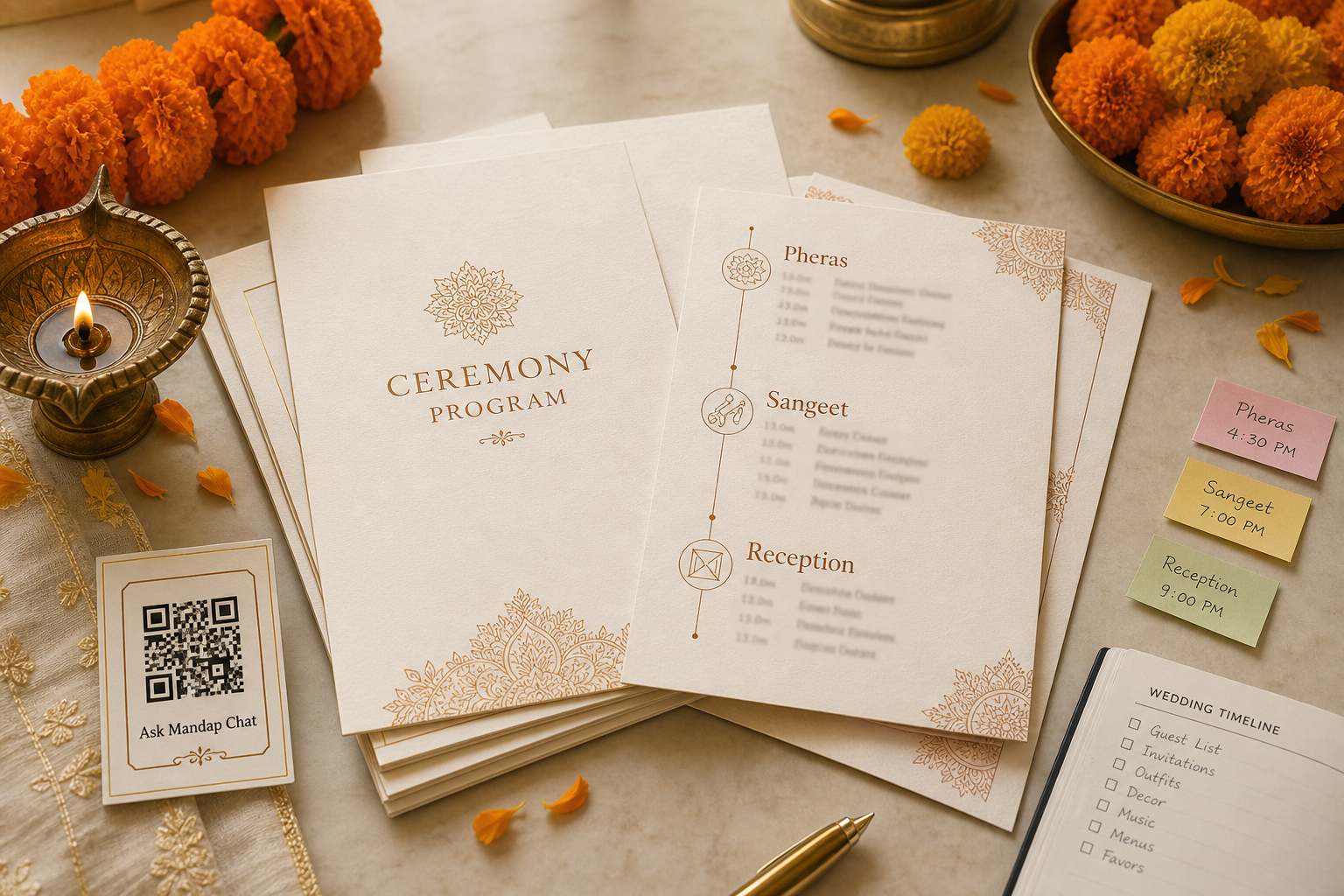
The ceremony is the emotional center of the wedding, but for many guests it is also the least understood part.
They hear Sanskrit, Tamil, Punjabi, Gujarati, Marathi, Telugu, Kannada, Malayalam, Urdu, or a mix of languages. They see relatives moving in and out of the mandap. They do not know when to stand, when to take photos, when food starts, or why everyone suddenly goes silent for one minute.
That confusion is not disrespect. It is an information problem.
The fix is a tight wedding ceremony program: one card that tells guests what is happening, what matters, and where to ask questions without interrupting the family.
Fast rule: print only what guests need during the ceremony. Put the longer explanations inside Mandap Chat, where guests can ask follow-up questions quietly.
What is a wedding ceremony program?
A wedding ceremony program is the guest-facing guide to the ceremony order, timing, people, and meaning. For Indian weddings, it should explain the main rituals in plain language so guests can follow the event without asking relatives what is happening every five minutes.
A wedding ceremony program is the ceremony's guest manual. It is not the priest's script, the planner's run sheet, or the family ritual document. Its job is to help guests understand the public parts of the ceremony.
Use it to answer:
- What time should guests be seated?
- Which rituals happen first, middle, and last?
- What is the meaning of the main ritual?
- Who are the key family members involved?
- Can guests take photos?
- When does lunch, dinner, or the next event begin?
- Where should guests ask questions after scanning the QR code?
If your wedding already has a full wedding itinerary for guests, the ceremony program is the smaller ritual-specific layer inside that guest communication system.
What should an Indian wedding ceremony program include?
An Indian wedding ceremony program should include the ceremony name, arrival time, mandap or venue location, short ritual order, key family roles, pronunciation help, dress and seating notes, photo rules, meal timing, and one QR code for live guest help.
Use this structure:
| Program section | What to write | Keep it short by | | --- | --- | --- | | Welcome line | Couple names, ceremony name, date, venue | One warm sentence | | Arrival note | When guests should be seated | Use exact time, not "early" | | Ritual order | 5 to 9 major ceremony moments | Avoid every micro-ritual | | Meaning notes | One line per important ritual | Explain the guest-visible action | | Family roles | Parents, siblings, priest, MC, elders | Include only public roles | | Guest cues | Stand, silence phones, photo limits | Use direct wording | | Next step | Meal, reception, shuttle, photos | Point guests to what happens next | | QR code | Mandap Chat or live details link | Say what the QR answers |
Do not turn the program into a 12-page booklet unless your audience genuinely wants one. Most guests will read a clear card. Almost nobody reads a dense booklet while the ceremony is starting.
Which rituals should the program explain?
Explain only the rituals guests will see and wonder about. For most Hindu Indian weddings, that means the arrival, welcome, garland exchange, kanyadaan or family blessing, sacred fire, pheras or saptapadi, sindoor or mangalsutra moment, blessings, and meal cue.
A ceremony program should simplify, not flatten. Different communities follow different orders, so ask the priest or family elder which moments must be named correctly.
For a North Indian Hindu wedding, include:
| Ritual | Guest-facing explanation | | --- | --- | | Baraat | The groom's processional arrival with family, music, and dancing | | Milni | The families formally greet each other | | Jaimala | The couple exchanges garlands | | Kanyadaan | The bride's family gives blessings and formally joins the couple | | Agni or havan | The sacred fire witnesses the vows | | Pheras or saptapadi | The couple takes vows around the sacred fire | | Sindoor and mangalsutra | Visible symbols of marriage are placed | | Ashirwad | Elders bless the newly married couple |
For South Indian weddings, do not force the same labels. Use the right community-specific guide: Tamil wedding ceremony order, Telugu wedding ceremony order, Kannada wedding ceremony order, or Malayalam wedding ceremony order.
One legal note for Hindu ceremonies: India's official India Code says a Hindu marriage may be solemnized according to customary rites and ceremonies, and where those rites include saptapadi, the marriage becomes complete and binding when the seventh step is taken: India Code, Hindu Marriage Act Section 7. That does not mean every community's program should use identical wording. It means your program should respect the family's actual ceremony.
What is the fastest wedding ceremony program template?
The fastest template is a one-page program with a welcome line, ceremony order, ritual meanings, guest cues, meal timing, and QR code. It should take guests less than two minutes to understand and should remove the questions most likely to hit the family during the ceremony.
Copy this structure:
[Name] and [Name]
[Ceremony name]
[Date] | [Venue or mandap name]

Please be seated by [time].
Phones on silent. Photography: [allowed / no flash / family only during key rituals].

Ceremony order
1. [Ritual name] - [one-line meaning]
2. [Ritual name] - [one-line meaning]
3. [Ritual name] - [one-line meaning]
4. [Ritual name] - [one-line meaning]
5. [Ritual name] - [one-line meaning]
6. Blessings and family photos
7. [Lunch / dinner / reception] at [time and location]

Guest help
Scan the QR code to ask about timing, venue, food, shuttle, dress code, and ritual meanings.
For a Hindu wedding:
The pheras are the central vows around the sacred fire. Please remain seated and keep phones silent during this moment. After the blessings, lunch will be served in [location].
For a Sikh Anand Karaj:
The couple will walk around the Guru Granth Sahib during the Laavan. Guests are requested to keep heads covered inside the gurdwara and remain seated during the hymns.
For a Muslim nikah:
The nikah includes the proposal and acceptance, witnesses, mehr, dua, and family blessings. Please follow the seating guidance shared by the family or venue team.
For an interfaith or mixed-region wedding:
This ceremony combines traditions from both families. The program highlights the moments guests will see, and the QR code has deeper explanations for anyone who wants more context.
Should the ceremony program be bilingual?
Use a bilingual ceremony program when a meaningful share of guests will not understand the ceremony language. The best bilingual version uses English for navigation and the family language for ritual names, blessings, and cultural warmth.
Do not translate every paragraph twice. That makes the program visually heavy and guests stop reading. Translate the pieces that help people follow the ceremony.
Use this decision rule:
| Guest mix | Program language | | --- | --- | | Mostly same language and region | One language plus pronunciation for ritual names | | NRI guests and local family | English plus Hindi or family language headings | | Two Indian regions | English plus both ritual names where needed | | International guests | English first, with plain-language meaning notes | | Elder-heavy wedding | Add printed local-language cards near the mandap |
For multilingual weddings, pair the program with the broader multilingual Indian wedding guide. The printed card handles the ceremony. Mandap Chat handles "what does this ritual mean?" in the guest's own wording.
What should the QR code on the program say?
The QR code should promise a specific answer. "Scan me" is weak. "Scan to ask about ceremony timing, ritual meanings, food, and shuttle" is useful.
Use wording like:
| Weak QR label | Better label | | --- | --- | | Scan me | Scan for ceremony and guest help | | Wedding info | Ask about rituals, timing, food, and shuttle | | QR code | Scan to ask Mandap Chat | | Ceremony details | Ritual meanings and next-event details | | Help | Guest questions answered here |
If the QR code sends guests into WhatsApp, use the correct click-to-chat or group-link setup from the WhatsApp Help Center. If it opens a live itinerary or venue map, test the link on an iPhone and Android before printing. The QR code is only useful if it opens the right answer in under five seconds.
What should guests be told about photos and phones?
Tell guests the photo rule before the key ritual begins. A ceremony program should say whether phones are welcome, silent-only, no flash, family-photographer-only, or fully unplugged for the main vows.
Use clear wording:
Please keep phones silent during the ceremony. Photos are welcome from your seat, but please keep the aisle clear for the family and photographer.
For stricter ceremonies:
The family requests an unplugged ceremony during the vows. Please put phones away for the pheras and enjoy the moment. Official photos will be shared later.
For gurdwara or temple settings:
Please follow the venue's head-covering, footwear, seating, and photography guidance. The welcome team can help if you are unsure.
Do not leave this to an awkward announcement after guests already have phones up. Put it in the program, on the wedding welcome sign, and in Mandap Chat.
How do planners make the program accurate?
Planners should confirm the ceremony order with the priest, officiant, or family elder before design starts. Then they should test the program against the timeline, venue layout, meal service, photo plan, and guest questions.
Use this checklist:
- Ask the priest or officiant for the final ritual order.
- Confirm which names and ritual spellings the family wants.
- Mark the exact muhurtham, nikah, Anand Karaj, or vow moment.
- Decide which moments guests should understand before they happen.
- Confirm photo and phone rules.
- Add the meal, blessings, family photo, or reception cue.
- Add the Mandap Chat QR code and short link.
- Test the QR code on two phones.
- Upload the same ritual meanings and guest cues into Mandap Chat.
- Give the MC the same language, so spoken announcements match the printed card.
The mistake is designing the program before the ceremony order is final. Pretty but wrong is worse than plain and accurate.
How does Mandap Chat support the ceremony program?
Mandap Chat supports the ceremony program by moving long explanations and repeat questions out of the printed card. Guests scan one QR code and ask normal questions like "What are pheras?", "When is lunch?", "Where do we go after blessings?", or "Can I take photos?"
That lets the printed program stay elegant:
- One-line ritual meanings on paper.
- Deeper ceremony explanations in chat.
- Live updates if the muhurtham, lunch, shuttle, rain plan, or photo timing changes.
- Different answers for different guest groups when the family approves them.
- A calmer family because guests are not asking the same ceremony questions in five WhatsApp groups.
This is the same operating principle as a wedding help desk for guests: one official answer system, many guest-facing surfaces.
For wedding planners, the ceremony program is also a sales moment. It shows the family that you are not just decorating the mandap. You are designing the guest experience.
Final ceremony program checklist
Before printing, confirm:
- The program fits on one card, folded sheet, or mobile page.
- Ceremony start time and guest seating time are both visible.
- Ritual names are spelled the way the family wants.
- Each major ritual has a one-line meaning.
- Photo and phone rules are clear.
- Meal, blessing, shuttle, or reception next step is included.
- Bilingual text is used only where it helps guests.
- The QR code opens Mandap Chat or the live guest-help page.
- The QR code wording says what guests can ask.
- The same answers exist in the MC script, WhatsApp message, website, and Mandap Chat.
The point is not to explain every sacred detail in public. The point is to help guests follow the ceremony with respect, confidence, and fewer interruptions.
FAQ
What should an Indian wedding ceremony program include?
An Indian wedding ceremony program should include the ceremony start time, venue or mandap location, short ritual order, key family roles, pronunciation help for important rituals, dress or seating notes, photo restrictions, meal timing, and one QR code for live guest questions.
How long should a wedding ceremony program be?
Keep the guest-facing wedding ceremony program to one printed card, one folded sheet, or one mobile page. Guests need the order and meaning of the ceremony, not a full religious textbook. Put deeper FAQs in Mandap Chat or on the wedding website.
Do Indian weddings need a ceremony program?
A ceremony program is especially useful when guests come from different regions, languages, countries, or faith backgrounds. It helps them follow the rituals quietly instead of asking relatives what is happening during the pheras, kanyadaan, mangalya dharanam, or nikah.
Should the ceremony program be bilingual?
Use a bilingual ceremony program when more than 20 to 25 percent of guests may not understand the ceremony language. Keep headings in English plus the family language, and put pronunciation or meaning notes under only the rituals guests need to follow.
How does Mandap Chat help with a wedding ceremony program?
Mandap Chat lets guests scan one QR code and ask ceremony questions in plain language. The printed program stays short, while Mandap Chat answers details about rituals, timing, venue movement, dress code, meals, and family-approved FAQs.